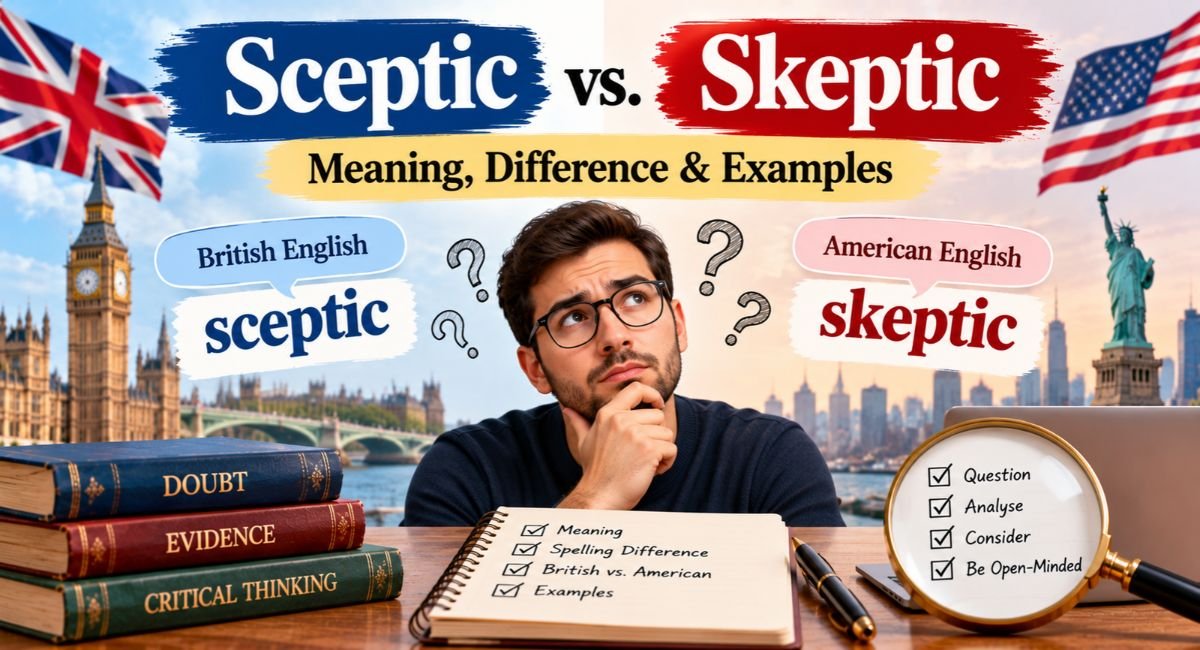
Sceptic vs. Skeptic: Meaning, Difference & Examples
A sceptic or skeptic is a person who doubts whether a claim, belief, or statement is true. Both words have the same meaning and pronunciation. Sceptic is the usual British English spelling, while skeptic is preferred in American English. The correct choice depends on your audience, not on a difference in meaning.
The difference between sceptic and sceptic comes down to spelling rather than meaning. You might read sceptic in a British newspaper and skeptic on an American website, but both describe someone who questions a claim instead of readily accepting it.
Think about an advertisement promising that a new drink will improve your memory overnight. A sceptic might ask for evidence before spending money on it. That doesn’t mean they have already decided the product is useless. They simply aren’t convinced yet.
The interesting distinction isn’t between the two spellings. It’s between questioning a claim, rejecting it, and distrusting the person making it. Understanding those differences will help you use the word accurately.
What Does Sceptic Mean in English?
A sceptic is someone who doubts the truth or value of a particular idea, claim, or belief. The word is often used for a person who needs more convincing before accepting something.
You can be sceptical about almost anything: an advertising promise, a political proposal, a scientific finding, or even a friend’s prediction about the weekend’s weather.
The word doesn’t tell us whether your doubts are correct. It simply describes a questioning attitude. Someone may have excellent reasons for being sceptical, while another person may doubt something without understanding the evidence.
Is Being a Sceptic Good or Bad?
The word can have positive, negative, or neutral associations.
A teacher who encourages students to check unreliable internet sources might praise healthy scepticism. In another situation, someone might complain that a colleague is such a sceptic that no proposal ever satisfies them.
Compare these sentences:
- Positive: “She’s a thoughtful sceptic who checks the facts before sharing news.”
- Neutral: “I’m a sceptic about the proposed changes.”
- Negative: “He’s such a sceptic that he dismisses every suggestion.”
Being a sceptic is not automatically a sign of intelligence, stubbornness, or negativity. The circumstances matter.
Sceptic vs. Skeptic: British and American Spelling
The central difference is straightforward: British English generally prefers sceptic, while American English prefers skeptic. Both are accepted English spellings, and neither represents a stronger form of doubt.
| Feature | British English | American English |
| Singular noun | Sceptic | Skeptic |
| Plural | Sceptics | Skeptics |
| Adjective | Sceptical | Skeptical |
| Abstract noun | Scepticism | Skepticism |
| Adverb | Sceptically | Skeptically |
| Pronunciation | SKEP-tik | SKEP-tik |
The Cambridge Dictionary identifies sceptic as the British form and skeptic as its American equivalent.
When Should You Use Sceptic?
Use sceptic when writing in British English, particularly for a UK audience. This spelling is also generally familiar in Australian and New Zealand English.
For example:
“The committee remained sceptical about the proposed housing scheme.”
When writing an essay, newspaper article, or professional report in British English, it makes sense to use the related spellings sceptical and scepticism as well.
When Should You Use Skeptic?
Use skeptic when writing in American English.
For example:
“The committee remained skeptical about the proposed housing plan.”
The two sentences express the same idea. Only the regional spelling and some surrounding vocabulary differ.
Canadian English also commonly uses skeptic, although spelling preferences in Canada vary by word and publication.
Are There Exceptions to the Regional Rule?
Yes. A publication or organisation may use skeptic in its official name even when based outside the United States.
You should preserve the established spelling of an organisation, book title, or direct quotation rather than changing it to match your usual writing style.
If your audience is international, either recognised spelling can work. Consistency within your own text is more useful than trying to choose a supposedly universal version.
How to Pronounce Sceptic and Skeptic
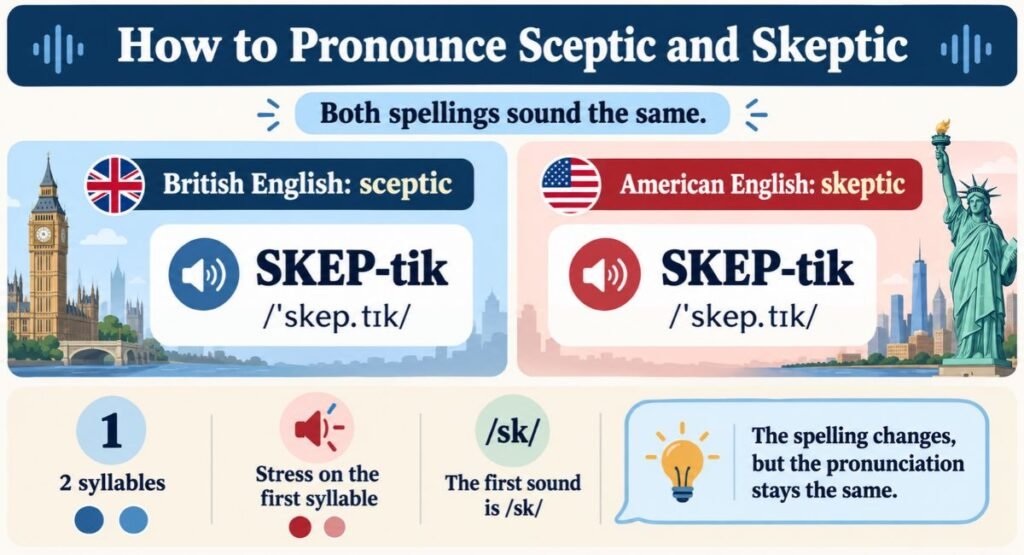
Both spellings have the same standard pronunciation.
Simple pronunciation
SKEP-tik
IPA pronunciation
/ˈskep.tɪk/
Two syllables, with the strongest stress on the first syllable.
The first syllable rhymes with step, apart from the additional /k/ sound after /s/. The second syllable is short and unstressed.
Why Does Sceptic Begin With a K Sound?
The letters sc in sceptic produce the consonant combination /sk/. The American spelling sk represents that same sound.
This is why there is no meaningful pronunciation difference between the two forms.
If you are learning the word, practise the opening sound found in skill or skate. Don’t pronounce the initial letters as two separate syllables.
Both pronunciations are documented by Cambridge Dictionary.
Sceptic Grammar: Nouns, Adjectives and Word Forms
In ordinary modern English, sceptic is primarily a countable noun. It identifies a person who questions something.
The adjective is usually sceptical, and the abstract noun scepticism refers to the attitude itself.
Is Sceptic a Countable Noun?
Yes. You can refer to one sceptic, several sceptics, or a group of sceptics.
Singular: “My brother is a sceptic.”
Plural: “Several sceptics questioned the results.”
The abstract noun scepticism, by contrast, is generally uncountable when referring to doubt as an attitude.
“Her scepticism was understandable.”
You would normally say “several doubts” rather than “several scepticisms” when discussing different concerns about a claim.
Sceptic vs. Sceptical: What’s the Difference?
Sceptic most commonly names a person, while sceptical describes a person’s attitude.
Compare:
- “Maria is a sceptic.” — Noun
- “Maria is sceptical about the plan.” — Adjective
- “Maria expressed scepticism.” — Abstract noun
- “Maria examined the report sceptically.” — Adverb
Some dictionaries also record adjectival uses of sceptic. However, sceptical is the normal adjective in everyday contemporary English.
Does Sceptic Have Verb Forms?
Sceptic isn’t normally used as a verb, so learners should avoid inventing forms such as scepticed or scepticing.
Instead, use doubt, question, challenge, or examine.
Incorrect: “She scepticed the explanation.”
Correct: “She questioned the explanation.”
Correct: “She was sceptical about the explanation.”
Historical English has recorded related verb formations, but these are not part of ordinary modern usage.
Prepositions Used With Sceptic and Sceptical
The word pairs naturally with several prepositions.
| Expression | Original example |
| Sceptic about | “He’s a sceptic about miracle diets.” |
| Sceptical about | “I’m sceptical about the proposed deadline.” |
| Sceptical of | “The editor was sceptical of the explanation.” |
| Scepticism towards | “Residents expressed scepticism towards the proposal.” |
| Sceptical that | “I’m sceptical that the repairs will finish tomorrow.” |
Sceptical about often introduces a plan or possibility, while sceptical of often introduces a specific claim or explanation. Their uses overlap, so this is a tendency rather than a strict grammar rule.
Sceptic and Skeptic Examples in Everyday English
One of the easiest ways to learn this word is to see how the same attitude appears in different situations.
Casual Conversation
“Don’t believe every discount you see online. I’m a sceptic when a deal looks too good to be true.”
“My sister was a skeptic about the new café, but she loved the food.”
“Tom’s always been a sceptic when it comes to personality tests.”
Academic and Scientific Writing
“The researcher remained sceptical until the findings were independently examined.”
“Several sceptics challenged the assumptions behind the economic forecast.”
“The experiment encouraged both sceptics and supporters to reconsider their earlier conclusions.”
Business Communication
“Investors expressed scepticism about the company’s ambitious revenue projections.”
“The marketing director was initially a skeptic of the proposed advertising strategy.”
“The management team addressed the sceptics’ concerns by presenting additional data.”
Journalism and Formal Writing
“Once a vocal sceptic, the columnist changed her position after reviewing the documents.”
“The proposal attracted criticism from both sceptics and supporters of the reform.”
“The report did not convince every skeptic, but it prompted further investigation.”
Notice something important in these examples: a sceptic can change their mind. The word does not necessarily describe permanent disbelief.
Synonyms for Sceptic and Skeptic: The Important Differences
Several words are associated with doubt, but they don’t all mean the same thing.
| Word | What makes it different |
| Doubter | Someone who feels uncertain, perhaps without investigating the issue. |
| Questioner | Someone who asks questions, whether out of curiosity or doubt. |
| Cynic | Someone inclined to distrust people’s sincerity or motives. |
| Critic | Someone who evaluates something and may approve or disapprove of it. |
| Disbeliever | Someone who does not accept a particular belief or statement. |
| Agnostic | Someone who withholds judgement about particular questions of knowledge or belief. |
| Scoffer | Someone who mocks or dismisses an idea rather than merely questioning it. |
Sceptic vs. Doubter
Imagine two students before an examination.
One says, “I don’t think I’ll pass.” That student is doubting their own ability.
Another says, “I’m not convinced the school’s revision programme improves results.” That student is expressing scepticism about a particular claim.
Both involve doubt, but the second situation more naturally suggests a sceptical attitude towards an assertion.
Sceptic vs. Cynic
This is one of the most useful vocabulary distinctions.
Imagine a charity asks people for donations.
A sceptic says, “Can I see how the money is spent?”
A cynic says, “The organisers probably just want publicity.”
The sceptic is questioning the evidence. The cynic is questioning the motives.
A person can be both, but the terms are not interchangeable.
Sceptic vs. Critic
A critic evaluates something, such as a performance, policy, or product. The resulting evaluation can be favourable or unfavourable.
A sceptic is concerned with whether a claim deserves belief.
A food critic might enjoy a restaurant while remaining sceptical about its claim to use only locally sourced ingredients.
Sceptic vs. Agnostic
Agnostic commonly refers to someone who holds that certain religious or philosophical questions are unknown or unresolved.
Sceptic has a wider everyday application. You can be sceptical about an advertisement, a theory, a proposal, or a person’s explanation.
The words overlap in some philosophical contexts, but agnostic is not a general-purpose replacement for sceptic.
Antonyms of Sceptic and Skeptic
There isn’t one perfect antonym for every context, because doubt can concern many different subjects.
| Word | Meaning and usage |
| Believer | Someone who accepts a claim or belief. “She became a believer after seeing the evidence.” |
| Credulous person | Someone too ready to accept claims. “A credulous buyer might trust the advertisement immediately.” |
| Trusting person | Someone generally inclined to trust others. “He remained trusting despite the uncertainty.” |
| Supporter | Someone who favours a proposal or cause. “The supporters welcomed the decision.” |
| Advocate | Someone who actively promotes an idea. “She became an advocate for the new programme.” |
Believer is often the clearest contextual opposite. However, belief can be based on careful research, so it would be misleading to describe all believers as gullible.
Sceptic and Skeptic Word Origin
The history of sceptic begins in Ancient Greek.
The word is ultimately related to skeptikos, meaning inquiring or reflective, and to a Greek verb associated with examining or considering something.
The English word appeared in the late sixteenth century, initially in connection with ancient philosophical scepticism. French sceptique and Latin scepticus were involved in its transmission into English.
The broader sense of someone who questions claims or suspends judgement developed during the early modern period.
The spelling skeptic is not a recent American invention. It has historical roots in English, and its sk form reflects the Greek spelling more directly. The two spelling traditions eventually acquired different regional preferences.
Scientific Scepticism vs. Everyday Doubt
Scientific scepticism involves evaluating claims using evidence, appropriate methods, and critical reasoning. It does not mean rejecting every scientific conclusion.
Suppose a researcher announces that a new teaching programme has improved examination scores by 40%.
A careful sceptic might ask how many students participated, whether there was a comparison group, and whether other researchers obtained similar results.
These questions matter because an impressive percentage tells us little without understanding how it was measured.
The researcher may be correct. The sceptic may eventually accept the results. The purpose of questioning is to assess the strength of the claim.
Everyday scepticism usually involves less formal investigation. Someone might question an unusually cheap online offer, a social media rumour, or a neighbour’s surprising story.
Both involve doubt, but the methods used to examine the claim may differ considerably.
Common Mistakes With Sceptic and Skeptic
Mistake 1: Thinking the Spellings Have Different Meanings
Incorrect assumption: “A sceptic doubts things less strongly than a skeptic.”
The spelling does not determine how strongly a person doubts something.
Mistake 2: Using Sceptic Instead of Sceptical
Less natural: “She is very sceptic about the results.”
Natural: “She is very sceptical about the results.”
Use the adjective sceptical when describing an attitude in ordinary English.
Mistake 3: Inventing a Verb
Incorrect: “He skepticked the announcement.”
Correct: “He questioned the announcement.”
Question and doubt are more natural verbs.
Mistake 4: Mixing Regional Spelling Unnecessarily
Inconsistent British-style text: “The sceptic expressed skepticism about the findings.”
Consistent British English: “The sceptic expressed scepticism about the findings.”
Consistent American English: “The skeptic expressed skepticism about the findings.”
Exceptions may be necessary for quotations and official names.
Mistake 5: Treating Scepticism as Cynicism
A sceptic may question a claim without believing the speaker is dishonest.
For example, doubting that a treatment works is not the same as accusing the person recommending it of deliberately lying.
Mistake 6: Assuming Sceptics Never Accept Evidence
A sceptic may reconsider an opinion after reviewing convincing information.
It is inaccurate to define every sceptic as someone who refuses to believe anything.
Which Spelling Should You Use in Your Writing?
Choose the spelling according to the English variety you’re using.
For British English, sceptic, sceptical, and scepticism are generally suitable. For American English, use skeptic, skeptical, and skepticism.
If you’re writing an academic assignment, follow your institution’s style requirements. For a website, use the spelling system that matches your main readership.
When quoting another author, keep their original spelling. A British article can quote an American sentence containing skeptic without treating it as an error.
Conclusion
Sceptic and skeptic share the same meaning and pronunciation. The difference is regional spelling, not the strength or type of doubt they describe.
The useful distinction lies in how the word is used. A sceptic questions a claim, a cynic often suspects someone’s motives, and a critic evaluates something. Those differences matter more than the choice between c and k.
For accurate writing, match your audience’s spelling convention and remember to use the appropriate related forms, including sceptical/skeptical and scepticism/skepticism.
Frequently Asked Questions?
What is the difference between sceptic and skeptic?
There is no difference in their core meaning. Both words describe someone who doubts or questions a claim, idea, or belief. The distinction is regional spelling: sceptic is generally preferred in British English, while skeptic is preferred in American English. They are also pronounced the same way.
Is sceptic a positive or negative word?
Sceptic can be positive, negative, or neutral depending on context. It may describe someone who carefully examines evidence before concluding. However, it can also describe a person who seems excessively doubtful or difficult to convince. The word itself does not establish whether the person’s doubts are reasonable.
Are sceptic and skeptic pronounced the same way?
Yes. Both sceptic and skeptic are pronounced SKEP-tik, represented in the International Phonetic Alphabet as /ˈskep.tɪk/. Each word has two syllables, with stress on the first. The British spelling begins with sc, but those letters produce the same /sk/ sound as the American spelling.
What is the difference between a sceptic and a cynic?
A sceptic questions whether a claim is true or convincing, while a cynic is inclined to distrust people’s motives or sincerity. For example, a sceptic might ask for evidence that a charity uses donations responsibly. A cynic might assume that the organisers are mainly interested in publicity.
Should I use sceptical or skeptical in English?
Both sceptical and skeptical are correct adjectives meaning doubtful or unconvinced. Sceptical is generally preferred in British English, while skeptical is preferred in American English. Choose the spelling that matches your audience or publication style, and use related forms such as scepticism or skepticism consistently.