

Cord vs. Chord: Difference, Meaning & Examples
Cord refers to a rope, electrical cable, or cord-like structure in the body. Chord describes musical notes played together or a straight line segment connecting two points on a circle. Both words sound identical, but their meanings differ. Use context to choose the correct spelling.
Cord vs. Chord – Difference, Meaning, Pronunciation & Examples
The difference between cord vs. chord is easy to miss because both words sound exactly alike. Imagine a guitarist preparing for a performance. They plug an instrument into an amplifier using a cord, then play a chord. One word describes the physical cable; the other refers to musical notes.
That example captures the distinction, but English has a few surprises. We talk about vocal cords, geometric chords, power chords, and the expression strike a chord. The correct spelling depends on what the word means in the sentence, not simply on the subject being discussed.
Once you understand these different uses, you can recognize the right word without guessing. This guide explains their definitions, pronunciation, grammar, related vocabulary, and common mistakes, including several situations where both spellings are correct.
Cord vs. Chord – Meaning and Main Differences
The word cord usually describes a length of rope, string, or flexible electrical cable. It also appears in anatomical terms such as spinal cord and umbilical cord. Chord has two especially common meanings: a combination of musical notes and a straight line segment connecting two points on a circle.
Although their meanings are distinct, their spellings can overlap in specialized situations. Someone discussing a guitar might legitimately use both words. Instead of memorizing a rule such as “music always means chord,” it is more useful to identify precisely what the sentence describes.
| Feature | Cord | Chord |
| Main meaning | Rope, cable, or string | Musical notes played together |
| Other uses | Anatomy, firewood measurement | Geometry, figurative expressions |
| Pronunciation | KORD | KORD |
| Part of speech | Mainly noun | Mainly noun |
| Plural | Cords | Chords |
| Example | Extension cord | Guitar chord |
Consider these sentences:
- The lamp’s power cord was damaged.
- The pianist played a C major chord.
- The singer rested her vocal cords.
- The teacher drew a chord inside a circle.
Each spelling follows the meaning of the word. This is the central principle behind using cord and chord correctly.
What Does Cord Mean in English?
Cord is a noun with several related meanings. Its most familiar sense is a flexible length of twisted or braided material used for tying, securing, or connecting things. In technology, it can describe an insulated electrical cable.
The word also appears in medicine and measurement. These meanings may seem unrelated at first, but many developed around the idea of a long, narrow structure resembling a string or rope.
Cord as a Rope or String
A cord may be made from cotton, nylon, polyester, or another suitable material. It can be used to tie parcels, secure lightweight equipment, or hang decorative objects.
For example, a craftsperson might use cotton cord to create a macramé wall hanging. A camper might choose a stronger synthetic cord to secure equipment. Both are cords, but their properties differ according to their materials and intended use.
Cord in Electricity and Technology
An electrical cord contains insulated conductors that connect equipment to a power supply. Common examples include power cords, extension cords, and appliance cords.
The phrase charging cord is also common in everyday conversation, although charging cable may be more precise for many modern devices.
A useful distinction appears with electric guitars. The cable connecting an instrument to an amplifier is sometimes called a guitar cord. The music played through that equipment involves chords.
Cord in Human Anatomy
Several structures in the human body contain cord in their established names.
The spinal cord is part of the central nervous system. The umbilical cord connects a developing baby to the placenta. Vocal cords, also known as vocal folds, are involved in producing voice.
These structures are not ordinary pieces of rope. Their names reflect anatomical terminology that developed around their elongated or cord-like appearance.
Cord as a Measurement of Firewood
In the United States, a cord is also a measurement used when selling stacked firewood.
One standard cord occupies 128 cubic feet of stacked volume, traditionally illustrated by a stack measuring 4 feet high, 4 feet deep, and 8 feet long.
The measurement includes spaces between the logs. Therefore, it should not be confused with 128 cubic feet of solid wood.
This is a useful example of a meaning that cannot be understood simply by imagining a rope.
What Does Chord Mean in English?
Chord is best known as a musical term. In basic music theory, it generally refers to three or more different pitches sounded together. Certain styles also use the term for two-note structures, particularly power chords.
The word also appears in geometry, where it has a precise mathematical definition. These two meanings are especially important because they show why chord cannot be understood only as another word for harmony.
Chord in Music
A musical chord combines pitches to create harmony. On a piano, for example, playing C, E, and G together produces a C major triad.
Chords help establish the harmonic structure of a piece of music. A guitarist might change chords while accompanying a singer, while a pianist might use different chord voicings to change the texture of an arrangement.
Major and minor chords are often described as bright and somber, respectively. These descriptions can help beginners recognize their different qualities, but a chord does not carry one fixed emotion. Musical context matters.
Chord in Geometry
A geometric chord is a straight line segment connecting two points on a circle.
Imagine drawing a circle and marking two points, A and B, along its circumference. A straight line segment joining those points is a chord.
If that line segment passes through the center of the circle, it is also a diameter.
This leads to an important geometric rule: every diameter is a chord, but not every chord is a diameter.
Chord in Figurative Expressions
The phrase strike a chord means to create an emotional response or remind someone of a meaningful experience.
For example:
“The teacher’s story about struggling with mathematics struck a chord with several students.”
The sentence does not refer to musical performance. It means the story connected with the students’ experiences.
You may also encounter the expression touch a chord, although strike a chord is the more familiar fixed phrase in contemporary English.
Cord vs. Chord Pronunciation – Simple Phonetics and IPA
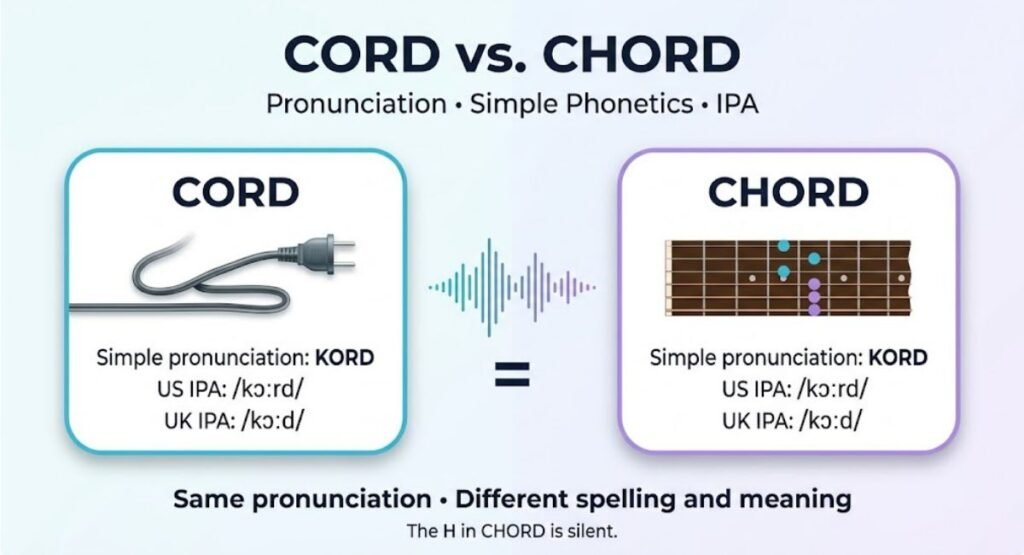
Cord and chord are homophones. That means they have the same pronunciation despite their different spellings and meanings.
The h in chord is silent. Both words have one syllable, and neither contains an additional sound that distinguishes it from the other.
| Word | Simple phonetics | American IPA | British IPA |
| Cord | KORD | /kɔːrd/ | /kɔːd/ |
| Chord | KORD | /kɔːrd/ | /kɔːd/ |
These transcriptions follow the pronunciation shown in the Cambridge Dictionary. Some American dictionaries use /kɔrd/ instead, reflecting a difference in transcription conventions rather than a separate standard pronunciation.
American English generally pronounces the r in these words. In many standard British English accents, that r is not pronounced when the word appears alone.
Because the words sound identical, pronunciation practice alone cannot teach you which spelling to use. You need to understand the sentence.
Compare:
- “Please replace the cord.”
- “Please repeat the chord.”
Both sound natural when spoken. Only the context tells you whether someone is discussing a cable or a musical sound.
Cord and Chord Grammar Rules
Both cord and chord are primarily nouns. In their common individual-object meanings, they are countable, meaning you can use singular and plural forms.
However, cord also has an uncountable material sense. For example, “The basket was decorated with cord” refers to the material generally rather than a particular measured length.
Cord as a Countable and Uncountable Noun
When describing individual objects, cord is countable.
Examples:
- A cord was hanging from the ceiling.
- Two electrical cords were lying behind the desk.
- The workers replaced several damaged cords.
When referring to cord material generally, it can be uncountable.
Example:
“The artist used cotton cord to create the design.”
Here, cord describes a type of material rather than one specific cord.
For firewood, cord is a countable unit of measurement:
“We ordered two cords of firewood.”
Chord as a Countable Noun
Chord is countable in its familiar musical and mathematical meanings.
Examples:
- The song begins with a minor chord.
- She practiced four new chords.
- The circle contains several drawn chords.
The regular plural is chords, not chordes.
Can Cord and Chord Be Verbs?
Both words have specialized verb uses, but these are uncommon compared with their noun forms.
The verb cord can mean to tie, fasten, or provide something with cord. Its regular forms are cord, cords, corded, and cording.
The verb chord may be used in musical contexts to describe arranging or playing chords. Its regular forms are chord, chords, chorded, and chording.
For everyday writing, expressions such as tie with cord, play a chord, and harmonize a melody are usually clearer than uncommon verb constructions.
Common Prepositions and Collocations
Neither noun has one preposition that must always follow it. The choice depends on the meaning.
| Expression | Example |
| Cord of | A cord of firewood was delivered. |
| Cord for | I need a replacement cord for the lamp. |
| Connected by | The equipment is connected by a cord. |
| Chord on | She played a chord on the piano. |
| Chord in | I recognized the opening chord in the song. |
| Chord of | Draw a chord of the circle. |
| Strike a chord with | The message struck a chord with readers. |
These combinations are worth learning because they sound natural in everyday English.
Cord vs. Chord Example Sentences
The following examples show how word choice changes across everyday, professional, academic, and creative contexts.
Sentences Using Cord
- I left my charging cord at the library and had to borrow another one.
- The technician discovered that the printer’s power cord was damaged.
- She threaded a green cotton cord through the wooden ornament.
- The medical report described an injury to the patient’s spinal cord.
- Our family ordered a cord of firewood before the first snowfall.
- The photographer used a thin cord to secure the background fabric.
The meaning changes from sentence to sentence, but each use remains connected to an established definition.
Sentences Using Chord
- My brother practiced a difficult guitar chord for nearly an hour.
- The pianist finished the performance with a gentle minor chord.
- The documentary’s final scene struck a chord with viewers.
- The mathematics teacher drew a chord connecting two points on the circle.
- The composer replaced the opening chord to change the atmosphere of the song.
- The guitarist learned a new chord progression for the recording session.
Here, the examples move between musical, geometric, and figurative meanings.
Sentences Using Both Words
“The amplifier cord disconnected just as the guitarist played the final chord.”
“The musician coiled the guitar cord after practicing several difficult chords.”
“The electrical cord lay beside the piano while the student studied a new chord progression.”
These sentences make the spelling distinction especially memorable because both words belong naturally in the same setting.
Cord vs. Chord Synonyms and Related Words
Choosing synonyms requires care. Many words associated with cord describe different materials or structures. Likewise, several musical terms related to chord are not true synonyms.
Understanding these differences helps you choose more precise vocabulary instead of treating every related word as interchangeable.
Synonyms for Cord
| Related word | How it differs |
| Rope | Often thicker and used for securing, pulling, or lifting. |
| String | Usually thinner and commonly used for light tying tasks. |
| Cable | May contain conductors or be designed to withstand mechanical loads. |
| Wire | Usually a metal strand, sometimes used to conduct electricity. |
| Twine | A thin, relatively strong material often used in gardening or packaging. |
For instance, you would generally describe a heavy line securing a boat as a rope, not a piece of ordinary string. An electrical cable serves a different purpose from cotton twine.
The most accurate word depends on the object’s construction and function.
Words Related to Chord
| Related word | How it differs |
| Harmony | Refers more broadly to relationships between simultaneous musical pitches. |
| Triad | A particular chord structure made from three pitch classes. |
| Note | Represents an individual pitch rather than a chord. |
| Melody | A succession of pitches forming a musical line. |
| Arpeggio | The notes of a chord played in succession rather than simultaneously. |
The distinction between chord and arpeggio is particularly useful for musicians.
If a pianist sounds C, E, and G together, the result is a C major chord. If the pianist plays those notes one after another in a broken-chord pattern, that is an arpeggio.
This practical difference is more informative than simply calling both concepts musical sounds.
Does Cord or Chord Have an Antonym?
Neither word has a standard direct antonym in its main noun meanings.
Cord identifies a physical object or material, while chord identifies a musical or geometric structure. Unlike adjectives such as open and closed, these nouns do not belong to simple opposite pairs.
However, certain contrasting expressions are useful in context.
Related Contrasts for Cord
Corded vs. cordless: A corded drill requires a physical electrical connection; a cordless drill does not need a power cord during normal operation.
Wired vs. wireless: A wired connection uses physical conductors, while a wireless connection transfers information without a connecting cable.
These are contrasts involving related adjectives, not direct antonyms of cord.
Related Contrasts for Chord
Consonance vs. dissonance: These terms describe different qualities of musical relationships, not opposite forms of a chord.
Chord vs. single note: A chord involves a combination of pitches, whereas a single note represents one pitch.
Neither contrast should be presented as a dictionary antonym for chord.
Cord vs. Chord Etymology and Word Origins
The history of these words is more closely connected than their modern meanings suggest.
Cord entered Middle English through Old French corde, meaning rope or string. That form is traced to Latin chorda, itself derived from Greek khordē, associated with strings, particularly those of musical instruments.
The musical word chord has a more complicated history. According to the Online Etymology Dictionary, its musical meaning developed through a shortening of accord, or a similar French development, with influence from the older word for a musical string.
The spelling with h is recorded around 1600. The geometric use arose in a separate historical development connected with the idea of a string stretched between points.
It would therefore be misleading to say simply that someone added h to cord to make a musical word. The history involved several related forms and meanings rather than one straightforward spelling change.
Common Cord vs. Chord Mistakes
Some mistakes involving these words are straightforward. Others are harder because the two spellings can both be correct within the same topic.
The following examples focus on expressions that genuinely cause confusion.
Vocal Cord or Vocal Chord?
Use vocal cord in standard modern English.
Vocal cords, also called vocal folds, are structures in the larynx involved in voice production. The spelling vocal chord does occur, but it is not the preferred spelling for contemporary general or medical writing.
Correct: The singer rested her vocal cords after the concert.
Power Cord or Power Chord?
Both expressions are correct, but they mean different things.
A power cord is an electrical cable used to connect equipment to a power source.
A power chord is a musical structure used frequently in rock music, typically emphasizing a root and its fifth, sometimes with an additional octave.
Correct: He connected the amplifier’s power cord before playing a power chord.
Guitar Cord or Guitar Chord?
A guitar cord is an informal term for a cable used with an electric guitar.
A guitar chord is a group of notes played together on the instrument.
Correct: The guitarist replaced the damaged cord before learning another chord.
The fact that both expressions involve a guitar does not make either one incorrect.
Strike a Cord or Strike a Chord?
The correct standard idiom is strike a chord.
It means to connect emotionally with someone or remind them of a personal experience.
Correct: The novel’s portrayal of family relationships struck a chord with readers.
The expression strike a cord would ordinarily be a mistake when describing emotional resonance.
Cut the Cord or Cut the Chord?
Another easily overlooked distinction involves the expression cut the cord.
Literally, it may refer to cutting a physical cord, including the umbilical cord after birth. Figuratively, it means ending a dependency or breaking away from an existing connection.
In television and streaming discussions, cut the cord commonly refers to canceling traditional cable or satellite television service.
Correct: After comparing subscription prices, the family decided to cut the cord.
Because this idiom refers to a connection rather than musical harmony, it uses cord.
How to Remember Cord vs. Chord?
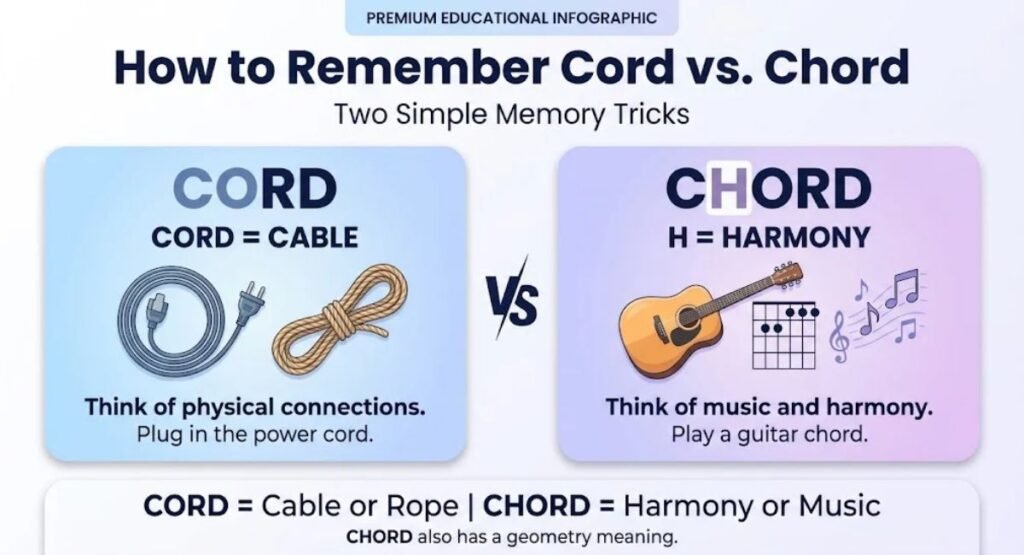
The simplest memory trick is to associate the h in chord with harmony.
When you see chord, think of musical notes working together. This will help with expressions such as major chord, minor chord, guitar chord, and chord progression.
For cord, imagine a physical cable or rope connecting two objects.
These associations cover many everyday examples, but remember two exceptions to the simple pattern: chord is also a geometric term, and strike a chord is an expression about emotional connection.
A Quick Context Test
Try deciding which spelling belongs in these sentences before checking the answers.
- The musician played a beautiful ___ on the piano.
- The electrician replaced the damaged ___.
- The doctor examined the patient’s spinal ___.
- The diameter is the longest ___ of a circle.
- Her graduation speech struck a ___ with the audience.
- The musician connected the amplifier using a power ___ and then played a power ___.
Answers: 1. chord; 2. cord; 3. cord; 4. chord; 5. chord; 6. cord, chord.
Question six is especially useful. It shows that the correct spelling may change within the same sentence, even when both words relate to music equipment.
Conclusion
The difference between cord vs. chord becomes clear when you consider meaning and context. Cord usually refers to a rope, electrical cable, or cord-like anatomical structure. Chord refers to a musical combination of pitches or a geometric line segment connecting points on a circle.
The trickiest examples are expressions such as power cord, power chord, vocal cords, strike a chord, and cut the cord. Learning these phrases helps prevent mistakes that pronunciation alone cannot resolve.
Remember: chord contains h, just like harmony. Cord commonly describes physical connections. With these associations and a little practice, choosing the correct spelling becomes much easier.
Frequently Asked Questions
What is the main difference between cord and chord?
Cord refers to a rope, electrical cable, or cord-like structure in the body. Chord describes musical notes played together or a straight line segment joining two points on a circle. Both words sound identical, but their meanings are different. The correct spelling depends on the situation.
Is it vocal cord or vocal chord?
Vocal cord is the preferred spelling in modern English. Vocal cords, also called vocal folds, are structures in the larynx that vibrate during voice production. Although vocal chord sometimes appears in informal writing, vocal cord is the recommended form for everyday communication, educational materials, and medical explanations.
Is it power cord or power chord?
Both expressions are correct, but they mean different things. A power cord is an electrical cable connecting equipment to a power source. A power chord is a musical structure frequently used in rock guitar playing. For example, a guitarist may connect an amplifier using a power cord before playing a power chord.
Do cord and chord have the same pronunciation?
Yes, cord and chord are homophones, meaning they sound identical despite having different spellings and meanings. Both are pronounced KORD in simple phonetics. In American English, they’re often pronounced/kɔːrd/, while in British English they’re commonly /kɔːd/. The letter h in chord is silent.
Is it guitar cord or guitar chord?
Both expressions can be correct depending on the meaning. A guitar cord informally refers to the cable connecting an electric guitar to an amplifier or other equipment. A guitar chord describes musical notes played together on the instrument. Someone can replace a damaged guitar cord while practicing a new guitar chord.





One Comment