
Ageing vs Aging: Which Is Correct? Meaning & Examples
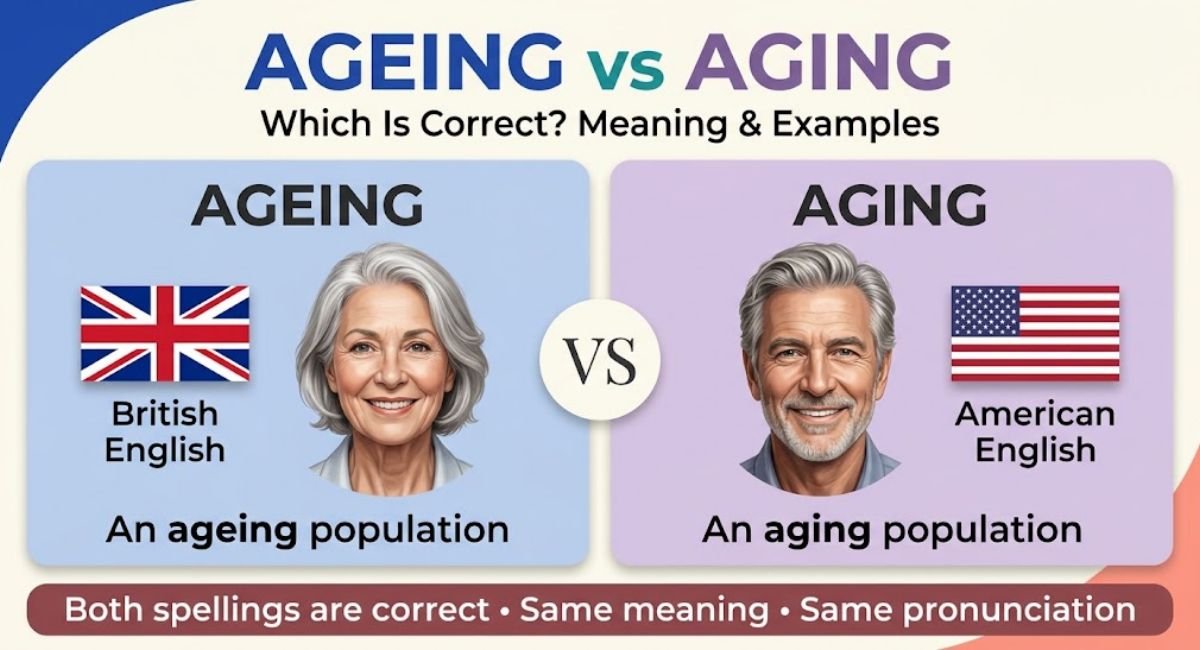
Both ageing and aging are correct English spellings. Ageing is generally preferred in British English, while aging is standard in American English. Both describe becoming older or changes that occur over time. They have identical pronunciations and grammatical functions. The best spelling depends on your audience, regional conventions, and publication style.
The ageing vs aging difference can be confusing when you read English content from different countries. A British newspaper may discuss an ageing population, while an American healthcare website refers to an aging population. Neither writer has made a spelling mistake. They are simply following different conventions.
The distinction matters in academic assignments, medical articles, technical reports, and website content. It also becomes more interesting when the word describes wine, old buildings, biological changes, or overdue customer invoices. Understanding these contexts helps you choose the correct spelling without treating every appearance of the word as a reference to elderly people.
Ageing vs. Aging – Meaning and Main Differences
Ageing and aging describe the process of growing older or undergoing changes associated with time. The spelling difference does not change the meaning. Whether someone writes about an ageing workforce or an aging workforce, the basic idea remains the same.
The main consideration is regional preference. British English commonly retains the e, producing ageing. American English normally removes it, producing aging. Writers should also consider editorial guidelines, particularly when preparing documents for international organizations or academic journals.
| Feature | Ageing | Aging |
| Preferred variety | British English | American English |
| Basic meaning | Becoming older | Becoming older |
| Pronunciation | AY-jing | AY-jing |
| IPA | /ˈeɪ.dʒɪŋ/ | /ˈeɪ.dʒɪŋ/ |
| Grammatical roles | Noun, adjective, verb form | Noun, adjective, verb form |
| Example | An ageing population | An aging population |
| Other contexts | Healthcare, materials, society | Healthcare, finance, engineering |
For instance, a UK organization might publish a report titled “Supporting an Ageing Workforce.” An American organization covering the same subject would probably use “Supporting an Aging Workforce.” The message would not change.
What Does Ageing Mean in British English?
Ageing is the usual British English spelling for the process of getting older. It applies to humans and animals, but its meaning is not limited to living organisms. Buildings, machinery, materials, and manufactured products can also age.
The word does not automatically suggest illness, weakness, or deterioration. A person may remain healthy and independent while ageing. Similarly, certain foods and materials undergo controlled changes that can produce desirable characteristics.
Ageing as a Natural Human Process
Human ageing involves changes that occur as people grow older. These changes can affect physical health, appearance, and other aspects of life, but they do not affect every individual in exactly the same way.
Consider the sentence, “Her grandfather is ageing, but he still enjoys gardening and traveling.” The sentence simply recognizes the passage of time. It does not imply that he is unable to participate in everyday activities.
This distinction is important because age-related vocabulary can unintentionally create negative assumptions about older people.
Ageing Population in British English
An ageing population is one in which older people account for an increasing share of the total population.
Population ageing can result from several demographic changes, including declining fertility and increasing survival into older ages. It may influence healthcare planning, pensions, housing, and public services.
An ageing population is not necessarily the same as an elderly population. The first expression describes a demographic trend. The second describes a population characterized as older.
For example, a country may experience population ageing even while its total number of inhabitants continues to grow.
Healthy Ageing and Public Health
Healthy ageing concerns maintaining well-being and the abilities that support everyday life as people grow older.
The expression appears frequently in British healthcare and public policy discussions. It does not mean avoiding all physical changes or remaining permanently youthful.
A person can experience an age-related medical condition while still participating actively in family, work, or community life. This is why careful health writing should avoid equating ageing with disease.
What Does Aging Mean in American English?
Aging is the standard American spelling of ageing. It has the same meanings and can describe biological, physical, social, and technical processes.
American publications commonly use expressions such as healthy aging, aging infrastructure, and aging workforce. The spelling is also familiar in manufacturing, food production, engineering, and accounting.
Aging in Everyday American English
In ordinary American conversation, aging often refers to someone becoming older.
For example, “My parents are aging, but they still love hiking” describes the passage of time without necessarily implying declining health.
The same word can describe objects. An aging car may need maintenance, while an aging computer may struggle to run modern software.
The meaning depends on the surrounding words rather than the spelling itself.
Aging Infrastructure and Equipment
Engineers and public officials may describe roads, bridges, water systems, or electrical networks as aging infrastructure.
This expression generally means the infrastructure has been in service for many years and may require inspection, repair, replacement, or modernization.
However, age alone does not prove that a structure is unsafe. Its condition depends on design, maintenance, materials, use, and environmental exposure.
For precise technical writing, it is better to describe observed defects than to assume older infrastructure is automatically failing.
Aging in Food and Drink
Aging can also describe a controlled production process.
Wine aging allows chemical and sensory characteristics to change over time. Cheese aging, often called maturation or ripening, may develop particular flavors and textures.
Dry-aging beef involves storing meat under carefully controlled conditions to produce specific changes in flavor and texture.
These examples show why aging should not automatically be replaced with deterioration. In some settings, the intended changes are considered beneficial.
Aging in Accounting
One particularly useful meaning appears in accounting.
An accounts receivable aging report groups unpaid customer invoices according to how long they have been outstanding.
For example, a business may separate invoices into categories such as current, 1–30 days overdue, 31–60 days overdue, and more than 60 days overdue.
This use has nothing to do with human biology. It concerns how much time has passed since payment became due.
Understanding this specialized meaning is important when reading business documents, financial reports, or accounting software instructions.
Ageing vs. Aging Pronunciation – Simple Phonetics and IPA
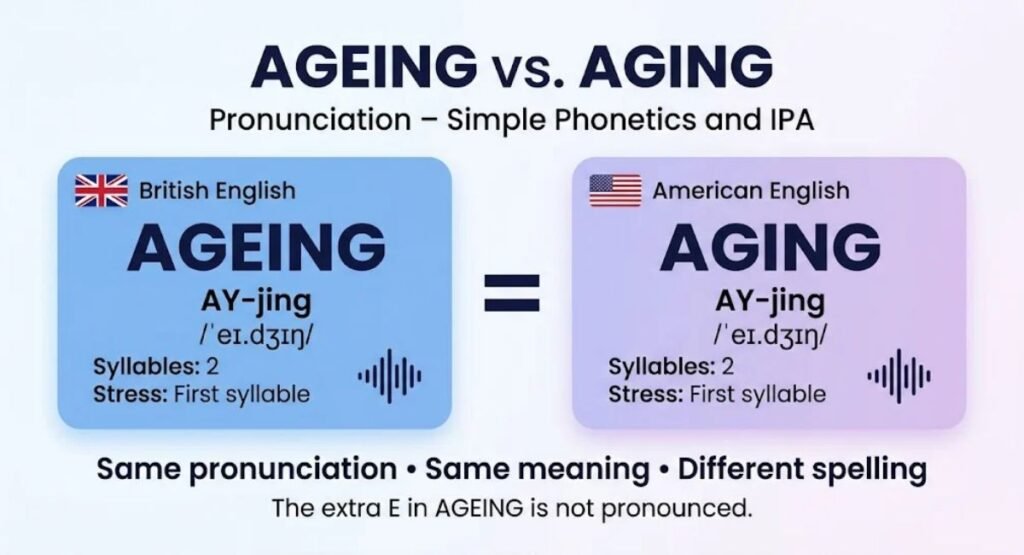
Ageing and aging have the same pronunciation in standard British and American English. The additional e in ageing does not create another syllable or change the sound of the word.
Both forms have two syllables, with the main stress on the first.
| Word | Simple phonetics | British IPA | American IPA |
| Ageing | AY-jing | /ˈeɪ.dʒɪŋ/ | /ˈeɪ.dʒɪŋ/ |
| Aging | AY-jing | /ˈeɪ.dʒɪŋ/ | /ˈeɪ.dʒɪŋ/ |
The first syllable contains the same vowel sound heard in the word day. The second syllable contains the consonant sound in judge, followed by the vowel in sit and the final ng sound.
Unlike some regional vocabulary differences, the spelling variation does not signal a pronunciation difference.
A listener therefore cannot determine whether someone would write ageing or aging merely by hearing the word spoken.
Ageing and Aging Grammar Rules
Both spellings come from the verb age. They can function as present participles, nouns, or adjectives, depending on the sentence.
The underlying grammar is identical. Choosing British or American spelling does not change the verb’s tense, the sentence structure, or the relationship between words.
Ageing and Aging as Present Participles
A present participle can appear in progressive verb constructions.
British English: “The population is ageing.”
American English: “The population is aging.”
Both sentences describe an ongoing process.
A more detailed example is, “The bridge has been aging for decades.” Here, the verb phrase uses the present perfect progressive construction.
The spelling choice does not change the grammatical tense.
Ageing and Aging as Nouns
Both words can function as nouns when referring to the process of growing older.
Examples:
- Healthy ageing is an important public health concern.
- Aging occurs throughout life.
- Researchers investigate biological ageing.
When referring to the general process, ageing and aging are normally uncountable nouns.
However, specialized uses may differ. In accounting, for example, aging can refer to a particular classification or analysis of outstanding accounts.
Therefore, it would be too broad to claim that the word can never have a countable use.
Ageing and Aging as Adjectives
Both forms can appear before nouns as participial adjectives.
Examples include:
- An ageing population
- An aging workforce
- Ageing equipment
- An aging vehicle
These expressions describe people or things that are getting older.
The adjective does not necessarily indicate whether the effects of time are beneficial, harmful, or neutral.
Verb Forms of Age
| Form | Example |
| Base form | Age |
| Third-person singular | Ages |
| Past tense | Aged |
| Past participle | Aged |
| Present participle, British | Ageing |
| Present participle, American | Aging |
The verb age can be intransitive or transitive.
Intransitive: “The wooden furniture aged naturally.”
Transitive: “Continuous exposure to sunlight aged the fabric.”
In the first sentence, the furniture changes over time. In the second, an external factor causes the material to develop characteristics associated with age.
Common Prepositions and Expressions
The verb age does not require one fixed preposition.
Common constructions include:
- Age over time
- Age for several years
- Age in oak barrels
- Signs of ageing
- Effects of aging
- Changes associated with age
For example, “The wine aged in oak barrels for several years” identifies both the storage environment and the duration.
By contrast, “The report examined the effects of aging” uses aging as a noun rather than a verb.
Ageing vs. Aging Example Sentences
The following original sentences demonstrate how the words appear in everyday communication, academic writing, professional reports, and specialized fields.
British English Examples Using Ageing
- The council is preparing additional transport services for an ageing population.
- Engineers inspected the ageing railway bridge before recommending repairs.
- Her grandmother believes that ageing should never prevent someone from learning.
- The university published research on healthy ageing.
- The company plans to replace its ageing computer systems.
- The documentary examines how different communities respond to population ageing.
American English Examples Using Aging
- The city allocated additional funding to repair aging water pipes.
- Researchers are studying the relationship between sleep and healthy aging.
- The winery closely monitors temperature during the aging process.
- My parents are aging, but they remain active in their neighborhood.
- The accounting department prepared an aging report for overdue invoices.
- The museum is developing a plan to preserve its aging collection of photographs.
British and American English Comparisons
| British English | American English |
| The population is ageing. | The population is aging. |
| Healthy ageing matters. | Healthy aging matters. |
| The ageing process varies. | The aging process varies. |
| The factory uses ageing equipment. | The factory uses aging equipment. |
Each pair expresses the same meaning. The difference is orthographic, meaning it concerns spelling rather than pronunciation or grammar.
Ageing vs. Aging Synonyms and Their Differences
Several expressions are related to ageing and aging, but they do not always convey the same meaning.
Choosing the correct alternative depends on whether the subject is a person, an object, a material, or a process.
Synonyms and Related Expressions
| Word | Subtle difference |
| Growing older | Neutral everyday expression emphasizing increasing age. |
| Getting old | Informal phrase that may suggest approaching old age. |
| Maturing | Often emphasizes development or reaching maturity. |
| Senescence | Scientific term describing certain biological ageing processes. |
| Deteriorating | Becoming worse in condition; not an exact synonym. |
| Weathering | Changes caused by exposure to environmental conditions. |
| Ripening | A developmental or production process associated with fruit and some foods. |
| Maturation | Development toward maturity, sometimes involving desirable changes. |
Consider the difference between ageing and maturing.
A teenager may mature emotionally as they grow older. However, emotional maturity is not guaranteed simply because someone has lived for more years.
Similarly, a building can age without necessarily deteriorating. Good maintenance may preserve its condition for a long time.
These distinctions make related vocabulary more useful than a simple list of interchangeable words.
Do Ageing and Aging Have Antonyms?
Neither spelling has one universal antonym.
Chronological ageing refers to time passing, while some related words describe changes in appearance, physical condition, or function.
These concepts should not be treated as exact opposites.
Rejuvenation
Rejuvenation means making something appear or function more youthfully.
Example: “The renovation rejuvenated the appearance of the old building.”
The building remains the same chronological age despite its improved condition.
Renewal
Renewal refers to restoring, replacing, or improving something.
Example: “The company began a renewal program for outdated machinery.”
Renewal may address age-related problems, but it does not reverse the passage of time.
Preservation
Preservation means protecting something against damage or unwanted change.
Example: “The archive uses controlled storage conditions to preserve historical photographs.”
The photographs continue to grow older even when deterioration is slowed.
De-Aging
De-aging is used particularly in filmmaking, visual effects, and digital image processing.
Example: “The filmmakers used digital de-aging to make the actor appear younger.”
This changes the representation of age rather than reversing biological ageing.
Ageing vs. Aging – Etymology and Word Origin
Both spellings come from the English verb age.
The noun age entered Middle English through Old French forms such as aage and eage. These forms ultimately developed from Latin roots associated with a period of life or lifetime.
The English verb age appeared later, referring to becoming older. The -ing forms developed through ordinary English verb formation.
The spelling distinction reflects differences in regional conventions.
In standard American English, aging follows the common pattern of dropping a final silent e before adding -ing.
British English commonly retains the e in ageing.
However, British English does not always keep a final e before -ing. Words such as making, taking, and changing normally drop the e in both British and American English.
Ageing is therefore an established spelling variation rather than evidence of a universal British spelling rule.
There is no need to attribute either form to a particular writer or historical reformer without reliable documentary evidence.
Common Ageing vs. Aging Mistakes
Most spelling mistakes occur when writers assume only one form is valid or when they switch between British and American conventions without a clear reason.
Other errors involve confusing the -ing form with aged, elderly, or age-related terminology.
Is Ageing Incorrect in American English?
Ageing is a recognized spelling variant, but aging is standard in American English.
An American editor may change ageing to aging to follow publication style. This does not mean the British form is grammatically incorrect.
For most writing intended for a US audience, aging is the straightforward choice.
Is Aging Wrong in British English?
Aging is not inherently wrong in British English. It appears in some specialized and internationally influenced writing.
However, ageing is generally preferred in ordinary British English.
A British publication may also retain aging when it appears in an official title, a brand name, or a direct quotation.
Aged vs. Ageing
Aged and ageing have different grammatical roles.
Aged can be the past tense or past participle of age.
Example: “The cheese was aged for twelve months.”
Ageing describes an ongoing process.
Example: “The ageing machinery requires regular maintenance.”
Aged can also indicate a specific age, as in “children aged ten to twelve.”
Ageing Population vs. Elderly Population
An ageing population describes a demographic change in which older people account for an increasing proportion of the population.
An elderly population refers to a group or population characterized as older.
The terms are not interchangeable.
In contemporary public communication, older adults or older people may also be more appropriate than elderly when referring respectfully to individuals.
Anti-Ageing vs. Anti-Aging
Anti-ageing follows British spelling conventions, while anti-aging follows American conventions.
Both forms are common in skincare marketing.
However, a product described as anti-aging has not necessarily been scientifically demonstrated to reverse biological ageing.
Writers should distinguish marketing terminology from specific, supported effects, such as reducing the visible appearance of fine lines.
Ageing vs. Aging in Academic and Professional Writing
Choosing a spelling is partly an editorial decision.
The same subject may appear under different spellings in British and American publications. What matters is using terminology that matches the intended readers and following any applicable style guide.
Academic Writing
Students should follow their institution’s language requirements.
If an assignment uses British English, ageing is usually appropriate. If the required variety is American English, aging is preferred.
Academic journals may have their own instructions for authors. These requirements should take priority over general assumptions about regional spelling.
Official names and quotations should normally retain their original wording.
Healthcare and Scientific Writing
British publications commonly use healthy ageing, while American publications generally prefer healthy aging.
The spelling does not change the underlying scientific concept.
However, writers should distinguish chronological ageing from biological ageing. Chronological age measures elapsed time since birth, while biological ageing concerns physiological and molecular changes associated with ageing.
These ideas are related but not identical.
Business and Financial Writing
The expression accounts receivable aging is common in American accounting terminology.
A UK business may also encounter the American spelling when using internationally developed accounting software or following a particular reporting system.
Rather than automatically changing a technical report heading, editors should check the terminology required by their organization.
SEO and Website Content
For SEO, the spelling should match the audience and the page’s editorial style.
A British website can naturally use ageing, while an American website may prefer aging.
There is no reliable basis for claiming that one spelling automatically guarantees better Google rankings.
Search relevance depends on more than spelling. The page should answer the user’s question clearly, use accurate terminology, and provide genuinely useful information.
Including both spellings naturally in a comparison article is appropriate because readers are specifically searching for the difference between them.
How to Remember Ageing vs. Aging
The easiest memory aid is to associate each form with its usual regional convention.
British English: AGE + ING = AGEING
American English: AGE − E + ING = AGING
This is a mnemonic for these two established spellings, not a universal rule for every verb in British and American English.
Practice Exercise
Choose the preferred spelling for each situation.
- A British newspaper discusses an ___ population.
- An American hospital publishes a guide to healthy ___.
- A UK engineer reports on ___ railway bridges.
- A US accountant prepares an accounts receivable ___ report.
- A British university publishes research on biological ___.
- An American winery discusses the ___ process for its wines.
Answers
- Ageing
- Aging
- Ageing
- Aging
- Ageing
- Aging
The exercise demonstrates that the spelling changes with the intended variety of English, while the meaning remains unchanged.
Conclusion
Both ageing and aging are correct spellings of the same English word. Ageing is generally preferred in British English, while aging is standard in American English.
They share the same pronunciation and grammatical functions. Their meanings extend beyond human ageing to demographic trends, buildings, food maturation, science, and financial reporting.
The most useful approach is to choose the form appropriate for your readers, follow any relevant style guide, and remain consistent throughout your writing.
Frequently Asked Questions
Is ageing or aging the correct spelling?
Both ageing and aging are correct English spellings. Ageing is generally preferred in British English, while aging is standard in American English. Both refer to growing older or changing over time. The appropriate choice depends on your target audience, regional spelling conventions, and any editorial style guide you must follow.
Is ageing British English or American English?
Ageing is primarily associated with British English and is also common in countries that follow British spelling conventions. Aging is the standard spelling in American English. However, exceptions occur in technical terminology, official names, and quotations. For professional writing, use the spelling preferred by your publication or intended audience.
Do ageing and aging have the same pronunciation?
Yes, ageing and aging have identical pronunciations. Both are pronounced AY-jing, with the IPA transcription /ˈeɪ.dʒɪŋ/. Each word contains two syllables, with the stress on the first syllable. The additional letter e in ageing does not change the sound, so the distinction is purely a matter of spelling.
Why does American English drop the e in aging?
American English uses aging, following the common spelling pattern of removing a final silent e before adding -ing. British English retains the e in the established spelling ageing. This is a specific spelling variation, not a universal British rule, because words such as making and changing drop the e in both varieties.
Should I use ageing or aging in academic and SEO writing?
Use ageing when writing in British English and aging when following American English conventions. Academic writers should check institutional or journal style guides, while website publishers should consider their target audience. Neither spelling automatically guarantees better search rankings. Clear explanations, helpful content, and consistent editorial style are more important.




One Comment