
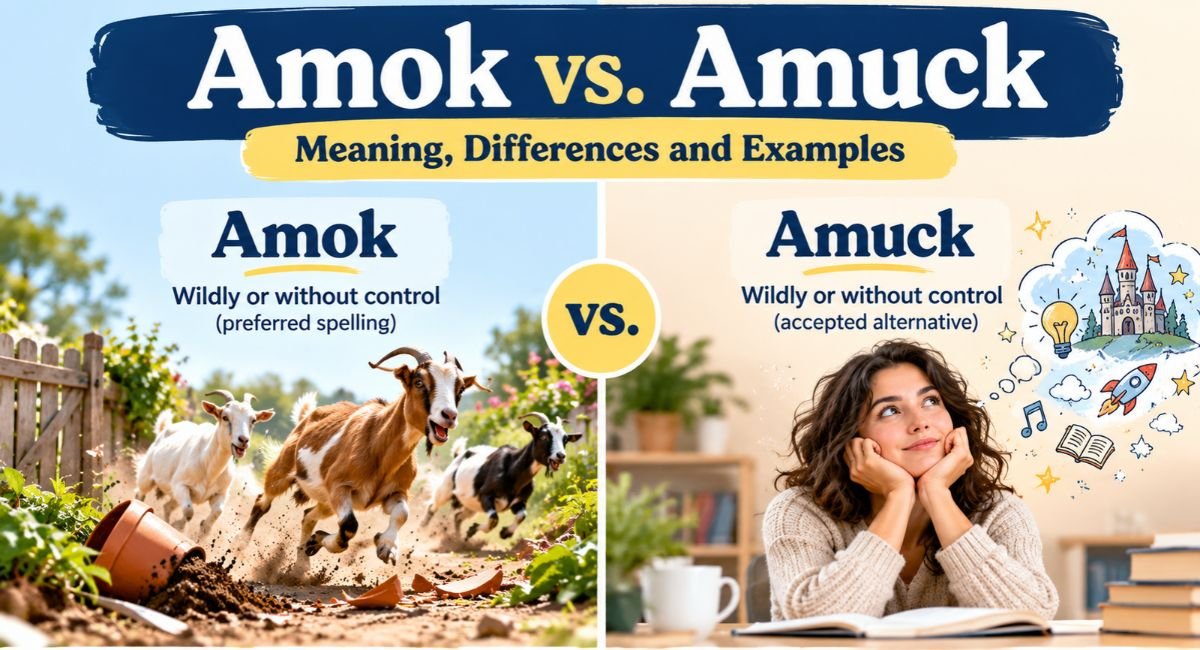
Amok vs. Amuck: Meaning, Difference & Examples
Amok and amuck are two accepted spellings of the same English word. Both appear in the expression “run amok,” meaning to behave wildly, dangerously, or without control. Amok is the more familiar spelling in modern English, while amuck is an established alternative. The difference is spelling, not meaning.
The confusion around amok vs. amuck is understandable. You may have seen a headline describing a crowd running amok, then encountered a novel in which someone’s imagination runs amuck. Both expressions are correct. Neither spelling changes what the writer is saying, although the situation itself determines how seriously the phrase should be understood.
For most new writing, amok is a sensible choice. It is familiar, easy to recognise, and widely used in the idiom “run amok.” But the spelling question is only part of the story. The expression also has an unusual history, specific grammatical patterns, and figurative uses that can confuse readers who interpret the word too literally.
What Does Amok Mean in English?
Amok describes wild, uncontrolled, or potentially dangerous behaviour. In everyday English, it usually appears with the verb run. Someone who runs amok behaves without ordinary restraint, often causing disorder or creating a situation that other people struggle to control.
Picture a group of goats escaping through an open farm gate. They scatter across the vegetable garden, knock over containers, and ignore attempts to guide them back. You could naturally say, “The goats ran amok.” The phrase conveys more than movement. It suggests disorder and a loss of control.
Not every use involves animals, crowds, or physical destruction. A writer can also describe imagination, speculation, or ambition as running amok. These figurative expressions retain the idea of something exceeding reasonable limits without requiring anyone to behave violently.
Amok Meaning in Simple English
The simplest explanation of amok is “out of control.” When people run amok, their behaviour becomes wild or disorderly. When an imagination runs amok, thoughts develop in unexpected, exaggerated, or uncontrolled directions.
For example, imagine hearing a strange sound outside your bedroom. Within minutes, you begin imagining a burglar, a wild animal, or something mysterious. A friend might say, “Your imagination is running amok.”
The expression works because the thoughts are developing beyond what the available evidence justifies. Nobody is physically running, and no actual danger needs to exist.
What Does Amuck Mean in English?
Amuck is an alternative spelling of amok. It has the same basic meaning and appears in the expression “run amuck.” Cambridge Dictionary recognises amuck and directs readers to the definition of amok, confirming their close lexical relationship.
Consider these sentences:
“The children ran amok through the house.”
“The children ran amuck through the house.”
Both suggest uncontrolled or disorderly behaviour. The second sentence does not necessarily describe a more violent event, a different kind of disorder, or a different grammatical construction.
The distinction is primarily orthographic, meaning it concerns written form. Readers may have individual preferences, but the two spellings do not carry separate standard definitions.
Is Amuck a Real Word?
Yes. Amuck is a recognised English spelling, not simply an accidental misspelling. It has appeared in English writing for centuries and remains listed in contemporary dictionaries.
It is nevertheless useful to distinguish between an accepted form and an editorial preference. Writers preparing a new educational article or professional document can generally choose amok without needing to discuss the alternative spelling every time.
An existing quotation, title, or historical passage may use amuck. In those circumstances, preserving the original wording is usually more appropriate than silently changing it.
Amok vs. Amuck: Which Spelling Is Correct?
Both spellings are correct, but amok is generally the preferred choice for contemporary edited English. Amuck remains an accepted alternative rather than a word with a different meaning.
This makes the pair different from commonly confused words such as affect and effect, where grammar and meaning frequently determine the correct choice. With amok and amuck, the choice usually concerns spelling convention.
| Feature | Amok | Amuck |
| Meaning | Wildly or without control | Same meaning |
| Standard dictionary recognition | Yes | Yes |
| Modern editorial preference | Generally preferred | Accepted alternative |
| Common expression | Run amok | Run amuck |
| Main grammatical use | Adverb | Adverb |
| American pronunciation | /əˈmʌk/ | /əˈmʌk/ |
| British pronunciation | /əˈmɒk/ | /əˈmʌk/ |
Is It Run Amok or Run Amuck?
Both expressions are accepted. If you are writing something new and have no particular reason to prefer the alternative spelling, choose “run amok.”
For instance, “The escaped animals ran amok through the market” is a natural modern sentence. Replacing amok with amuck would not change the event being described.
The important grammatical element is the verb run, which changes according to tense. The spelling choice does not affect the sentence’s verb forms.
Is Amok British and Amuck American?
No simple British-versus-American spelling rule separates these forms. Both are recognised in English, and neither should be described as belonging exclusively to one national variety.
There is a useful pronunciation distinction, however. Cambridge Dictionary records different British pronunciations for amok and amuck, while its American pronunciations are the same.
This shows why spelling preference and pronunciation should be treated as separate questions. A regional pronunciation difference does not automatically establish a regional spelling rule.
Amok and Amuck Pronunciation
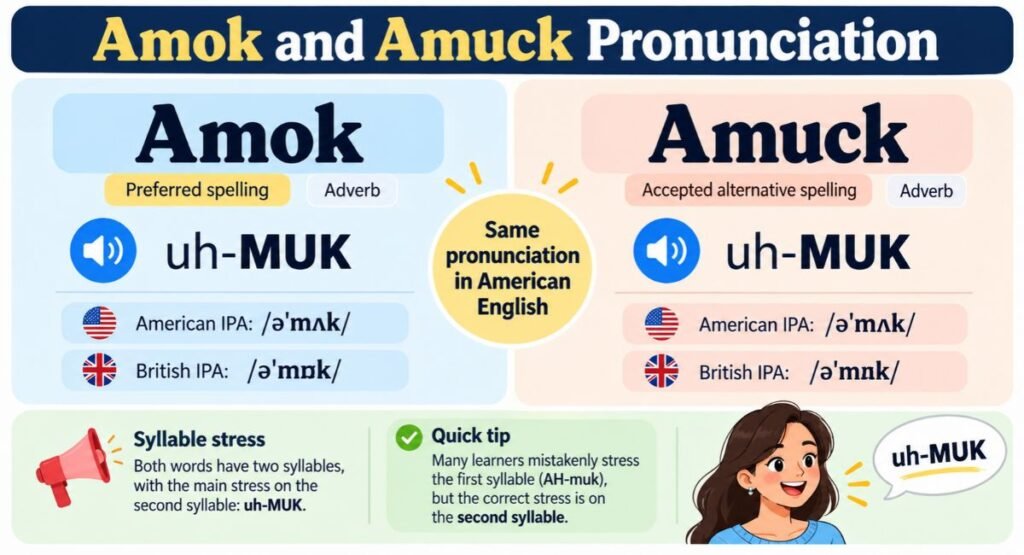
Both words have two syllables, with the main stress on the second syllable. Their American pronunciations are commonly identical.
| Word | Simple Pronunciation | American IPA | British IPA |
| Amok | uh-MUK (American) | /əˈmʌk/ | /əˈmɒk/ |
| Amuck | uh-MUK | /əˈmʌk/ | /əˈmʌk/ |
The simple pronunciation guide represents American English. In the British pronunciation of amok, the stressed vowel is commonly similar to the vowel in the British pronunciation of lock.
Common Pronunciation Mistakes
Learners sometimes place the stress on the first syllable because the words look unfamiliar. The normal stress falls on the second syllable.
Another mistake is assuming that amok and amuck must always sound different because they are spelt differently. In American English, both commonly have the same pronunciation.
Dictionary recordings are useful because approximate phonetic spellings cannot represent every accent precisely.
Parts of Speech and Grammar Rules
In modern English, amok and amuck primarily function as adverbs. They most commonly appear in the established idiom “run amok” or its alternative spelling, “run amuck.”
Some dictionaries and historical sources also recognise adjectival uses. However, learners should begin with the ordinary idiom rather than treating amok as an adjective that can freely replace words such as wild or chaotic in every sentence.
Neither amok nor amuck functions as an ordinary verb in contemporary English. Instead, the verb run carries the tense, while the final word remains unchanged.
How to Use Run Amok in a Sentence
The expression combines the verb run with amok, which describes a wild or uncontrolled state.
Examples:
- “The horses ran amok after escaping their enclosure.”
- “His imagination began to run amok.”
- “Rumours have run amok since the announcement.”
The third sentence is figurative. Rumours cannot physically run, but their development or circulation may be portrayed as uncontrolled.
Verb Forms of Run Amok
The verb run is irregular. Its past tense is ran, and its past participle is run.
| Verb Form | Correct Expression | Example |
| Base form | Run amok | “Don’t let the animals run amok.” |
| Present simple | Runs amok | “His imagination runs amok.” |
| Past simple | Ran amok | “The crowd ran amok.” |
| Present participle | Running amok | “The children are running amok.” |
| Past participle | Run amok | “Speculation has run amok.” |
Amuck follows exactly the same grammatical pattern.
The spelling of the final word does not change when the tense changes. Only the verb is conjugated.
Is Amok Countable or Uncountable?
In its ordinary modern adverbial use, countability does not apply. Amok is not functioning as a noun, so it does not normally take articles or plural endings.
You would not say “three amoks” to describe three episodes of uncontrolled behaviour in ordinary contemporary English.
Historical noun uses exist, but they are separate from the common expression being discussed here. For most learners, the important grammatical pattern is simply “run amok.”
Which Prepositions Follow Run Amok?
There is no single preposition required by amok. A preposition may follow the expression to describe location, direction, or the people affected.
Examples:
- “The goats ran amok in the garden.”
- “The horses ran amok through the village.”
- “The children ran amok around the playground.”
- “Panic seemed to run amok among the spectators.”
These prepositions belong to the wider sentence. They are not fixed parts of the idiom.
Run Amok: Literal and Figurative Meanings
One reason the expression deserves more explanation than a dictionary definition is that its meaning changes in intensity depending on its subject.
A crowd running amok may suggest a serious public disturbance. Children running amok at a birthday party may simply suggest noisy, disorderly behaviour. An imagination running amok describes neither physical movement nor a public disturbance.
All three uses retain the idea of something escaping ordinary restraint.
Literal Use: Uncontrolled Behaviour
The expression is relatively concrete when it describes people or animals acting wildly.
For example:
“The escaped sheep ran amok through the market, scattering baskets and frightening shoppers.”
The animals are physically moving, and their activity has become disorderly.
The phrase would be less appropriate if the sheep were simply walking slowly through an empty field. The disorder is what makes the expression meaningful.
Figurative Use: Imagination Running Amok
An imagination can run amok when someone develops exaggerated, unlikely, or uncontrolled thoughts.
Consider a novelist inventing increasingly bizarre explanations for a mysterious event. The writer might say:
“By midnight, her imagination had run amok, turning a missing key into an elaborate conspiracy.”
Here, the expression is creative rather than threatening.
It suggests that imagination has moved beyond ordinary limits.
Figurative Use: Rumours Running Amok
Rumours can also be described as running amok, particularly when speculation appears widespread and uncontrolled.
For example:
“After the announcement was delayed, rumours began to run amok around the office.”
This wording is more dramatic than simply saying that several employees discussed the delay.
Writers should use it carefully in news or factual reporting. The phrase implies a significant loss of control, so the surrounding evidence should justify that description.
An Unusual Grammar Pattern: Noun + Run Amok
Amok sometimes appears in compressed descriptions such as “ambition run amok” or “technology run amok.”
In this pattern, run amok describes something that has gone beyond appropriate limits. The phrase works like a shortened descriptive clause.
For example:
“The story explores ambition run amok.”
This means the story concerns ambition that has become uncontrolled or excessive.
The construction is particularly useful in literary criticism, opinion writing, and headlines. It is more specific than simply calling something chaotic because it suggests that a particular force or impulse has exceeded reasonable boundaries.
Amok vs. Amuck Example Sentences
The following original examples show how the expression works in casual conversation, professional writing, and creative descriptions.
Everyday Conversation Examples
- “The puppy ran amok through the kitchen and knocked over a bowl of flour.”
- “The children were running amok in the playroom when their parents returned.”
- “My imagination ran amuck after I heard a strange sound outside.”
- “The escaped chickens ran amok around the farmyard.”
These examples describe different levels of disorder. The first, second, and fourth involve physical behaviour, while the third is figurative.
Professional and Formal Examples
- “Speculation began to run amok after the organisation postponed its announcement.”
- “The report warned against allowing unverified claims to run amok online.”
- “The editorial criticised what it described as bureaucracy run amok.”
- “The committee introduced additional controls to prevent unchecked spending from running amok.”
These examples demonstrate how the expression can communicate criticism. In professional contexts, it often suggests that activity has moved beyond appropriate limits.
Creative Writing Examples
- “Her imagination ran amok, filling the silent house with impossible possibilities.”
- “The escaped horses ran amuck through the village before their handlers caught them.”
- “By the final chapter, the character’s ambition had run amok.”
- “A single misunderstanding allowed suspicion to run amok among the guests.”
These sentences illustrate that the idiom can apply to physical movement, emotions, imagination, and abstract ideas.
Synonyms of Amok and Their Differences
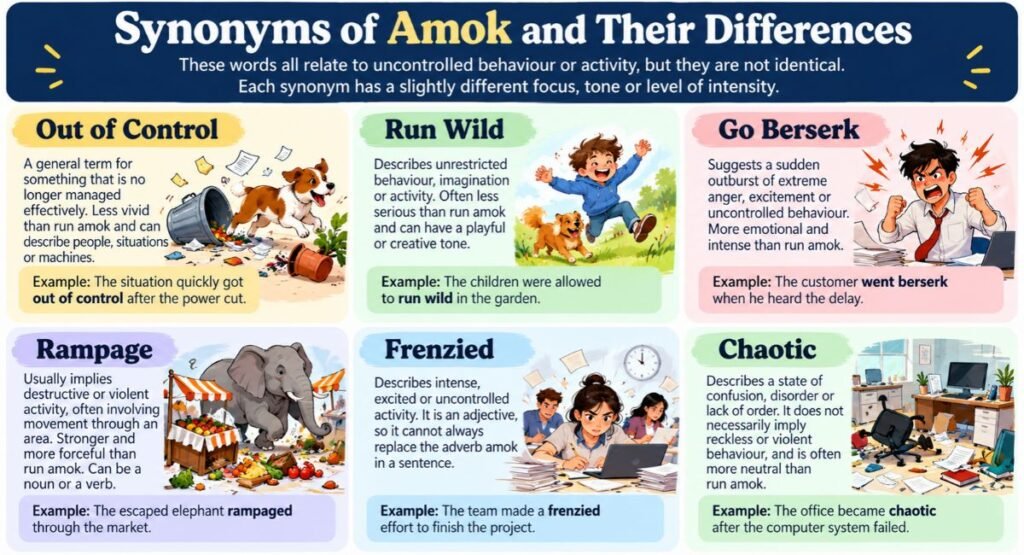
Several English expressions resemble run amok, but they differ in seriousness, grammatical function, and emotional tone.
The best alternative depends on whether you want to describe general disorder, unrestricted activity, intense emotion, or destructive behaviour.
Amok vs. Out of Control
“Out of control” is a broad expression for something no longer being managed effectively.
“Run amok” is more vivid and can suggest wild or dangerous behaviour.
Example: “The crowd became difficult to control after the barriers collapsed.”
Amok vs. Run Wild
“Run wild” can describe unrestricted behaviour, imagination, or creativity.
It is often less severe than “run amok,” especially when describing play or artistic freedom.
Example: “The children were allowed to run wild in the garden.”
Amok vs. Go Berserk
“Go berserk” often suggests an intense outburst of anger, excitement, or uncontrolled behaviour.
“Run amok” can also describe broader situations that develop into disorder without one dramatic emotional outburst.
Example: “The fans went berserk when their team scored.”
Amok vs. Rampage
“Rampage” commonly suggests destructive or violent activity.
It can function as a noun or verb, whereas amok is primarily used adverbially in modern English.
Example: “The escaped animal rampaged through the market.”
Amok vs. Frenzied
“Frenzied” describes intense or agitated activity.
It is an adjective and therefore cannot directly replace amok in every sentence.
Example: “The staff made a frenzied effort to finish the preparations.”
Amok vs. Chaotic
“Chaotic” describes confusion or lack of order.
It does not necessarily imply reckless, violent, or dangerous behaviour.
Example: “The office became chaotic after the computer system stopped working.”
Antonyms of Amok and Amuck
Amok has no single perfect antonym for every context. Its opposite depends on whether the sentence concerns emotions, physical behaviour, or an uncontrolled situation.
- Controlled: Kept within appropriate limits. “The situation remained controlled throughout the event.”
- Orderly: Following rules or an organised pattern. “The students left the classroom in an orderly manner.”
- Calm: Free from unusual agitation. “The passengers remained calm during the delay.”
- Restrained: Moderate or held back. “The speaker gave a restrained response.”
- Disciplined: Showing self-control. “The team followed a disciplined approach.”
- Composed: Emotionally steady. “She remained composed despite the interruption.”
These are contextual opposites rather than exact grammatical replacements.
For example, “The crowd remained orderly” contrasts naturally with “The crowd ran amok.” However, replacing amok directly with orderly after the verb run would not produce the same grammatical structure.
Word Origin and Etymology
Amok entered English through contact with Malay and related Southeast Asian language usage. Its source is associated with Malay amuk, referring to furious or violent attacking behaviour.
The Online Etymology Dictionary records the expression “run amok” in English by the 1670s. It also identifies earlier European-language forms, including Portuguese spellings associated with historical descriptions of violent frenzy.
These historical accounts should be interpreted in their original context rather than treated as accurate generalisations about a population or culture.
Where Did the Spelling Amuck Come From?
Amuck is an established historical variant of amok. The Online Etymology Dictionary traces it to seventeenth-century English usage.
Its existence is therefore not a recent spelling mistake or an invention of modern informal writing.
Historical authors and usage commentators did not always prefer the same spelling. That disagreement helps explain why both forms survived.
However, the history does not establish two different modern meanings. Contemporary dictionaries continue to treat amuck as an alternative form of amok.
How the Meaning Developed
The earlier word was associated with violent or frenzied attacking behaviour.
English later extended the expression to describe activities and situations that become uncontrolled without necessarily involving physical violence.
This development explains why modern writers can describe imagination, rumours, spending, ambition, or bureaucracy as running amok.
The figurative meanings still preserve the central idea of behaviour or activity exceeding reasonable limits.
Common Mistakes When Using Amok and Amuck
Most errors involve misunderstanding the spelling relationship, treating amok as an ordinary verb, or using the idiom too dramatically.
Mistake: Assuming Amuck Has a Different Meaning
Incorrect assumption: “Amok means violence, but amuck means harmless disorder.”
Correct understanding: Both spellings share the same standard meaning. The context determines whether the situation is dangerous, playful, or figurative.
Mistake: Writing Runned Amok
Incorrect: “The animals runned amok.”
Correct: “The animals ran amok.”
The past tense of run is ran.
Mistake: Using Amok as an Independent Verb
Incorrect: “The children amoked through the classroom.”
Correct: “The children ran amok through the classroom.”
Modern English normally uses the established expression rather than creating a verb from amok.
Mistake: Believing Someone Must Literally Run
Incorrect assumption: “Rumours cannot run amok because they cannot move.”
Correct understanding: The expression is often figurative. Rumours, imagination, and ambition can all be described as running amok.
Mistake: Using Run Amok for Every Inconvenience
Exaggerated: “My pencil fell off the desk, and everything ran amok.”
More natural: “My pencil fell off the desk, interrupting my work.”
Run amok generally suggests more substantial disorder or a noticeable loss of control.
Mistake: Treating Amuck as a Typographical Error
Incorrect assumption: “Every occurrence of amuck should be corrected to amok.”
Correct understanding: Amuck is an accepted alternative. A publication may prefer amok for consistency, but historical quotations and titles should preserve their original spellings.
How to Choose Between Amok and Amuck
Choose amok for most new writing unless your publication’s style or the source material gives you a reason to use amuck.
The greater challenge is deciding whether the idiom accurately describes your subject. Run amok is expressive. It works well when an activity appears genuinely uncontrolled, but it may be unnecessarily dramatic for ordinary confusion or excitement.
Compare these sentences:
“The meeting became disorganised.”
“The meeting descended into chaos.”
“The participants ran amok.”
The final sentence suggests particularly unruly behaviour by the participants. It should not be treated as a neutral replacement for every disorganised meeting.
Quick Practice Exercise
Choose the correct form of run and complete each sentence with amok.
- The goats ______ through the vegetable garden yesterday.
- Her imagination began to ______ after she heard the mysterious story.
- Rumours have ______ throughout the office.
- The children were ______ in the playroom.
- The crowd ______ when the organisers lost control of the entrance.
Answer Key: 1. Ran amok; 2. Run amok; 3. Run amok; 4. Running amok; 5. Ran amok.
Amuck is also acceptable in these examples. The verb form changes according to the sentence, while the spelling variant does not alter the meaning.
Run Amok in Casual, Formal and Creative Writing
The expression’s tone depends heavily on context.
In casual conversation, it can be humorous. A parent might describe young children running amok after a birthday party. The phrase exaggerates the lively disorder without necessarily implying serious harm.
In journalism, run amok may suggest a more troubling situation involving uncontrolled behaviour or failures of oversight. Writers should be careful because the idiom can communicate judgement as well as description.
In creative writing, it works especially well with imagination, ambition, suspicion, and fear. These abstract subjects cannot physically move, but the idiom makes their development sound difficult to contain.
The strongest writing uses run amok when the image adds something meaningful. If “became disorganised” communicates the situation more accurately, there is no reason to choose the more dramatic expression.
Conclusion
The difference between amok vs. amuck is mainly spelling, not meaning. Both forms describe wild or uncontrolled behaviour, particularly in the idiom run amok. Amok is generally the more familiar choice in modern edited English, while amuck remains an established alternative.
Understanding the expression also means knowing that it can be literal or figurative. Escaped animals may run amok through a garden, while imagination or speculation may run amok without any physical action.
For most new writing, choose amok, use the correct form of the irregular verb run, and make sure the expression accurately reflects the situation.
Frequently Asked Questions
What is the difference between amok and amuck?
Amok and amuck have the same basic meaning. Both describe wild, disorderly, or uncontrolled behaviour, especially in the phrases “run amok” and “run amuck.” The difference is primarily spelling. Amok is generally preferred in contemporary edited English, while amuck is a recognised alternative. Neither spelling makes the behaviour more serious.
Is it run amok or run amuck?
Both “run amok” and “run amuck” are correct English expressions. They describe behaviour or activity that becomes wild or uncontrolled. Run amok is usually the better choice for modern articles, professional documents, and educational content because it is the more familiar spelling. Run amuck remains acceptable and has the same meaning.
What does running amok mean in simple English?
Running amok means acting wildly, creating disorder, or behaving without control. It can describe people, animals, or situations. For example, children running amok might be behaving noisily and recklessly. The expression can also be figurative: an imagination running amok means thoughts are developing in exaggerated or uncontrolled directions.
Is amuck a real English word or a spelling mistake?
Amuck is a recognised English word, not simply a spelling mistake. Cambridge Dictionary lists it as an alternative form of amok. Both spellings appear in English writing and convey the same meaning. However, amok is generally the preferred modern spelling, especially in the commonly used expression “run amok.”
Where does the word amok come from?
Amok entered English from Malay, where the related word amuk was associated with violent or frenzied behaviour. English originally used the term in more serious contexts, but its meaning broadened over time. Today, “run amok” can describe uncontrolled imagination, spreading rumours, or disorderly activity without necessarily involving physical violence.





One Comment