

Supersede or Supercede Meaning: Spelling & Usage
Supersede is the standard English spelling, while supercede is a disputed variant that should generally be avoided in formal writing. Supers
If you are looking for the meaning of supersede in English, use supersede in standard writing. It means to replace something earlier, especially when a newer rule, system, version, agreement, or method becomes the one in use. Some dictionaries list supersede as a disputed spelling.
The spelling is what makes this word troublesome. English learners know precede, concede, and recede, so supercede looks plausible. Yet the established spelling is supersede. Its unusual -sede ending is connected with the word’s Latin history rather than the -cede pattern seen in those other verbs.
Understanding that history helps, but knowing when to use the word is more useful. Supersede is not simply a fancy replacement for replace. It works particularly well when one thing succeeds another as the current rule, document, version, system, method, or authority.
Supersede or Supercede: Which Spelling Should You Use?
For contemporary standard English, write supersede.
Cambridge lists supersede as a transitive verb, while Collins records supercede as a “disputed” spelling. That makes supercede different from a completely invented form, but it is still not the spelling to choose for ordinary edited English.
Use these forms:
- supersede
- supersedes
- superseded
- superseding
The spelling trap becomes easier to understand when you compare the word with familiar verbs:
- precede
- concede
- recede
- intercede
Those words encourage writers to expect supercede. In supersede, however, that analogy leads you in the wrong direction.
A useful memory cue is simply:
supersede = super + sede
Do not try to make it match precede.
What Does Supersede Mean?
Supersede means to replace or take the place of something that came before.
Cambridge defines it as replacing something, particularly something older or old-fashioned. Its American dictionary entry also notes contexts in which the thing being replaced is older, less effective, less important, or less official.
That gives supersede a useful shade of meaning that plain replace does not always carry.
Compare these two situations:
“I replaced the battery in my watch.”
This is ordinary substitution. One battery came out; another went in.
“The revised policy supersedes the policy issued in 2024.”
Here, the newer document becomes the version that now applies. The sentence is about succession and status, not merely physical substitution.
That is where supersede earns its place.
The Core Idea Behind Supersede: One Thing Becomes the New Standard
The most useful way to understand supersede is to picture an old-to-new relationship.
A thing that supersedes another does not merely exist beside it. It takes over the earlier thing’s role, relevance, authority, or practical use.
For example:
“Version 4.0 supersedes Version 3.5.”
The sentence tells readers more than “Version 4.0 is newer.” It signals that 4.0 is now the successor.
The same logic works naturally with:
- policies
- contracts
- regulations
- specifications
- procedures
- technical standards
- software versions
- products and models
- methods or systems
Cambridge’s Business English entry specifically illustrates supersede with laws, rules, agreements, systems, processes, and products.
How to Pronounce Supersede
The pronunciation is easier than the spelling.
Simple pronunciation: soo-per-SEED
The main stress falls on the final syllable.
UK IPA: /ˌsuː.pəˈsiːd/
US IPA: /ˌsuː.pɚˈsiːd/
Cambridge gives these UK and US forms. The main regional difference shown in the transcription is the middle vowel; both pronunciations end with the stressed sound /siːd/.
Do not let the spelling tempt you into stressing the first syllable. The strongest beat comes at the end: SEED.
What Part of Speech Is Supersede?

Supersede is a transitive verb. In normal use, something or someone supersedes something or someone else. Cambridge labels the verb [T], meaning transitive.
The basic pattern is:
A supersedes B.
For example:
“The new procedure supersedes the previous procedure.”
Here:
- the new procedure is the subject;
- supersedes is the verb;
- the previous procedure is the direct object.
Because supersede is a verb, the noun categories countable and uncountable do not apply to it.
Verb Forms of Supersede
The forms are regular once you know the correct spelling:
Base form: supersede
Third-person singular: supersedes
Past tense: superseded
Past participle: superseded
Present participle: superseding
Cambridge confirms superseded as the past and past participle and superseding as the present participle.
Notice what does not happen:
- not supercedes
- not superceded
- not superceding
If the base word is supersede, its inflected forms keep that spelling pattern.
Active and Passive Grammar With Supersede
Two sentence patterns are especially useful.
A Supersedes B
Use the active form when you want the newer thing to be the focus:
“The revised handbook supersedes the 2024 edition.”
“The new payment system supersedes the old portal.”
B Is Superseded by A
The passive form is useful when the older thing is already the topic:
“The 2024 handbook has been superseded by a revised edition.”
“The old authentication method was superseded by a newer system.”
Cambridge explicitly records the pattern be superseded by something, particularly in business and formal contexts.
This passive construction is worth learning because it appears naturally when writers are warning readers that a document, specification, or rule is no longer current.
Does Supersede Take a Special Preposition?
In its ordinary active form, supersede does not require a preposition before its object.
Natural:
“The new regulation supersedes the old regulation.”
Less natural if you force a preposition into the same structure:
“The new regulation supersedes over the old regulation.”
That is incorrect.
In the passive, by introduces the thing doing the replacing:
“The old regulation was superseded by the new one.”
For ordinary substitutions expressed as “X with Y,” the verb replace is often the more natural choice:
“The company replaced the paper forms with an online system.”
Trying to force supersede into every pattern used by replace can make otherwise grammatical writing sound stiff.
Original Examples of Supersede in Context
The meaning becomes clearer when the object changes.
Policy
“The updated expenses policy supersedes all guidance issued before 1 July.”
The newer document is now the one employees should follow.
Contract
“The signed agreement supersedes the draft terms exchanged during negotiations.”
The sentence establishes which document now governs the arrangement.
Technology
“The new login protocol will eventually supersede the company’s password-only system.”
The newer method is expected to take over the function of the old one.
Product Development
“The manufacturer plans to supersede the current model with a lighter version next year.”
Here the emphasis is on product succession.
Academic Writing
“The later framework refined the earlier model rather than completely superseding it.”
This example is useful because supersede does not have to mean that replacement actually happened.
Instructions
“This installation guide supersedes the instructions included with units shipped before March.”
Readers immediately know which set of instructions is current.
Everyday Conversation
“My phone has almost superseded my camera for travel photos.”
This is grammatical, although many speakers would choose the simpler verb replace in casual conversation.
Supersede vs Replace: They Are Close, but Not Identical
Replace is the general-purpose verb. Supersede often adds the idea of succession.
You can replace:
- a broken window;
- a missing button;
- a battery;
- an employee;
- a piece of furniture.
In many of those situations, supersede would sound unusually formal or would suggest a meaning the speaker did not intend.
By contrast, supersede fits particularly well when the newer item becomes the recognized successor:
“The revised standard supersedes the 2022 standard.”
The distinction is not absolute. Cambridge lists replace as a synonym of supersede, so overlap clearly exists. The difference is one of typical use and nuance rather than a rigid grammatical rule.
Supersede vs Supplant
Supplant is another close synonym, and Cambridge lists it alongside replace.
The difference is often one of emphasis.
Supersede usually focuses on succession or replacement.
Supplant can put more emphasis on one thing taking the position previously occupied by another.
Compare:
“The new specification supersedes the previous edition.”
This sounds orderly and administrative.
“Streaming services supplanted DVD rental stores.”
This emphasizes displacement.
The distinction can blur in real writing, so treat it as a nuance rather than a hard rule.
Supersede vs Override
These words should not be treated as interchangeable.
Override often means to set aside, cancel, or take precedence over a decision, setting, instruction, or rule.
For example:
“An administrator can override the automatic setting.”
The automatic setting still exists; it has simply been overridden in that situation.
By contrast:
“The new procedure supersedes the previous procedure.”
This normally indicates that the newer procedure has taken the older one’s place.
So override can be temporary or situational. Supersede points more naturally toward replacement or succession.
Supersede vs Surpass
This distinction prevents a common vocabulary mistake.
Surpass means to exceed something in performance, quality, quantity, achievement, or another measure.
Supersede means to take its place.
A new phone can surpass an older model in battery life without superseding it in a product range.
A newer model can supersede an older model even if you are not making a claim that it is better in every respect.
Therefore:
“The runner surpassed the previous record.”
Not:
“The runner superseded the previous record.”
The second sentence changes the meaning.
Synonyms of Supersede, With the Differences That Matter
Replace — the broad, neutral option for putting one thing in place of another.
Supplant — often emphasizes displacement: one person, practice, or thing takes a position previously held by another.
Displace — focuses on removal from a former position rather than on becoming the official successor.
Override — means to prevail over or set aside something, often through greater authority or control; it does not necessarily mean permanent replacement.
Succeed — can mean to come after someone or something, but coming later does not automatically mean rendering the earlier thing obsolete.
Surpass — means to exceed, not replace.
These distinctions matter more than memorizing a long synonym list. If you can choose correctly among these six verbs, you understand supersede at a much deeper level than a dictionary definition alone provides.
Antonyms and Contrasting Ideas
Supersede does not have one perfect opposite in every sentence because replacement can be contrasted with several different actions.
Retain — keep the existing thing instead of replacing it.
“The board retained the existing policy.”
Maintain — continue using or supporting the current arrangement.
“The company maintained its original procedure.”
Preserve — keep something from being lost, changed, or replaced.
“The archive preserved the earlier version.”
Continue — allow the existing system or practice to remain in effect.
“The temporary rule will continue until December.”
Keep — the ordinary conversational choice.
“We kept the old software for another year.”
Why Is Supersede Spelled With -sede?
This is the most distinctive feature of the word.
Supersede ultimately comes from Latin supersedere, formed from super (“above”) and sedere (“to sit”). Etymonline traces the English word to the mid-15th century and notes that its earliest English senses included “postpone” and “defer,” meanings that are now obsolete. The replacement sense developed later.
That history explains why the modern spelling does not follow the pattern of concede or precede.
The important point is not that English spelling is random. In this case, the odd-looking spelling preserves a different etymological history.
Is Supercede a Real Word?
A simple “no” would be too absolute.
Collins, drawing on Webster’s New World, records supercede as a disputed spelling of supersede.
That does not make it the preferred spelling.
For present-day edited English, supersede is the form to choose. Cambridge’s UK, US, learner, and business entries all use supersede.
So the practical advice is straightforward:
Use supersede unless you are specifically discussing spelling history or variant forms.
Common Mistakes With Supersede
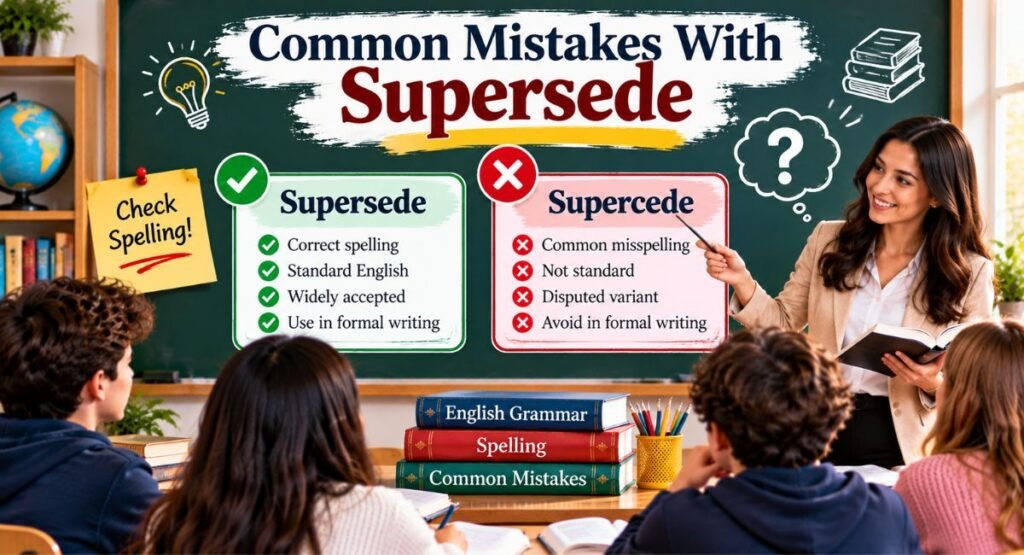
Writing Supercede by Analogy
The learner sees precede and concede and produces supercede.
Prefer:
supersede
The mistake is understandable, but knowing the Latin sedere connection makes the standard spelling easier to remember.
Writing Superceded or Superceding
Once the base word is misspelled, its other forms usually follow.
Standard forms are:
superseded
superseding
Using Supersede When You Mean Surpass
Wrong idea:
“The new player superseded the old scoring record.”
Better:
“The new player surpassed the old scoring record.”
A record is exceeded; it is not normally replaced in the same sense as a policy or specification.
Using Supersede for an Ordinary Swap
Stiff:
“I superseded my cracked mug with a new one.”
Natural:
“I replaced my cracked mug with a new one.”
The ability to use a more formal word does not make it the best choice.
Assuming Newer Automatically Means Superseding
A new document can exist without superseding an earlier one.
For example, a supplementary guideline may sit alongside an existing policy. Calling it a document that “supersedes” the policy would wrongly imply replacement.
That distinction matters in formal writing: use supersede only when the earlier item genuinely loses its former role or status.
When Supersede Is the Better Word
Choose supersede when all or most of these ideas are present:
- there is a clear earlier version;
- something newer takes its place;
- the change involves succession rather than a simple physical swap;
- the earlier version is no longer the one normally followed or used;
- the context is formal, technical, administrative, contractual, or procedural.
Choose replace when none of that extra meaning is needed.
That single distinction will improve your usage more than trying to insert supersede wherever a thesaurus suggests it.
Frequently Asked Questions?
Is it supersede or supercede?
Supersede is the standard spelling to use in contemporary edited English. Supercede is recorded by some dictionaries as a disputed spelling, so it is inaccurate to pretend the form has never existed. For ordinary academic, business, professional, and general writing, however, supersede is the appropriate choice.
What does supersede mean in simple English?
Supersede means to take the place of something that came before. It is especially useful when a newer rule, agreement, system, product, method, or version becomes the one now used or recognized. The word therefore often carries a stronger sense of succession than the general verb replace.
What is the past tense of supersede?
The past tense and past participle are both superseded. The third-person singular is supersedes, and the present participle is superseding. For example: “The old specification was superseded by a revised version.” These forms preserve the standard spelling of the base verb.
What is the difference between supersede and replace?
Replace is the broader word and works for almost any substitution, including physical objects. Supersede often suggests that a newer item becomes the successor to an earlier rule, version, system, or document. A battery is usually replaced; a revised technical standard may supersede the previous standard.
How can I remember how to spell supersede?
Remember that supersede is unusual: it ends in -sede, not -cede. Its history helps explain the spelling—the word ultimately comes from Latin supersedere, which contains sedere, “to sit.” That makes super + sede a more useful memory cue than comparing the word with precede..
Conclusion
The difficult part of supersede is not its definition. It is knowing why the spelling looks unusual and when the word says more than the simpler verb replace.
Use supersede when one thing takes over the role or status of something earlier: a revised policy supersedes an old policy, a new specification supersedes an earlier edition, or one system supersedes another. Use replace for ordinary substitutions where no special idea of succession is needed.
And when spelling the word, resist the pull of precede and concede. The standard form is supersede, with -sede.

One Comment