

Synchronise or Synchronize: Meaning & Difference
Synchronise or synchronize means to make two or more things operate according to the same timing, coordinate their actions, or keep their information consistent. Synchronize is the standard American English spelling. British English accepts both synchronise and synchronize, depending on editorial style. Both spellings are regular verbs with identical meanings.
What Does Synchronise or Synchronize Mean?
Imagine recording a video on your phone and editing its audio separately. When you combine them, the speaker’s lips should move at the same moments that the corresponding words are heard. If the sound arrives half a second late, the audio and video are out of sync.
Correcting that timing is an example of synchronisation.
The verb has three closely related uses:
- Matching timing: Making clocks, signals, or events follow a common time reference.
- Coordinating actions: Arranging movements or activities so they happen in a planned relationship.
- Keeping information consistent: Updating data between devices, applications, or systems.
These meanings share the idea of bringing separate things into a coordinated relationship. They do not, however, always require everything to happen at precisely the same moment.
For example, traffic lights may be synchronised to create a sequence of green signals along a road. They are coordinated, but they do not necessarily all turn green simultaneously.
Similarly, two phones can have synchronised calendars without continuously exchanging information every second.
Synchronise Meaning in Simple English
To synchronise means to make things work together at the right time or according to the same arrangement.
You might synchronise your watch with an official clock, your presentation slides with recorded narration, or your calendar with an online account.
The meaning becomes clearer when you ask: What exactly needs to match—time, movement, or information?
Synchronise or Synchronize Meaning in Urdu
There is no single Urdu translation that works equally well in every context. The best expression depends on what is being synchronised.
| English meaning | Urdu translation | Roman Urdu |
| Match timing | وقت ایک جیسا کرنا | Waqt aik jaisa karna |
| Make things simultaneous | ہم وقت کرنا | Hum waqt karna |
| Coordinate actions | ہم آہنگ کرنا | Hum aahang karna |
| Bring information into agreement | معلومات میں مطابقت پیدا کرنا | Maloomat mein mutabiqat paida karna |
Consider these examples.
English: Synchronize the clocks before the experiment.
Urdu: تجربے سے پہلے گھڑیوں کا وقت ایک جیسا کر لیں۔
English: The dancers synchronized their movements.
Urdu: رقاصوں نے اپنی حرکات میں ہم آہنگی پیدا کی۔
English: The application synchronizes files between devices.
Urdu: یہ ایپ مختلف ڈیوائسز کے درمیان فائلوں کو ہم آہنگ کرتی ہے۔
The first sentence concerns time, the second concerns movement, and the third concerns digital information. Translating all three mechanically as “make simultaneous” would lose important differences in meaning.
Synchronise vs. Synchronize: British and American Spelling
The difference between the two forms is spelling, not meaning.
Synchronize is the standard American English form. British English accepts both synchronise and synchronize, although preferences vary between dictionaries, publishers, and style guides.
| Feature | Synchronise | Synchronize |
| Spelling convention | Common British spelling | American standard; also British |
| Part of speech | Verb | Verb |
| Past tense | Synchronised | Synchronized |
| Present participle | Synchronising | Synchronizing |
| Related noun | Synchronisation | Synchronization |
| Meaning | Coordinate timing or information | Same meaning |
Why Is Synchronize Also Correct in British English?
Many learners are taught that British English uses -ise and American English uses -ize. That is a useful starting point, but it is not a universal rule.
Oxford spelling conventions prefer -ize in many verbs derived from Greek-related suffixes. As a result, synchronize is also a legitimate British English spelling.
This does not mean that every English word ending in -ise can be changed to -ize. Words such as advertise, advise, and surprise have their own established spelling patterns.
Which Spelling Should You Use?
For American readers, choose synchronize.
For British readers, follow the publication’s spelling convention. If it prefers organise and realise, synchronise will usually fit naturally. If it follows Oxford -ize conventions, synchronize may be preferred.
The important point is consistency within a document, not treating one accepted spelling as inherently superior.
How to Pronounce Synchronise and Synchronize
Both spellings have the same pronunciation. The word has three syllables, and the main stress falls on the first.
| Feature | Pronunciation |
| IPA | /ˈsɪŋ.krə.naɪz/ |
| Simple phonetics | SING-kruh-nyze |
| Syllable count | Three |
| Primary stress | First syllable |
The first syllable begins with the vowel sound heard in sit, followed by the nasal sound /ŋ/, as in sing. The middle syllable is short and unstressed. The final syllable contains the diphthong /aɪ/, as in eyes.
Why Does the First Syllable Sound Like “Sing”?
English spelling does not always reveal how consonants are pronounced together. In synchronize, the letter n before c represents a nasal sound that is commonly realised as /ŋ/ before the following /k/.
This is why pronouncing the beginning as though it contained a clearly separated /n/ sound can sound unnatural.
The spelling endings -ise and -ize do not change the pronunciation. Both finish with the voiced /z/ sound.
Synchronise Grammar: Verb Forms and Sentence Patterns
Synchronise and synchronize are regular verbs. Their past tense and past participle are formed with -d, because the base form already ends in e.
| Grammar form | British -ise form | -ize form |
| Base | Synchronise | Synchronize |
| Third-person singular | Synchronises | Synchronizes |
| Past simple | Synchronised | Synchronized |
| Past participle | Synchronised | Synchronized |
| Present participle | Synchronising | Synchronizing |
Unlike nouns, verbs are not classified as countable or uncountable. Instead, their grammatical behaviour includes tense, agreement, and whether they take an object.
Transitive Use: Synchronize Something
A transitive verb takes a direct object.
“The technician synchronized the clocks.”
Here, the clocks is the object receiving the action.
Other examples include:
- Synchronise the audio and video.
- Synchronize your contacts.
- Synchronise the traffic signals.
In each sentence, someone or something actively brings the objects into coordination.
Intransitive Use: Things Synchronize
The verb can also appear without a direct object.
“The two clocks synchronized automatically.”
“The dancers synchronized after several rehearsals.”
In these sentences, the subject undergoes or achieves synchronisation without a separate direct object.
Synchronize With, To, and Across
The preposition changes according to the relationship being expressed.
Synchronize with commonly identifies another system, object, or activity:
“The laptop synchronizes with the cloud account.”
Synchronize to can identify a reference signal, rhythm, or timing source:
“The lighting system synchronizes to the music.”
Synchronize across identifies multiple environments or locations:
“The software synchronizes settings across several devices.”
These are natural usage patterns, not rigid rules that make other constructions impossible.
Synchronise, Synchronous, and Synchronisation
These related words have different grammatical roles.
| Word | Part of speech | Meaning |
| Synchronise / synchronize | Verb | Bring things into coordination |
| Synchronised / synchronized | Adjective or verb form | Coordinated or brought into sync |
| Synchronisation / synchronization | Noun | The process or state of synchronising |
| Synchronous | Adjective | Happening at the same time or according to shared timing |
| Asynchronous | Adjective | Not requiring events or actions to happen at the same time |
The distinction between synchronous and asynchronous is particularly useful in education and computing.
A live online class is typically synchronous because students and the teacher participate at the same time. A recorded lesson that students watch whenever they choose is asynchronous.
However, asynchronous does not simply mean “badly synchronised.” It describes a different arrangement of timing or communication.
Synchronise or Synchronize Example Sentences
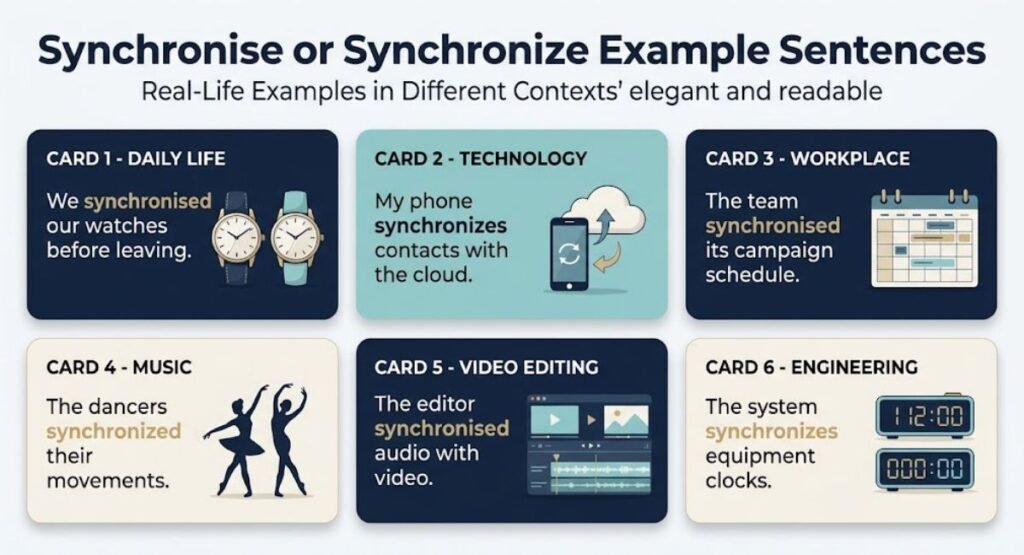
The following examples show how the verb behaves in real situations.
- Casual: We synchronized our watches before leaving for the hiking trail.
- Technology: My phone automatically synchronizes new contacts with my online account.
- Workplace: The marketing team synchronised its campaign schedule with the product launch.
- Music: The drummer helped the dancers synchronize their movements with the beat.
- Formal: The laboratory synchronized its measuring instruments before collecting data.
- Video editing: The editor adjusted the soundtrack to synchronise the dialogue with the actors’ lip movements.
- Education: The lecturer synchronised the slides with the recorded explanation.
- Travel: We agreed to synchronize our departure times so that both cars would arrive together.
- Software: The application failed to synchronize after the network connection dropped.
- Engineering: The control system uses a shared reference signal to synchronize the equipment.
Notice that these sentences do not all describe simultaneous events.
A video editor matches sound to images. A laboratory may align instrument clocks. A software application exchanges changes to maintain consistent information.
The core idea is coordination, but the practical operation differs.
Synchronise vs. Sync: Is There a Difference?
Sync is a shortened form of synchronise or synchronize. It is widely used in technology, where shorter labels are convenient.
A phone might display “Sync Now” instead of “Synchronize Now.” Both communicate essentially the same instruction.
In everyday conversation, “I need to sync my calendar” sounds natural. In formal technical documentation, the full verb may be preferable, particularly when precision and consistency matter.
The noun sync is also common in expressions such as out of sync, lip sync, and sync settings.
These expressions have become familiar enough that replacing every occurrence with the longer word would often sound unnatural.
Synonyms of Synchronise With Meaning Differences
Several verbs are related to synchronise, but they emphasise different relationships.
| Word | Nuance | Example |
| Coordinate | Organise actions to work effectively together | The departments coordinated their schedules. |
| Align | Bring positions, goals, or arrangements into agreement | The manager aligned the team’s priorities. |
| Match | Make things correspond | Match the soundtrack to the video. |
| Harmonise | Make separate elements work together smoothly | The teams harmonised their procedures. |
| Integrate | Combine components into a connected system | The developer integrated two applications. |
| Time | Arrange something for a particular moment | She timed the slides to the narration. |
| Sync | Shorter, often informal form of synchronise | Sync your files before travelling. |
Synchronise vs. Coordinate
Two teams can coordinate a project by dividing responsibilities, even if they work at different times.
Synchronising their activities suggests a stronger requirement for matching schedules, sequences, or shared information.
Use coordinate for general organisation and synchronise when timing or consistency is central.
Synchronise vs. Align
Align often refers to bringing goals, positions, or plans into agreement.
For example, a manager might align a team’s objectives with company priorities.
Synchronising a team’s activities is more likely to involve matching deadlines, workflows, or timing.
Synchronise vs. Integrate
Integrate means combining systems or components so they work as part of a larger whole.
Two software applications can be integrated without keeping all their data synchronised. Integration may enable communication, while synchronisation is a process that maintains an intended relationship between data or operations.
This distinction matters when describing software features accurately.
Antonyms of Synchronise and Synchronize
The most direct opposite is desynchronise or desynchronize, meaning to lose or disrupt synchronisation.
Other words express related contrasts but are not exact substitutes.
| Word | Difference | Example |
| Desynchronise | Lose coordinated timing or state | The signals desynchronised after the timing error. |
| Misalign | Move out of correct alignment | The subtitles became misaligned with the dialogue. |
| Disconnect | Break a connection | The laptop disconnected from the network. |
| Disrupt | Interrupt an organised process | The power failure disrupted the recording. |
| Separate | Keep things apart | The editor separated the audio and video tracks. |
A useful technical distinction is that disconnected does not necessarily mean desynchronised.
Two devices can hold identical data after their connection is lost. They may become out of sync later if one copy changes without the other receiving the update.
Synchronise Word Origin and Etymology
The word belongs to a family that includes synchronous, synchronism, and synchronisation.
Its underlying elements come from Greek: syn- conveys the idea of togetherness, and chronos means time.
These elements explain why the word originally centres on a relationship between events and time.
The modern verb also developed broader applications in engineering, communication, computing, and digital information systems.
The exact historical route and earliest recorded dates for the competing English spellings require specialist dictionary evidence; they should not be attributed to a particular spelling reformer without documentation.
Common Synchronise or Synchronize Mistakes
Mistake 1: Thinking Synchronize Is Wrong in British English
British English accepts both spellings. Some publishers prefer synchronise, while others follow -ize conventions.
The correct choice depends on the intended editorial standard.
Mistake 2: Using Synchronise When Coordinate Is Better
“The manager synchronised the employees’ responsibilities” is possible in a specialised context, but it may sound unnecessarily technical.
“The manager coordinated the employees’ responsibilities” is clearer if the sentence simply means that duties were organised.
Synchronise is most useful when timing, sequence, or consistency matters.
Mistake 3: Using the Wrong Preposition
Less natural: “Synchronize your phone to your laptop” when referring generally to keeping their information consistent.
More natural: “Synchronize your phone with your laptop.”
However, to is appropriate when referring to a timing source:
“Synchronize the lights to the music.”
Mistake 4: Assuming Synchronisation Is Always Instant
A cloud service may synchronise information immediately, periodically, or only when a device reconnects.
The word does not, by itself, promise real-time updates.
A precise product description should explain the actual behaviour rather than simply saying that everything “automatically syncs.”
Mistake 5: Confusing Synchronisation With Backup
Synchronisation and backup solve different problems.
Synchronisation aims to maintain a desired relationship between copies of information. Depending on the service, deleting a file in one location may cause that deletion to be reflected elsewhere.
A backup is intended to preserve information so it can be recovered later.
A service may offer both functions, but synchronisation alone should not be assumed to provide independent, recoverable backups.
Synchronisation in Technology: Three Distinct Uses
The technical meaning becomes easier to understand when divided into three cases.
Clock Synchronisation
Two computers may need their clocks to agree closely enough for logging, security, or distributed operations.
Clock synchronisation attempts to maintain a shared time reference within an acceptable level of accuracy.
This does not mean their clocks are guaranteed to be perfectly identical at every instant.
File Synchronisation
A file synchronisation service exchanges changes between locations to maintain a desired consistent state.
If you edit a document on your laptop, the updated version may later appear on your phone.
The exact result depends on the service’s rules for connectivity, conflicts, deletions, and version history.
Audio and Video Synchronisation
Audio and video synchronisation concerns the timing relationship between sound and images.
If speech is heard noticeably before or after the corresponding lip movements, the recording appears out of sync.
Fixing that relationship may involve shifting an audio track or correcting timing information.
These three examples explain why the same verb appears in computing, media production, and engineering without always describing the same technical operation.
Synchronise or Synchronize Practice Questions
Check your understanding.
1. Which spelling is standard in American English? Synchronize.
2. Is synchronise incorrect in British English? No. It is a common accepted spelling.
3. Which preposition is natural in “Synchronize your calendar ___ your phone”? With.
4. What is the past tense of synchronise? Synchronised.
5. Does synchronising files automatically guarantee a recoverable backup? No. Synchronisation and backup are different functions.
Conclusion
Synchronise and synchronize are two accepted spellings of the same verb. The American standard is synchronize, while British English accepts both forms according to editorial convention.
The word can describe matching clocks, coordinating movements, aligning audio with video, or maintaining consistent information between devices. These uses share a common idea, but they are not technically identical.
For accurate English, choose the appropriate spelling, use the correct grammatical construction, and pay attention to what is actually being synchronised.
Frequently Asked Questions
Is synchronise or synchronize correct?
Both synchronise and synchronize are correct English spellings. Synchronize is the standard American English form, while synchronise is common in British English. However, synchronize is also accepted in British English, particularly under Oxford spelling conventions. Choose the spelling that matches your audience or publication style and use it consistently.
What does synchronise mean in simple English?
Synchronise means to make two or more things work together according to the same timing, sequence, or pattern. It can describe matching clocks, coordinating dancers’ movements, or keeping information consistent between devices. The precise meaning depends on whether the situation involves time, coordinated activities, or digital data.
What is the difference between synchronise and synchronize?
The difference between synchronise and synchronize is spelling, not meaning. Synchronise uses the -ise ending commonly found in British English, while synchronize uses the -ize ending standard in American English and also accepted in British English. Both are regular verbs with identical meanings, grammatical functions, and accepted pronunciations.
How do you pronounce synchronise and synchronize?
Both spellings share the same pronunciation. A common IPA transcription is /ˈsɪŋ.krə.naɪz/, approximately “SING-kruh-nyze.” The word has three syllables, with primary stress on the first. The final syllable rhymes approximately with “eyes.” Regional accents may affect individual sounds, but the spelling difference does not determine pronunciation.
What is the Urdu meaning of synchronize?
Synchronize can mean ہم وقت کرنا, ہم آہنگ کرنا, or مطابقت پیدا کرنا in Urdu, depending on context. The first expression refers to matching timing, the second to coordinating activities, and the third to creating consistency or agreement. In technology, synchronize commonly describes keeping information consistent across connected devices or systems.





One Comment