
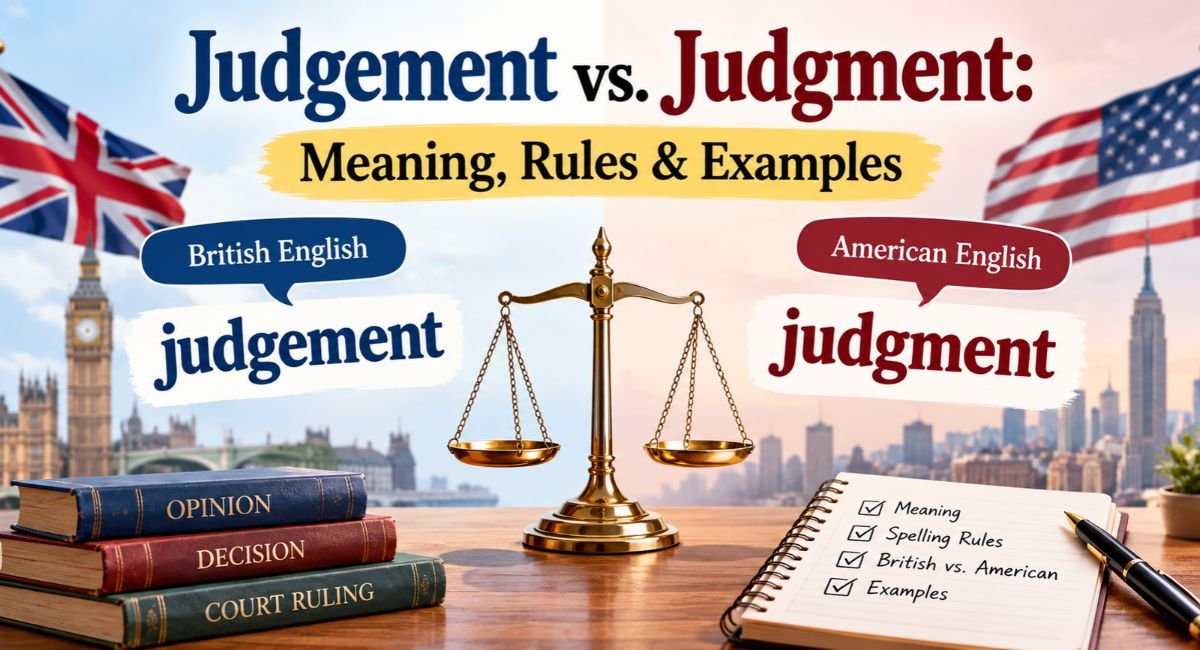
Judgement vs. Judgment: Meaning, Rules & Examples
Judgement vs. Judgment is mainly a difference in spelling, not meaning. Both words can describe an opinion, the ability to make sensible decisions, or a court ruling. Judgment is standard in American English, while judgement is common in British English. British legal writing generally uses judgment. Both spellings sound exactly the same.
Judgement vs. Judgment Meaning in Urdu
If you have seen both judgement and judgment in English books, websites, or legal documents, you might wonder whether they mean different things. They don’t. The spelling changes according to regional and editorial conventions, but the underlying meaning stays the same.
In Urdu, judgement and judgment can mean فیصلہ (decision), رائے (opinion), or اندازہ (assessment). When discussing someone’s ability to make wise decisions, the phrase فیصلہ کرنے کی صلاحیت expresses the meaning more accurately.
| English expression | Urdu meaning |
| Judgement / Judgment | فیصلہ، رائے، اندازہ |
| Good judgement | اچھے فیصلے کرنے کی صلاحیت |
| Poor judgement | ناقص فیصلہ کرنے کی صلاحیت |
| Sound judgment | سمجھداری سے فیصلہ کرنے کی صلاحیت |
| Personal judgment | ذاتی رائے یا فیصلہ |
| Court judgment | عدالتی فیصلہ |
| Judgment of character | کسی کے کردار کے بارے میں رائے |
Consider two sentences:
“She has good judgement.”
This means she can evaluate situations and make sensible decisions. A natural Urdu translation is “وہ اچھے فیصلے کرنے کی صلاحیت رکھتی ہے۔”
“The court delivered its judgment.”
Here, judgment means a court’s formal decision. The Urdu translation is “عدالت نے اپنا فیصلہ سنایا۔”
Notice that the first sentence describes an ability, while the second describes a particular decision. Using the same Urdu translation for both would lose that distinction.
What Does Judgement Mean in English?
Judgement is a noun with three common meanings: an opinion formed about something, the ability to make decisions, and a formal decision made by an authority. These meanings are connected because they all involve evaluating information or reaching a conclusion.
The word doesn’t necessarily suggest that someone has made the right choice. A judgement can be sensible, unfair, rushed, or completely mistaken. That is why English speakers use expressions such as good judgement, poor judgement, and an error of judgement.
Judgement as an Opinion
When judgement means an opinion, it describes what someone concludes after considering a person or situation.
Imagine a teacher who reads a student’s assignments before deciding whether additional support is needed. The teacher’s judgement is an assessment based on the work.
The same meaning appears in the sentence, “I won’t make a judgement about the restaurant until I’ve tried its food.”
Here, the speaker wants more information before forming an opinion.
Judgement as Decision-Making Ability
Judgement can also describe a person’s ability to recognise what is sensible or appropriate.
A driver who slows down during heavy rain demonstrates good judgement. Someone who ignores a warning and enters a dangerous area may be showing poor judgement.
In these examples, the noun describes the quality of decision-making rather than one isolated decision.
Judgement as a Legal Decision
In legal contexts, judgment can refer to a formal court decision. The precise legal meaning depends on the jurisdiction and the type of proceedings.
For example, a court might issue a written judgment explaining its reasoning. This is different from a person’s informal opinion because it forms part of a legal process.
Although judgement is familiar in general British writing, the shorter spelling judgment is the established convention for many British judicial decisions.
Judgment vs. Judgement: British and American English
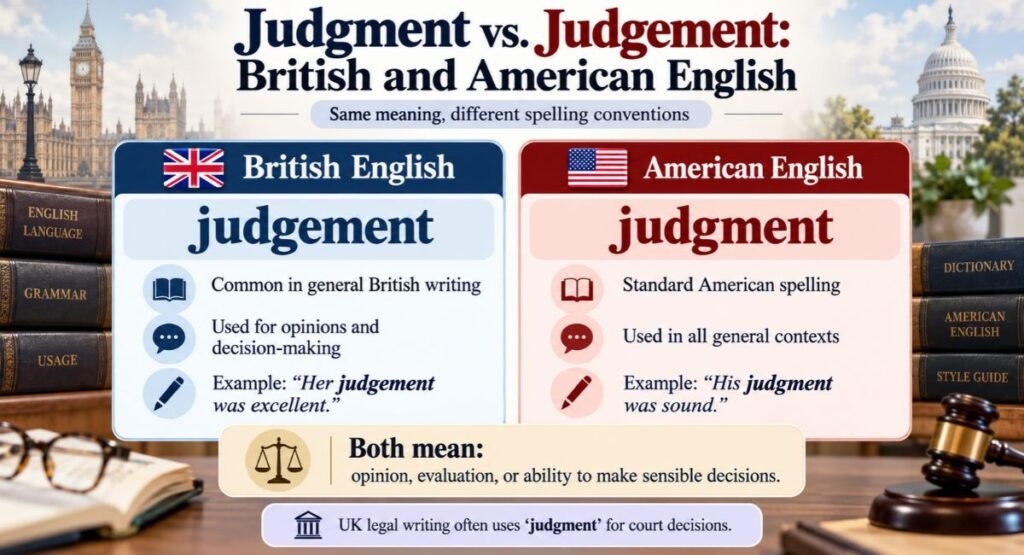
The distinction becomes easier once you stop looking for a difference in meaning and focus on spelling conventions instead.
American English normally uses judgment. British English commonly uses judgement in everyday writing, but judgment is also accepted, particularly in legal contexts.
| Feature | Judgement | Judgment |
| Meaning | Opinion, ability or decision | Same |
| Part of speech | Noun | Noun |
| American English | Less usual | Standard |
| British English | Common in general writing | Also accepted |
| British legal writing | Less usual for court decisions | Established convention |
| Pronunciation | JUJ-muhnt | JUJ-muhnt |
| Plural | Judgements | Judgments |
Which Spelling Is Correct in British English?
In general British English, judgement is a familiar choice.
For example:
“Her judgement helped the team avoid a costly mistake.”
“The manager questioned his own judgement after the meeting.”
However, judgment is not incorrect in British English. Some publications use it consistently, and it is particularly associated with legal writing.
Rather than treating one spelling as universally right, follow the convention expected by your intended audience.
Which Spelling Is Correct in American English?
Judgment is the standard spelling in American English.
You would normally write:
“The supervisor demonstrated excellent judgment.”
“The court issued its final judgment.”
American editors generally prefer the shorter spelling in both examples. The longer version would still be understandable, but it would not follow the usual American convention.
Why Does British Legal English Use Judgment?
British legal writing has an established tradition of using judgment for formal court decisions.
You may therefore encounter expressions such as court judgment, written judgment, and reserved judgment in British legal materials.
One important point: judgment and sentence are not necessarily the same thing. In criminal proceedings, a judgment or verdict may address the outcome or legal findings, while a sentence concerns the punishment imposed following conviction. The exact terminology depends on the legal system.
What About Canadian and Australian English?
Canadian English often favours judgment, while Australian general writing commonly uses judgement. Both varieties can show differences between dictionaries, publishers, and professional contexts.
These are broad usage preferences, not rules that apply to every publication. For academic, legal, or professional work, the relevant style guide should determine your spelling.
Judgement vs. Judgment Pronunciation
Both words have exactly the same standard dictionary pronunciation. The extra “e” in judgement is not pronounced, and it does not create another syllable.
- Simple phonetics: JUJ-muhnt
- British IPA: /ˈdʒʌdʒ.mənt/
- American IPA: /ˈdʒʌdʒ.mənt/
- Syllables: Two
- Stress: First syllable
The first syllable sounds like the word judge. The second syllable is weaker, with the relaxed vowel sound represented by /ə/ in IPA.
Common Pronunciation Mistakes
Some learners attempt to pronounce every written letter or give the second syllable too much emphasis.
The correct pronunciation has two syllables, not three. Whether a sentence uses judgement or judgment, the spoken form remains the same.
Judgement and Judgment Grammar Rules
Judgement and judgment are nouns. Their related verb is judge, and the grammatical difference matters when constructing sentences.
For example, “She judged the situation carefully” uses a verb. “Her judgment was accurate” uses a noun.
Is Judgment a Noun or a Verb?
Judgment is a noun, not a standard English verb. Use judge when describing the action of forming an opinion or evaluating something.
| Form | Word | Example |
| Base verb | Judge | Don’t judge too quickly. |
| Present singular | Judges | She judges the competition. |
| Past tense | Judged | They judged the entries yesterday. |
| Present participle | Judging | He is judging the finalists. |
| Past participle | Judged | The applications were judged fairly. |
| Noun | Judgment | His judgment was reasonable. |
Incorrect: “The teacher judgment the student.”
Correct: “The teacher judged the student.”
The suffix -ment helps form the noun, but it does not turn judgment into another verb form.
Countable and Uncountable Uses
When judgment refers to general decision-making ability, it is usually uncountable.
“Good judgment comes with experience.”
“She showed poor judgment during the meeting.”
In these examples, the noun describes a quality rather than a particular decision.
When it refers to individual opinions or decisions, judgment can be countable.
“The committee made several judgments.”
“The judge delivered two separate judgments.”
The plurals are judgments and judgements, depending on the spelling convention.
Prepositions Commonly Used with Judgment
Judgment appears with several prepositions, and each combination has a particular use.
| Expression | Example |
| Judgment about | She made a judgment about the proposal. |
| Judgment on | We should reserve judgment on the issue. |
| Judgment of | His judgment of the situation was accurate. |
| In my judgment | In my judgment, the plan is too expensive. |
| Pass judgment on | Don’t pass judgment on someone without knowing the facts. |
| Judgment against | The court entered judgment against the defendant. |
The expression pass judgment on someone often describes evaluating or criticising a person’s behaviour.
Meanwhile, reserve judgment means delaying an opinion until more information is available.
These expressions are worth learning as complete phrases because their prepositions are not freely interchangeable.
Common Expressions with Judgement and Judgment
Some of the most useful forms of this noun appear in fixed expressions. Their meanings are not always obvious from a direct translation.
Against My Better Judgement
This expression means doing something even though you believe it may be a bad idea.
“Against my better judgement, I lent him my laptop again.”
The speaker suspected the decision was unwise but made it anyway.
A Judgment Call
A judgment call is a decision that depends on personal evaluation, especially when there is no clear rule or perfect answer.
“Whether to postpone the outdoor event is a judgment call.”
This expression is particularly useful in business, sports, and everyday decision-making.
Reserve Judgment
To reserve judgment means to wait before expressing a final opinion.
“I’ll reserve judgment until I’ve heard both sides of the argument.”
It is often used when someone wants to avoid reaching a conclusion too early.
Pass Judgment on Someone
This expression means forming or expressing an opinion about another person, sometimes in a critical way.
“It’s easy to pass judgment on people without understanding their circumstances.”
It can carry a negative tone when the opinion is unfair or overly critical.
Judgmental vs. Good Judgment
These expressions illustrate an important difference that simple spelling guides often overlook.
Someone with good judgment makes sensible decisions. Someone described as judgmental is often too willing to criticise other people’s behaviour or choices.
For example:
“She’s good at making difficult decisions because she has sound judgment.”
“He’s judgmental about how other people spend their money.”
The second sentence does not praise someone’s decision-making ability. It criticises their attitude towards others.
Judgement vs. Judgment Example Sentences
The following original sentences show how the noun works in everyday conversation, professional writing, academic discussion, and legal contexts.
Everyday Conversation
“I trust your judgement when choosing a new flat.”
The speaker believes the other person can make a sensible choice.
“Against my better judgement, I bought the expensive headphones.”
The speaker made a purchase despite thinking it might be unwise.
Workplace Communication
“The manager exercised sound judgment when handling the complaint.”
This describes careful professional decision-making.
“We should reserve judgment until the investigation is complete.”
The speaker recommends waiting for additional information before forming an opinion.
Academic Writing
“Researchers must use sound judgment when interpreting incomplete data.”
This refers to careful evaluation when evidence is limited.
“The students were asked to explain the reasons behind their judgments.”
Here, judgments refers to several individual conclusions.
Legal Writing
“The court delivered its judgment after considering the evidence.”
The noun refers to a formal judicial decision.
“The written judgment explained why the application was refused.”
The sentence refers to a court document describing the decision.
Personal Relationships
“Her judgment of his character changed after she learned the truth.”
This describes a revised personal evaluation.
“He tends to pass judgment on people before hearing their explanations.”
The phrase suggests that he forms opinions too quickly.
Synonyms of Judgment and Their Subtle Differences
Judgment has several synonyms, but choosing one depends on the meaning you want to express. A legal judgment, a personal opinion, and the ability to make sensible choices are related ideas, yet they cannot always be described using the same alternative word.
Judgment vs. Opinion
Opinion refers to someone’s belief or viewpoint. Judgment can suggest an evaluation based on information or reasoning, though it may still be subjective.
Example: “My opinion is that the film was entertaining.”
Compare: “My judgment is that the proposal carries unnecessary financial risk.”
Judgment vs. Decision
Decision refers to a choice or conclusion. Judgment often places greater emphasis on the reasoning or evaluation involved.
Example: “She decided to cancel the event.”
Compare: “She showed good judgment by cancelling the event.”
Judgment vs. Verdict
Verdict is commonly used for a jury’s formal finding. Judgment has broader applications and can refer to judicial rulings as well as ordinary evaluations.
Example: “The jury returned a guilty verdict.”
Compare: “The judge issued a written judgment.”
Judgment vs. Assessment
Assessment usually involves examining something against information or criteria. Judgment can be broader and may rely on experience or interpretation.
Example: “The teacher completed an assessment of the student’s reading skills.”
Compare: “The teacher used professional judgment to recommend additional support.”
Judgment vs. Discernment
Discernment focuses on recognising subtle differences and important details. Good judgment involves using understanding to evaluate situations and make sensible decisions.
Example: “The designer showed discernment when examining the quality of the fabric.”
Compare: “The designer used good judgment when choosing a material within the budget.”
Judgment vs. Wisdom
Wisdom suggests deeper understanding gained through learning, experience, and reflection. Judgment can refer to applying understanding in a particular situation.
Example: “Her wisdom came from years of experience.”
Compare: “Her judgment helped resolve the immediate problem.”
Antonyms of Good Judgment
There is no single antonym that works for every meaning of judgment. When the noun describes sensible decision-making, several expressions can communicate the opposite.
| Word or expression | Difference in meaning |
| Poor judgment | Making unsuitable or unwise decisions |
| Foolishness | Acting without sensible thought |
| Recklessness | Ignoring significant risks or dangers |
| Impulsiveness | Acting before considering the consequences |
| Indiscretion | Failing to exercise appropriate discretion |
| Indecision | Being unable to make a choice |
For example, “His recklessness put other drivers at risk” describes dangerous behaviour, while “Her impulsiveness led to unnecessary spending” focuses on acting too quickly.
Indecision is not a strict antonym of judgment. Someone may hesitate because they are carefully considering the available options rather than because they lack good judgment.
Origin and History of Judgment
The English word judgment developed from the Old French word jugement, which was associated with legal decisions and judging. The related French verb jugier meant to judge.
These forms are connected to Latin iudicare, meaning to judge or examine officially. English records show forms of the noun from the thirteenth century, including legal and decision-making senses.
Over time, the word also became associated with opinions, evaluations, and discernment.
Why Do Both Spellings Exist?
The difference between judgment and judgement developed through historical spelling variation. English spelling was not always standardised, and different forms survived as dictionaries and editorial conventions developed.
The spelling judgment did not originate as a recent American invention. Historical English forms already included variation, and the shorter spelling became standard in American English while remaining in use in British English.
Today, the difference is primarily regional and editorial rather than semantic.
Common Mistakes with Judgment and Judgement
Most mistakes involving these words fall into three categories: spelling conventions, grammar, and confusion with related expressions.
Mistake: Thinking Judgement Is Incorrect
Both forms are established spellings. Judgment is standard in American English, while judgement is common in general British usage.
The correct choice depends on the intended audience and style.
Mistake: Using Judgment as a Verb
Incorrect: “She judgment the situation.”
Correct: “She judged the situation.”
Use judge or judged when describing the action.
Mistake: Using an Article with Uncountable Judgment
Awkward: “She has a good judgement when solving problems.”
Natural: “She has good judgement when solving problems.”
When referring to someone’s general decision-making ability, judgment is usually uncountable.
Mistake: Confusing Judgment with Decision
Awkward: “My judgment is to leave at six.”
Natural: “My decision is to leave at six.”
Decision is often clearer when describing a specific choice. Judgment can describe the evaluation behind that choice.
Mistake: Mixing Spellings Without a Reason
Inconsistent British general writing:
“The manager showed good judgement, but his judgment was later questioned.”
More consistent:
“The manager showed good judgement, but his judgement was later questioned.”
There can be legitimate exceptions, particularly when specialist legal terminology is involved. Otherwise, use the same spelling throughout a document.
Mistake: Treating Judgmental as a Compliment
Incorrect assumption: “He’s judgmental” means “He makes good decisions.”
Actual meaning: Judgmental often describes someone who criticises other people too readily.
To compliment someone’s decision-making ability, say “He has good judgment” or “He shows sound judgment.”
How to Remember Judgement vs. Judgment
The simplest memory rule is to associate judgment without the extra “e” with standard American English.
For general British writing, judgement with the additional “e” is common. British legal writing often uses judgment, so the rule has an important exception.
Before choosing a spelling, consider your audience, the type of document, and any relevant style guide. These factors matter more than trying to identify a difference in meaning.
Conclusion
Judgement and judgment are two spellings of the same English noun. Both can refer to an opinion, a formal decision, or someone’s ability to evaluate situations and make sensible choices.
Judgment is the standard American spelling, while judgement is common in general British writing. British legal usage often favours judgment. The pronunciation, basic grammar, and meanings remain the same.
The most useful lesson goes beyond spelling: good judgment is an ability, a judgment can be an individual conclusion, and being judgmental is not the same as making sensible decisions. Understanding these distinctions will help you use the word naturally and accurately.
Frequently Asked Questions
Is It Judgement or Judgment in British English?
Both judgement and judgment are accepted in British English. Judgement is common in everyday British writing, especially when discussing opinions or decision-making ability. However, judgment is also correct and is particularly established in British legal writing. The appropriate spelling depends on the context and the publication’s style guide.
Is Judgment the Correct American Spelling?
Yes, judgment is the standard spelling in American English. It refers to an opinion, the ability to make sensible decisions, or a formal court ruling. Although Americans can understand the alternative spelling judgement, it is less common in edited American writing. Use judgment consistently when preparing content for a US audience.
Why Is Judgment Used in UK Legal Documents?
Judgment is an established spelling convention in British legal writing, especially when referring to formal court decisions. A judge may deliver a judgment or reserve judgment until a later date. The spelling does not introduce a separate legal meaning. Writers should follow the terminology and style requirements of the relevant court.
Do Judgement and Judgment Mean the Same Thing?
Yes, judgement and judgment have the same meanings. Both are nouns that can describe an opinion, an evaluation, decision-making ability, or an official legal ruling. Their pronunciation is also identical. The main difference is spelling preference: judgment is standard in American English, while judgement is common in general British writing.
How Do You Pronounce Judgement and Judgment?
Both judgement and judgment are pronounced the same way: JUJ-muhnt. The IPA transcription is /ˈdʒʌdʒ.mənt/. Each word contains two syllables, with stress on the first syllable. The extra letter “e” in judgement does not add another sound. The standard British and American dictionary pronunciations are the same.




One Comment