
Math or Maths: Which Is Correct? UK vs US Guide
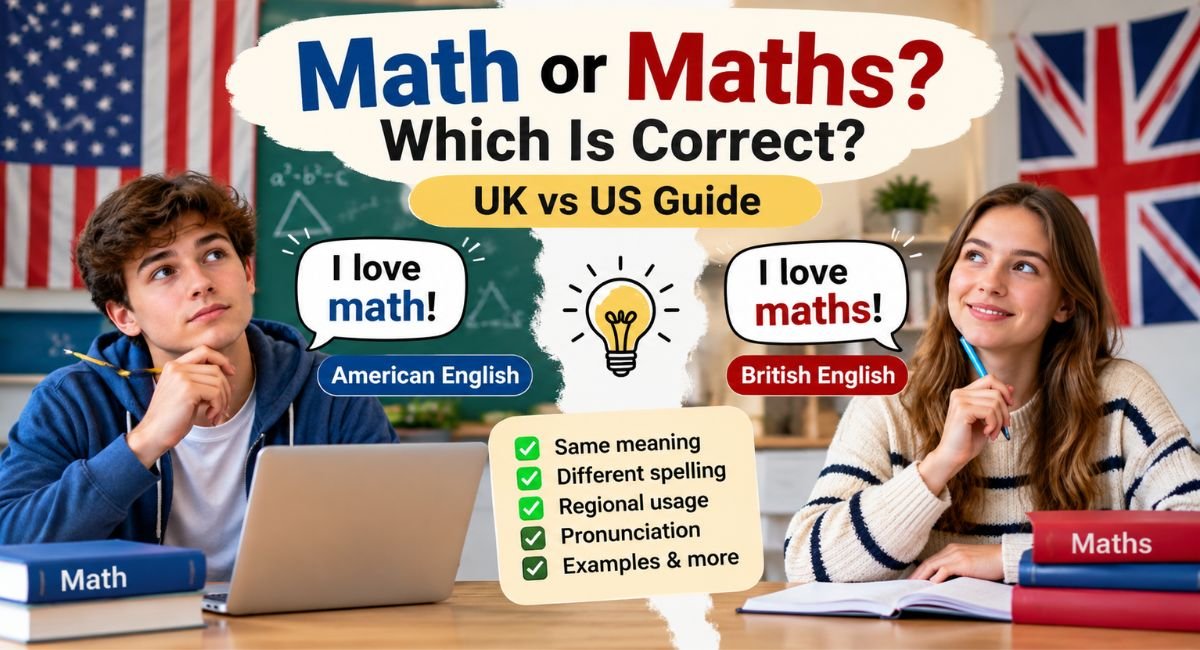
Both math and maths are correct shortened forms of mathematics, the study of numbers, shapes, patterns, and relationships. Math is standard in American English, while maths is standard in British English. They mean the same thing. The best choice depends on which variety of English you are using.
Should you write “math homework” or “maths homework”? The question of math or maths – which one to use? can be confusing when American websites, British textbooks and international schools use different words for the same subject.
The distinction is simpler than it first appears. Both forms are recognised English, and neither describes a different branch of mathematics. The important differences concern regional preference, pronunciation, and the way these words fit into sentences.
Math vs Maths: What Is the Difference?
The difference between math and maths is mainly geographical. American English normally uses math, whereas British English normally uses maths. Both are abbreviations of mathematics and refer to the same subject.
For example, an American student might say, “I’m studying math tonight.” A British student would more naturally say, “I’m studying maths tonight.” The activity is identical; only the regional wording changes.
Cambridge Dictionary recognises math as an American English noun and maths as the corresponding British English noun.
Math vs Maths Comparison Table
| Feature | Math | Maths |
| Meaning | Mathematics | Mathematics |
| Main variety | American English | British English |
| Pronunciation | /mæθ/ | /mæθs/ |
| Part of speech | Noun | Noun |
| Countability as a subject | Uncountable | Uncountable |
| Normal verb agreement | Math is | Maths is |
| Example | I enjoy math. | I enjoy maths. |
| Full form | Mathematics | Mathematics |
Neither spelling is inherently more correct or more formal. The appropriate choice depends on your readers, your location,n and the style conventions you are following.
What Does Math Mean in American English?
In American English, math is the ordinary shortened form of mathematics. The word describes a field of study involving numbers, space, patterns, quantities, and logical relationships.
American schools commonly use expressions such as math class, math teacher, and math homework. The word also appears outside education, especially when discussing money, measurements, or numerical decisions.
Consider this sentence:
“I checked the math before agreeing to the payment plan.”
Here, math refers to the relevant calculations rather than a lesson at school. This practical meaning is useful in conversations about budgets, prices, and financial choices.
What Does “Do the Math” Mean?
The expression do the math can mean working out actual figures or thinking carefully about the facts before concluding.
For example:
“The subscription costs £15 a month. Do the math before deciding whether the annual plan saves you money.”
In everyday conversation, the expression can also suggest that the conclusion should become obvious after considering the available information.
This is more specific than simply defining maths as a school subject and helps explain why the phrase appears in advertising, business discussions and casual speech.
What Does Maths Mean in British English?
Maths is the usual British English shortening of mathematics. It refers to the same subject and is commonly used in schools, colleges, universities and ordinary conversation.
A British student might say:
“Maths was my favourite subject at secondary school.”
The word appears in familiar combinations such as maths lesson, maths teacher, maths exam and maths homework. These phrases are standard British usage, not spelling mistakes.
Why Does Maths Have an S?
The final “s” is part of the established British shortened form of mathematics. It does not mean that maths refers to several separate subjects.
This is an important distinction because English nouns ending in “s” are not necessarily plural. For example, physics and mathematics also normally take singular verbs when referring to academic disciplines.
Compare:
“Maths is useful in everyday life.”
“Physics is another subject I enjoy.”
Both sentences use singular verb agreement.
Math or Maths in British, American and Other English Varieties
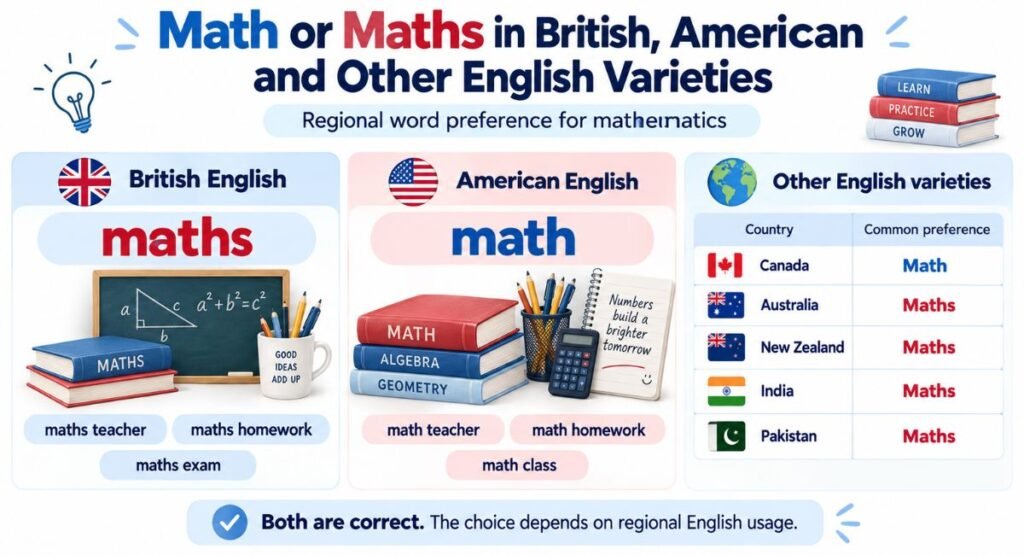
The United States and the United Kingdom are the clearest examples of the difference, but their conventions also influence English usage elsewhere.
| Country | Usual school-subject term |
| United States | Math |
| United Kingdom | Maths |
| Canada | Math |
| Australia | Maths |
| New Zealand | Maths |
| India | Maths |
| Pakistan | Maths |
These are general regional preferences, not rules followed by every person or institution. International schools and publications may adopt American or British terminology depending on their curriculum or editorial style.
For instance, an institution offering a qualification titled Mathematics should retain that official name rather than automatically replacing it with a regional abbreviation.
How to Pronounce Math and Maths
The pronunciations are closely related, but the British form includes an additional consonant at the end.
Math
American English
/mæθ/
One syllable
Maths
British English
/mæθs/
One syllable
The /æ/ vowel is similar to the vowel in cat. The /θ/ represents the unvoiced “th” sound in think. Maths adds /s/ immediately afterwards.
To pronounce math, place the tip of your tongue gently between your teeth for the final “th” sound. Air should pass through without vibration from your vocal cords.
To pronounce maths, begin the same way, then move directly into the final “s”. Do not insert an extra vowel between the consonants.
This final /θs/ combination is the main challenge for learners. The difference is not an additional syllable; it is simply one additional consonant sound. The dictionary pronunciations confirm this distinction.
Math or Maths Grammar: Singular, Plural and Uncountable Nouns
Both math and maths are nouns. When they name the academic subject, they are uncountable and normally take singular verb agreement.
Is Maths Singular or Plural?
As a school subject, maths is grammatically singular.
Correct: “Maths is an important subject.”
Incorrect: “Maths are an important subject.”
The spelling can be misleading because maths ends in “s”. However, the final letter is not an ordinary plural marker in this usage.
There is a useful exception: when maths means numerical calculations rather than the academic subject, British English may allow singular or plural agreement.
For example:
“If my maths is right, we can finish the project within budget.”
“If my maths are right, we can finish the project within budget.”
Oxford Learner’s Dictionaries recognises both forms in this calculation-related sense.
Are Math and Maths Countable?
Not normally when referring to the school subject. You would say “I study maths”, not “I study a maths”.
However, you can count individual mathematical problems, lessons, or calculations.
Correct: “I solved three maths problems.”
Incorrect for that meaning: “I solved three maths.”
The noun problems identifies what is being counted, while maths describes the type of problem.
Do Math and Maths Have Verb Forms?
Neither is normally used as a verb in standard educational English.
You would say “I study maths”, “I teach math” or “I solve mathematical problems”. Informal playful uses of math as a verb exist, but learners should not treat them as a replacement for ordinary verbs such as calculate or study.
Common Prepositions with Math and Maths
| Expression | Correct example |
| Good at maths | She’s good at maths. |
| Interested in math | He’s interested in math. |
| Help with maths | I need help with maths. |
| Struggle with math | Some students struggle with math. |
| Degree in mathematics | She has a degree in mathematics. |
| Apply maths to a problem | We can apply maths to the problem. |
These prepositions depend on the complete expression rather than on math or maths alone.
Math vs Maths: Examples in Real-Life Sentences
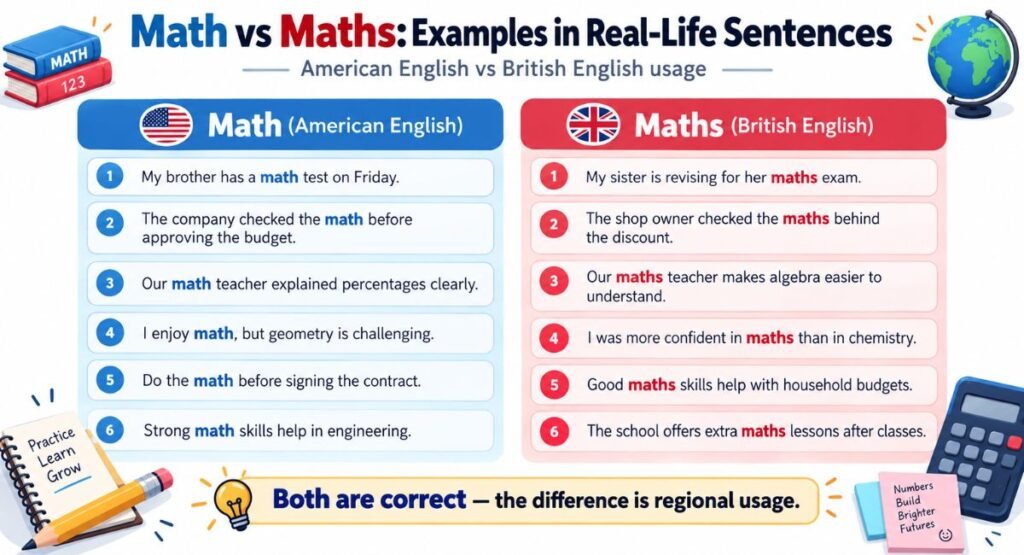
The following examples demonstrate how people use the two forms across everyday, academic, and professional situations.
Six American English Examples Using Math
- “My brother has a math test on Friday.”
- “The company checked the math before approving the new budget.”
- “Our math teacher explained percentages using shopping discounts.”
- “I enjoy math, but I sometimes find geometry difficult.”
- “You should do the math before signing a long-term contract.”
- “The engineering programme requires strong math skills.”
The first and fourth sentences describe mathematics as a subject. The second and fifth involve practical calculations or reasoning, while the others relate to educational skills and teaching.
Six British English Examples Using Maths
- “My sister is revising for her maths exam.”
- “The shop owner checked the maths behind the discount.”
- “Our maths teacher makes algebra easier to understand.”
- “I was more confident in maths than in chemistry.”
- “Good maths skills can help when planning a household budget.”
- “The school offers extra maths lessons after classes.”
The second sentence is especially useful because it demonstrates how maths can refer to calculations outside the classroom.
Math, Maths and Mathematics: Which Should You Use?
The full word mathematics works in both American and British English. Its shorter forms are tied more closely to regional conventions.
When to Use Math
Choose math when writing for an American audience or following American editorial conventions.
Examples include US school materials, educational websites and everyday discussions about calculations.
When to Use Maths
Choose maths for British English writing, especially when discussing education, examinations and mathematical skills.
For a UK-focused article, phrases such as maths revision and maths lessons will usually feel more natural than their American equivalents.
When to Use Mathematics
The full word is often useful in formal academic contexts and international communications.
For example, “Bachelor of Science in Mathematics” is an appropriate course title when that is the institution’s official wording.
However, math and maths are not automatically unprofessional. Both appear in educational and professional writing.
Maths vs Arithmetic, Numeracy and Calculation
Several related words are often confused with mathematics, but they refer to different concepts.
| Word | Meaning and difference |
| Mathematics | The complete academic discipline |
| Math | American shortened form of mathematics |
| Maths | British shortened form of mathematics |
| Arithmetic | The branch involving basic number operations |
| Numeracy | Practical ability to understand and use numbers |
| Calculation | The process of working out a numerical answer |
| Quantitative reasoning | Using numerical information to solve problems or draw conclusions |
For example, calculating a restaurant bill involves arithmetic and practical numeracy. Studying abstract algebra belongs to the wider discipline of mathematics but goes beyond basic arithmetic.
These distinctions matter because treating every number-related word as a direct synonym can produce inaccurate sentences.
Does Math or Maths Have an Antonym?
Neither math nor maths has a direct antonym in ordinary English. A subject such as literature or history is different from mathematics, but it is not its opposite.
Some related adjectives and concepts do have contrasts. Mathematical can be contrasted with non-mathematical. Numeracy can be contrasted with innumeracy, meaning difficulty understanding or using numerical information.
Similarly, quantitative and qualitative distinguish numerical approaches from those focused on non-numerical characteristics or experiences. These are contextual distinctions, not direct antonyms of mathematics.
Where Did the Words Math and Maths Come From?
Both words come from mathematics, which has a much older history than either abbreviation.
The English word ultimately derives from Greek terms associated with learning and knowledge, through Latin and French forms. Oxford traces it to the Greek mathēmatikē, linked to manthanein, meaning “to learn”.
The Online Etymology Dictionary records the American shortening math from 1890 and the British form maths by 1911. Those are reported historical attestations, not proof that either expression was invented in that exact year.
An especially interesting distinction is that math. can appear as a written abbreviation in British contexts, even though maths is the usual spoken form. Written abbreviations do not always reflect everyday pronunciation.
Common Mistakes When Using Math or Maths
Understanding the regional difference helps prevent several common errors.
Mistake: Thinking Only One Spelling Is Correct
Wrong assumption: “Maths is incorrect because math is shorter.”
Both forms are recognised. What matters is whether they fit the audience and style of English being used.
Mistake: Using a Plural Verb for the School Subject
Incorrect: “Maths are my favourite subject.”
Correct: “Maths is my favourite subject.”
The subject takes singular agreement despite its final “s”.
Mistake: Mixing Regional Styles Unnecessarily
Inconsistent British-style sentence: “Our maths teacher gave us difficult math homework.”
More consistent: “Our maths teacher gave us difficult maths homework.”
Mixed usage is understandable, but consistency improves the quality of edited writing.
Mistake: Treating Arithmetic as Mathematics in Every Context
Arithmetic deals with number operations; mathematics includes a wider range of concepts.
You cannot replace mathematics with arithmetic in every sentence without changing the meaning.
Mistake: Adding an Indefinite Article
Incorrect: “She studies a maths.”
Correct: “She studies maths.”
You can, however, say “She studies a branch of mathematics” because branch is countable.
Which Is Better for Students, Writers and International Readers?
There is no universally better choice between math and maths. The relevant question is which form your readers expect.
For American school materials, math will usually be the natural choice. For British educational resources, maths will generally be more appropriate.
If you are writing for a university, publisher or examination board, check its established terminology. Official names should remain unchanged even if they differ from your personal regional preference.
For international academic writing, mathematics is a useful full-form alternative when you do not want to favour either shortened version.
Conclusion
Math and maths have the same meaning, but their usage follows different regional conventions. Americans normally say math, while British speakers normally say maths. Both are accepted English, and both refer to mathematics.
The simplest rule is to use math for American English, maths for British English and mathematics when the full term best suits the context. Understanding the pronunciation, grammar and practical expressions will help you use each form confidently.
Frequently Asked Questions About Math or Maths
Is It Math or Maths in British English?
In British English, maths is the standard shortened form of mathematics. It appears in expressions such as maths teacher, maths homework and maths exam. Math is the usual American alternative. Both are understood, but maths generally sounds more natural when speaking or writing for a British audience.
Why Do Americans Say Math Instead of Maths?
Americans use math because it became the conventional shortened form of mathematics in American English. British English developed a different preference: maths. This is a regional language distinction, not a difference in the subjects being studied. Neither spelling is inherently more accurate or grammatically superior to the other.
Is Maths Grammatically Correct in English?
Yes, maths is a grammatically correct English noun, especially in British English. It is an uncountable noun when referring to the school subject and normally takes a singular verb. For example, “Maths is useful” is correct. The final “s” does not automatically make the word plural.
Is Maths Singular or Plural?
Maths is normally singular when it refers to the academic subject, so “Maths is my favourite subject” is correct. However, when maths means a set of calculations, British English sometimes allows singular or plural verb agreement. The meaning of the sentence determines which grammatical construction is appropriate.
Should I Use Math, Maths or Mathematics in Formal Writing?
Use math when following American English conventions and maths when following British English conventions. Mathematics is the full form and is common in academic titles and research writing. For formal documents, follow the relevant institution’s style guide and preserve official course names rather than changing them unnecessarily.


One Comment