
Its vs. It’s – What’s the Difference? Meaning, Rules & Examples
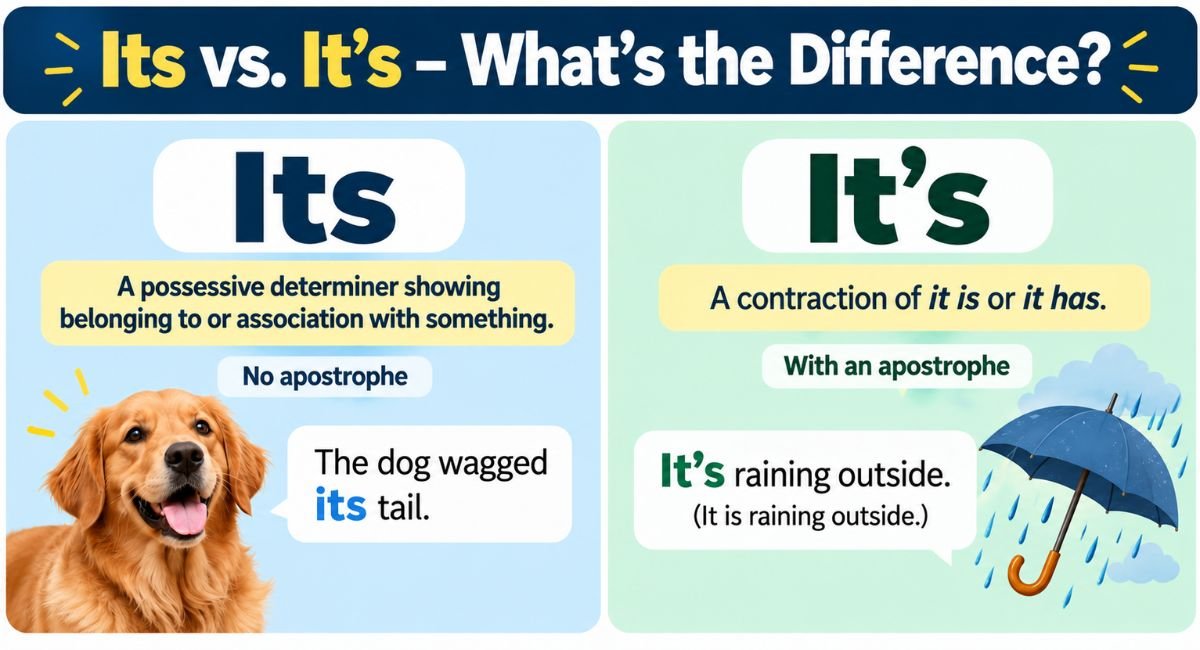
Its shows possession or association, while it’s is a contraction of it is or it has. For example, “The dog wagged its tail” uses the possessive form. “It’s raining outside” means “It is raining outside.” Both words sound identical, but the apostrophe changes their grammatical function.
The difference between its vs. it’s is one of the most useful English grammar rules to learn. Both forms sound the same, but they perform different jobs in a sentence. One indicates possession or association, while the other combines two words into a contraction.
The confusing part is the apostrophe. English frequently uses apostrophes to show possession, as in “the teacher’s book.” However, possessive its does not need one. Instead, the apostrophe in it’s represents missing letters from it is, or it has.
Once you understand this distinction, sentences such as “It’s important to protect its original design” become much easier to read and write correctly.
Its vs. It’s: What Is the Main Difference?
The main difference is grammatical. Its is a possessive determiner, used before a noun to show that something belongs to or is associated with something else. It’s is the shortened form of it is, or it has.
Consider the sentence, “The company changed its policy.” The policy belongs to or is associated with the company, so its is correct. In “It’s a new policy,” the word means it is, making the apostrophe necessary.
| Feature | Its | It’s |
| Meaning | Belonging to or associated with it | It is, or it has |
| Grammar | Possessive determiner | Contraction |
| Apostrophe | No | Yes |
| Pronunciation | /ɪts/ | /ɪts/ |
| Common pattern | Its + noun phrase | It’s + grammatical complement |
| Example | The bird opened its wings. | It’s getting dark. |
A Quick Way to Choose Its or It’s
Try replacing the word with it is or it has. If either expansion works and preserves the intended meaning, use it’s.
For example:
“It’s getting colder.”
Expanded: “It is getting colder.”
The expanded sentence is correct, so the contraction needs an apostrophe.
Now consider:
“The cat cleaned its paws.”
Replacing its with it is gives “The cat cleaned it is paws,” which is incorrect. The sentence needs the possessive determiner.
This simple method solves most mistakes, provided you remember to test both it is and it has.
What Does Its Mean in English?
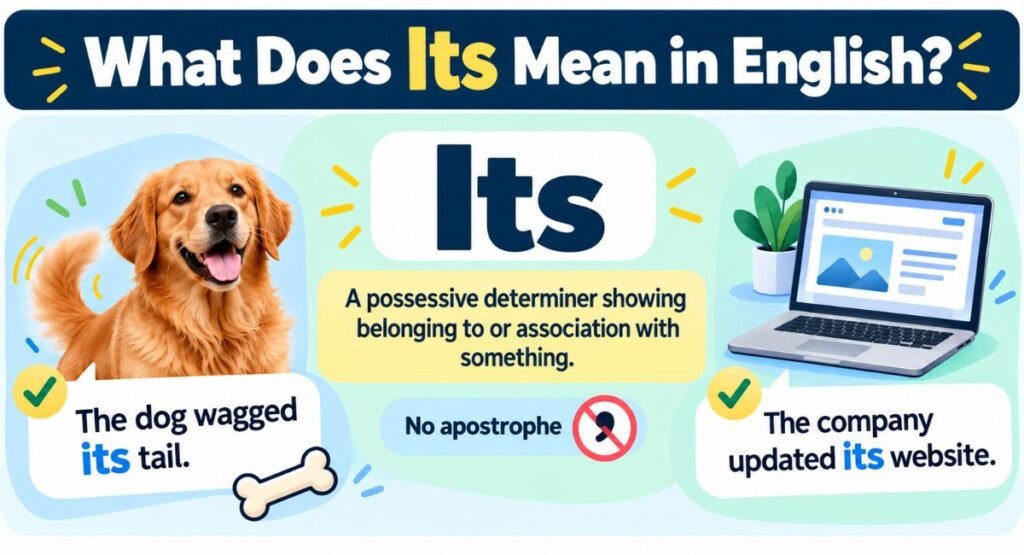
Its is a possessive determiner used to indicate that something belongs to or is associated with an animal, object, organisation, or idea. It normally appears before a noun or noun phrase.
In the sentence “The computer lost its connection,” the word identifies a relationship between the computer and its connection. The connection is associated with the computer.
Possession does not always involve ownership. It can also describe characteristics, parts, functions, or other relationships.
Its as a Possessive Determiner
English possessive determiners include my, your, his, her, its, our, and their. They usually appear before nouns and help readers identify the relevant person or thing.
Examples include:
- Its name
- Its purpose
- Its colour
- Its original design
- Its main features
- Its benefits
In “The school updated its timetable,” the determiner its identifies the timetable associated with the school.
Unlike independent possessive pronouns such as mine or yours, its is not normally used alone in contemporary standard English.
Using Its With Animals and Objects
Its is commonly used when referring to animals or inanimate objects.
“The puppy chased its tail” describes an animal’s body part.
“The laptop needs its charger” identifies a charger associated with the laptop.
For animals, writers may also use his or her when appropriate to the context. The choice depends on how the animal is being referred to.
Using Its With Companies and Organisations
A company or organisation can also be referred to as it, especially in American English.
For example:
“The company announced its annual results.”
Here, its connects the financial results to the company.
British English sometimes uses plural agreement when an organisation is viewed as a group of people, but its remains appropriate when the organisation is treated as a singular entity.
Why It Never Needs an Apostrophe for Possession?
Possessive nouns often use apostrophes:
“The dog’s collar.”
“The teacher’s desk.”
“The company’s website.”
Possessive determiners follow a different rule.
We write my book, your bag, her phone, and its cover without apostrophes.
The difference is grammatical rather than a special exception invented for one word.
What Does It’s Mean in English?
It’s is a contraction of two possible expressions: it is and it has. The apostrophe indicates that one or more letters have been omitted.
The intended meaning depends on the grammatical structure of the sentence.
“It’s cold outside” means “It is cold outside.”
“It’s been a difficult week” means “It has been a difficult week.”
Both uses are common in spoken and written English.
It’s Meaning It Is
This form describes things, states conditions, identifies, and describes ongoing actions.
Examples:
- It’s raining. — It is raining.
- It’s expensive. — It is expensive.
- It’s my favourite book. — It is my favourite book.
- It’s becoming difficult. — It is becoming difficult.
- It’s almost midnight. — It is almost midnight.
The contracted version often sounds more conversational, while the full version can be useful for emphasis or a more formal tone.
It’s Meaning It Has
It’s can also represent it has, particularly when has is an auxiliary verb in the present perfect.
Examples:
- It’s been repaired. — It has been repaired.
- It’s already started. — It has already started.
- It’s changed considerably. — It has changed considerably.
- It’s received several updates. — It has received several updates.
A common mistake is remembering only the it is expansion.
If “It is repaired” sounds wrong, that doesn’t mean “it’s been repaired” is incorrect. The appropriate expansion is it has been repaired.
When It’s Could Mean More Than One Thing
Some contractions can be interpreted in more than one way without additional context.
Consider:
“It’s finished.”
This could mean “It is finished,” describing a completed state.
It could also mean “It has finished,” describing something that completed an action.
For example, a washing machine may have finished its cycle, while a completed painting may simply be described as finished.
The sentence’s context determines the intended interpretation.
How to Pronounce Its and It’s
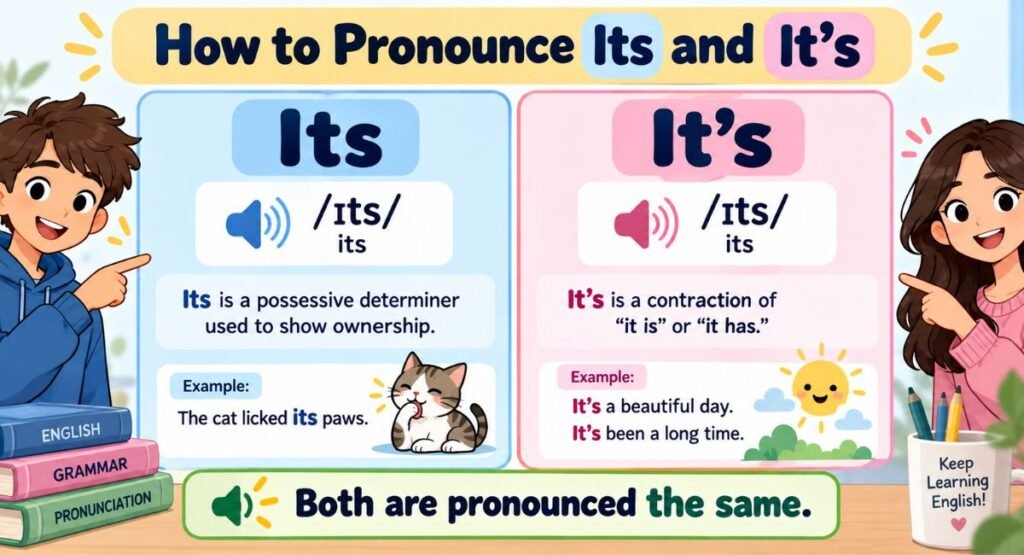
Both words are pronounced /ɪts/ in standard American and British English.
They are homophones: words that sound alike but differ in spelling or grammatical meaning.
The pronunciation has one syllable, beginning with the short vowel /ɪ/ and ending in the consonant sequence /ts/.
| Word | Simple pronunciation | IPA |
| Its | its | /ɪts/ |
| It’s | its | /ɪts/ |
Can You Hear the Apostrophe?
No. The apostrophe does not represent an extra sound.
Compare:
“The dog wagged its tail.”
“It’s a friendly dog.”
The first word is possessive in the opening sentence, while the second is a contraction in the next sentence.
In speech, listeners identify the intended meaning through the surrounding grammar rather than pronunciation.
Its and It’s: Parts of Speech and Grammar Rules
Its and it’s have different grammatical functions, so learning their sentence patterns is more helpful than simply memorising which form has an apostrophe.
Its is a possessive determiner. It’s combines the subject pronoun it with either the verb is or the auxiliary verb has.
Neither is an ordinary countable noun, so noun plural rules do not apply.
Grammar Patterns With Its
The basic pattern is:
Its + noun or noun phrase
Examples:
- Its cover
- Its original purpose
- Its important features
- Its own website
The phrase its own is useful when emphasising that something belongs to or is associated with a particular thing.
For example:
“The company developed its own software.”
The sentence distinguishes the company’s software from software supplied by someone else.
Grammar Patterns With It’s
The contraction appears in several common structures.
| Structure | Example | Meaning |
| It’s + adjective | It’s useful. | It is useful. |
| It’s + noun phrase | It’s a good idea. | It is a good idea. |
| It’s + verb-ing | It’s working. | It is working. |
| It’s + been | It’s been updated. | It has been updated. |
| It’s + past participle | It’s already arrived. | It has already arrived. |
A past participle can sometimes appear after either is or has, depending on the sentence. The structure provides clues, but context remains important.
Does It Have a Plural Form?
Its is a possessive determiner rather than a noun, so it does not have a normal plural form.
When the reference changes from a singular thing to plural things, the possessive determiner may change.
For example:
“The company updated its website.”
“The companies updated their websites.”
The change reflects the grammatical subject, not a plural form of its.
Does It’s Have Verb Forms?
It’s is not an independent verb. It contains a contracted form of is or has.
The verbs themselves have other forms, such as was, were, had, and having.
However, these are forms of the underlying verbs, not separate grammatical forms of it’s.
Its vs. It’s Example Sentences
Sentence examples are useful because they reveal the grammatical difference in context.
The following original examples cover schoolwork, technology, everyday activities, and professional communication.
Five Sentences Using Its
- The cat cleaned its paws after walking through the garden.
- The school updated its timetable before the new term.
- The laptop lost its wireless connection during the presentation.
- The company improved its website to make navigation easier.
- The museum restored its oldest painting before the exhibition.
Each example contains a noun phrase after its. The possessive determiner identifies the relationship between that noun phrase and something already mentioned.
Five Sentences Using It’s
- It’s raining heavily, so we should stay indoors.
- It’s been several months since the library reopened.
- It’s important to check the instructions carefully.
- It’s already received hundreds of responses.
- It’s becoming easier to find educational resources online.
In the second and fourth examples, it’s means it has.
The remaining examples use it is.
Sentences Using Both Its and It’s
Using both forms in the same sentence is a useful way to practise the difference.
- It’s amazing how the bird protects its nest.
- It’s important for the company to explain its policies clearly.
- It’s impressive how quickly the robot moves its arms.
- It’s been a successful year for the school and its students.
- It’s encouraging to see the town preserving its historic buildings.
Consider the first sentence:
“It’s amazing how the bird protects its nest.”
The opening contraction means it is. The second form, its, identifies the nest associated with the bird.
These two grammatical functions can coexist naturally because they perform different jobs.
Its vs. It’s: Understanding the Apostrophe Rule
Apostrophes are used for several purposes in English. Two particularly important uses are marking contractions and indicating possession in nouns.
The confusion between its and it’s occurs because learners may apply the noun possession rule to a possessive determiner.
Understanding the distinction helps prevent mistakes with other expressions too.
Apostrophes in Contractions
In contractions, an apostrophe marks omitted letters.
| Contraction | Expanded form |
| It’s | It is / It has |
| Who’s | Who is / Who has |
| They’re | They are |
| We’re | We are |
| Don’t | Do not |
| Can’t | Cannot |
Notice that it’s and who’s can both represent two different expanded forms, depending on the sentence.
Apostrophes in Possessive Nouns
Possessive nouns follow a different pattern.
“The student’s notebook” identifies a notebook belonging to a student.
“The school’s library” identifies a library associated with a school.
However, possessive determiners such as its and whose do not take apostrophes.
Compare:
“The company changed its policy.”
“Whose policy is this?”
Neither possessive determiner needs an apostrophe.
Is Its’ Correct English?
The spelling its’ is not a standard form in contemporary English.
It is not a plural possessive form, and placing an apostrophe after the final s does not create a valid alternative to its.
Use:
- Its — possessive determiner.
- It’s — contraction of it is or it has.
Avoid its’ in ordinary writing.
Its, It’s, and Related English Expressions
Because its and it’s serve grammatical functions, they do not have ordinary synonyms in the same way that words such as happy and joyful do.
Instead, it is more useful to compare them with related grammatical forms and expressions.
It’s Compared With Other Possessive Determiners
| Determiner | Typical reference |
| My | The speaker |
| Your | The person or people addressed |
| His | A male person or animal in context |
| Her | A female person or animal in context |
| Its | Something referred to as it |
| Our | The speaker and others |
| Their | Plural entities or singular they |
These forms perform similar grammatical functions but are not interchangeable without changing the reference.
For example:
“The company changed its policy.”
“The employees changed their schedules.”
The different determiners identify different relationships.
It’s Compared With It Is, and It Has
The full forms it is and it has are the direct expansions of it’s.
“It’s getting dark” and “It is getting dark” communicate the same basic meaning.
“It’s been repaired” and “It has been repaired” also have the same basic meaning.
Choosing the contracted or uncontracted version generally depends on tone, emphasis, and editorial style.
Do Its and It’s Have Antonyms?
Neither word has a conventional dictionary antonym.
Their functions are grammatical, so an opposite must be expressed through a larger sentence or a different relationship.
For example:
| Original expression | Contextual contrast |
| It’s working. | It isn’t working. |
| It’s available. | It isn’t available. |
| It’s finished. | It isn’t finished. |
| Its original design | A different design |
| Its owner | Someone unrelated to it |
These examples show contrasting ideas, not direct antonyms of the individual words.
Why Are Its and It’s Spelled Differently?
The distinction reflects the historical development of English possessive forms and apostrophe conventions.
Earlier English did not always use exactly the same distinction found in modern writing. Historical forms varied, and apostrophe practices became more standardised over time.
The History of Possessive Its
The possessive form its developed during the Early Modern English period.
Historical texts sometimes contain spellings that differ from modern conventions, including possessive uses of it’s.
The precise dating and development of these forms should be checked against a historical dictionary before making more specific chronological claims.
The important modern rule is clear: possessive its is written without an apostrophe.
How It’s Became a Contraction
The contraction it’s follows the general pattern of combining words and marking omitted letters with an apostrophe.
For example:
“It is” becomes “it’s.”
“It has” can also become “it’s.”
Modern spelling distinguishes these contracted forms from the possessive determiner its, even though their pronunciation is identical.
Common Mistakes With Its and It’s
Several common errors appear repeatedly in essays, emails, articles, and social media posts.
Most can be corrected by identifying whether the intended meaning involves possession or a contraction.
Writing It’s When You Mean Possession
Incorrect:
“The computer lost it’s connection.”
Correct:
“The computer lost its connection.”
The connection is associated with the computer.
Replacing the expression with it is produces an incorrect sentence, confirming that the apostrophe should be removed.
Writing Its When You Mean It Is
Incorrect:
“Its getting late.”
Correct:
“It’s getting late.”
The intended sentence means “It is getting late.”
Because the expansion is correct, the apostrophe is required.
Forgetting That It’s Also Means It Has
Consider:
“It’s been a difficult week.”
This means “It has been a difficult week.”
Checking only the it is expansion would lead to the wrong conclusion.
A good proofreading routine always tests both possible expansions.
Using Its Without a Following Noun
Its normally needs a following noun phrase.
For example:
“The dog found its toy.”
If someone asks whose toy it is, the natural response is “It’s the dog’s,” not simply “Its.”
This distinguishes its from independent possessive pronouns such as mine and yours.
Confusing Its With Its Own
The phrase its own is correct because own helps emphasise a possessive relationship.
For example:
“The school has its own library.”
Writing “it’s own library” would be incorrect when the intended meaning is possession.
The expansion “it is own library” does not work, making its the required form.
How to Check Its and It’s When Proofreading
A useful proofreading method involves two separate checks.
First, determine whether the word can be expanded into it is or it has while preserving the sentence’s intended meaning.
Second, if neither expansion works, identify the noun being described and ask whether it belongs to or is associated with something represented by it.
The Two-Step Grammar Test
Consider:
“It’s updating its settings.”
The first word expands to “It is updating,” so it requires an apostrophe.
The second word identifies the settings associated with the device or system being discussed.
This sentence is a particularly useful learning example because it contains both spellings correctly.
Check the Meaning, Not Just the Letters
A sentence may contain it is, or it has structures that look similar when contracted.
For example:
“It’s finished.”
Depending on context, this might describe a finished state or a completed action.
Expanding the contraction is helpful, but the intended meaning should guide the final interpretation.
A mechanical substitution test should support grammatical understanding rather than replace it.
Its vs. It’s in Formal and Informal Writing
The possessive form its is the same in formal and informal English.
The main stylistic difference concerns whether a writer chooses the contraction it’s or the expanded forms it is and it has.
Formal Writing
Formal academic or professional writing may favour uncontracted expressions where clarity or a particular house style requires them.
For example:
“It is essential to review the evidence.”
This may be preferable in a formal report.
However, contractions are not prohibited from every professional or academic context. Writers should follow the style requirements of their publication or institution.
Everyday Communication
Contractions are common in speech, messages, emails, and conversational writing.
“It’s getting late” sounds entirely natural.
“It is getting late” is also grammatical, but may sound more deliberate or emphatic depending on context.
Neither choice changes the possessive rule.
Conclusion
The difference between its and it’s is grammatical rather than phonetic. Its shows possession or association, while it’s represents it is or it has. The apostrophe is therefore a signal of contraction, not possession.
The most dependable proofreading method is to test both expanded forms and consider the surrounding sentence. If neither expansion works and the word describes a noun associated with something, its is usually the correct choice.
Frequently Asked Questions About Its vs. It’s
What is the difference between its and it’s?
Its is a possessive determiner that shows something belongs to or is associated with another thing. It’s is a contraction of it is or it has. For example, “The cat cleaned its paws” expresses possession, while “It’s sleeping” means “It is sleeping.” Both forms have the same pronunciation.
When should I use its without an apostrophe?
Use its without an apostrophe when describing something belonging to or associated with an animal, object, organisation, or idea. It normally appears before a noun, such as “its name”, “its purpose”, or “its colour”. For example, “The company updated its website” correctly uses the possessive determiner.
Can it’s mean both it is and it has?
Yes, it’s can mean either it is or it has. The intended meaning depends on the sentence structure and context. “It’s raining” means “It is raining”, while “It’s been repaired” means “It has been repaired”. Checking both expansions helps you identify the correct spelling and grammatical interpretation.
Why doesn’t possessive its have an apostrophe?
Possessive its does not require an apostrophe because it belongs to the group of possessive determiners, which includes my, your, his, her, our, and their. These words express possession without apostrophes. By contrast, it’s uses an apostrophe to show omitted letters in the contractions it is or it has.
Is its’ ever grammatically correct?
Its’ is not a standard spelling in contemporary English. The correct possessive form is its, without an apostrophe, while it’s is the contraction of it is or it has. For example, “The dog lost its collar” is correct. Adding an apostrophe after the final s would create an unnecessary punctuation error.