
Collocate vs Colocate: Meaning in English & Examples
Collocate means that words naturally occur together, as in “heavy rain” or “make a decision”. Colocate means placing people, equipment, or organisations in the same physical location. Although both words are associated with putting things together, their common uses differ: collocate belongs mainly to linguistics, while colocate describes shared locations.
Understanding collocate vs colocate meaning in English begins with a small but important spelling difference. The double “l” in collocate usually points towards language and vocabulary, while colocate commonly describes physical arrangements. An English teacher might discuss words that collocate, whereas an office manager might discuss teams that need to colocate.
There is more to the distinction than remembering one letter. Both words have connections with the idea of putting things together, and collocate has a broader meaning beyond linguistics. Their pronunciation also differs, and the related nouns collocation and colocation can cause confusion in academic and professional writing.
What Does Collocate Mean in English?
Collocate is a verb used in linguistics when words regularly occur together in a way that sounds natural to experienced speakers. Consider the expression “heavy rain”. English speakers commonly use “heavy” to describe intense rainfall, even though the rain does not literally have weight in the intended sense.
The adjective “heavy” therefore collocates with the noun “rain”. Other familiar combinations include “strong coffee”, “deep sleep”, “make a decision” and “pay attention”. These expressions illustrate how natural English depends on established word combinations, not simply on selecting words with individually suitable meanings.
Collocate also has an older, broader sense meaning to place or arrange things together. This meaning is recorded in reference works, although learners are more likely to encounter the word when studying vocabulary or language patterns.
Why Do Some English Words Collocate Naturally?
A learner might ask why English speakers say “make a mistake” instead of “do a mistake”. Both verbs are familiar, and both can describe actions. Yet “make a mistake” is the conventional combination, while “do a mistake” generally sounds unnatural in standard English.
These patterns develop through usage. They are not always predictable from grammar or dictionary definitions alone. Learning collocations as short phrases can therefore be more useful than studying isolated words, particularly when preparing for conversations, essays or language examinations.
Collocation Is Not the Same as a Fixed Idiom
Collocations and idioms can both involve familiar word combinations, but they are not identical. In “strong coffee”, the individual words retain their ordinary meanings. The combination is conventional, yet its meaning is reasonably transparent.
An idiom such as “spill the beans”, meaning to reveal a secret, cannot usually be understood through the literal meanings of its individual words. Some expressions fall between these categories, so the distinction is not always absolute. For learners, the practical lesson is that collocations often remain understandable even when a different word choice would sound unusual.
What Does Colocate Mean in English?
Colocate means to position or establish people, equipment or organisations in the same location. The word is common in workplace planning, telecommunications and technology. For example, a company may colocate its marketing and customer-support departments so employees can use the same office facilities.
The verb does not necessarily mean that the people or equipment perform the same function. Two departments can occupy one building while remaining administratively separate. Colocation describes where the entities are situated rather than automatically describing their ownership, management or working relationships.
Colocate Meaning in Business
Suppose a company has a design department on one side of a city and an engineering department on the other. Management decides to move both departments into one building.
A project announcement might state:
“The company will colocate its design and engineering teams at the new headquarters.”
This sentence describes a physical arrangement. It does not establish whether the relocation will improve productivity, reduce costs or increase cooperation; those would require separate evidence.
Colocate Meaning in Technology
In computing, colocation often involves placing an organisation’s servers or networking equipment in a third-party data centre. The facility may provide physical space, electrical power, cooling, security and network connectivity, depending on its services.
A technology company might own its servers while paying a data-centre provider to house them. This differs from many cloud-computing arrangements, where customers rent computing resources rather than placing their own physical equipment in a facility.
Collocate vs Colocate: The Main Differences
The most useful distinction is whether a sentence describes a linguistic relationship or a shared physical location.
| Feature | Collocate | Colocate |
| Main modern use | Natural word combinations | Shared physical locations |
| Typical context | Linguistics, vocabulary | Offices, servers, facilities |
| Part of speech | Verb; also a linguistic noun | Verb |
| Related noun | Collocation | Colocation |
| Alternative spelling | — | Co-locate |
| Example | “Strong” collocates with “coffee”. | Two teams are colocated. |
The table reflects common modern usage rather than an absolute division between the words. Collocate can also mean to arrange or place things together. However, colocate is generally the more specific contemporary choice for shared offices, facilities and equipment.
Canada.ca
A Simple Test for Choosing the Correct Word
Imagine a teacher writing:
“The adjective ‘serious’ frequently collocates with the noun ‘concern’.”
The sentence concerns a language pattern, so collocates is appropriate.
Now imagine a facilities manager writing:
“The finance and legal departments will be colocated on the third floor.”
The sentence concerns physical placement, making colocated the appropriate term.
The test is simple: ask what kind of relationship the writer is describing before choosing the spelling.
Collocate vs Colocate Pronunciation
The words have different vowel sounds, although the pronunciation of colocate permits more variation in stress placement.
How to Pronounce Collocate
COLLOCATE
KOL-uh-kayt
British IPA: /ˈkɒl.ə.keɪt/
American IPA: /ˈkɑː.lə.keɪt/
Colocate has three syllables, with the main stress on the first. The vowel differs between common British and American pronunciations. The final syllable rhymes with “late”.
English meaning – Cambridge Dictionary
How to Pronounce Colocate
COLOCATE / CO-LOCATE
koh-LOH-kayt
One accepted pronunciation, with second-syllable stress
Unlike collocate, colocate has a long “oh” sound in its first two syllables. Reference dictionaries recognise stress on the first, second or final syllable. Therefore, learners should not treat one stress pattern as the only correct pronunciation.
Canada.ca
The pronunciation difference matters when listening to presentations or conversations about specialised topics. A discussion of adjective–noun patterns probably concerns collocate, while a discussion of shared data-centre facilities concerns colocate.
Grammar Rules for Collocate and Colocate
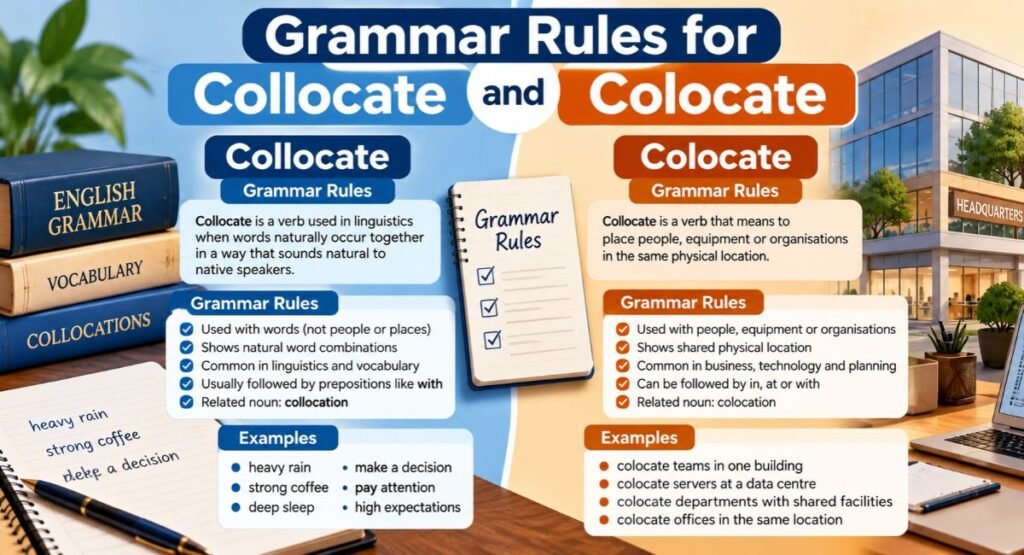
Both words are regular verbs. Their forms are similar, but the sentence structure changes according to the intended meaning.
Collocate as a Verb
In its linguistic sense, collocate is commonly an intransitive verb. This means it does not normally take a direct object in that use.
Correct examples include:
- “‘Strong’ collocates with ‘coffee’.”
- “‘Commit’ commonly collocates with ‘crime’.”
- “These words frequently collocate in formal writing.”
The preposition “with” is particularly useful when identifying the words associated with a particular expression.
Cambridge Dictionary specifically classifies the linguistic use of collocate as an intransitive verb.
English meaning – Cambridge Dictionary
Collocate as a Countable Noun
Collocate can also function as a countable noun in linguistics. A collocate is a word that frequently appears alongside a particular word.
For example:
“Researchers identified several frequent collocates of the word ‘decision’.”
In this sentence, collocates is a plural noun, not a verb.
The related noun collocation can refer to a particular word combination. For example, “make a decision” is a collocation, and “strong coffee” is another.
Colocate as a Verb
Colocate can be used with or without a direct object.
In a transitive construction, someone places entities together:
“The university colocated three research teams.”
In an intransitive construction, entities share or move into a location:
“The departments agreed to colocate.”
Passive constructions are also useful:
“The servers were colocated in a secure facility.”
Common prepositions include “with”, “in” and “at”, depending on the relationship being expressed.
Verb Forms and Spelling
| Form | Collocate | Colocate |
| Base form | collocate | colocate |
| Third-person singular | collocates | colocates |
| Past tense | collocated | colocated |
| Past participle | collocated | colocated |
| Present participle | collocating | colocating |
A particularly easy mistake is overlooking the extra “l” in collocated.
Compare:
“The researchers examined words that collocated frequently in the dataset.”
“The two research teams were colocated in one building.”
The first concerns language patterns. The second concerns physical location.
Original Example Sentences Using Collocate
The following sentences demonstrate how collocate works in different linguistic contexts.
- The teacher explained that “pay” naturally collocates with “attention”.
- The researcher studied how emotion-related adjectives collocate with particular nouns.
- Students learned that “make” collocates with “progress”, while “do” does not normally form that expression.
- In the newspaper dataset, “economic” frequently collocates with “growth”.
- The dictionary lists several collocates of the word “problem”.
- Writers should notice which prepositions collocate with familiar verbs.
- The language-learning exercise asks students to identify words that naturally collocate.
These examples demonstrate different grammatical patterns, including verb usage, noun usage and references to data analysis.
The expression “economic growth” also illustrates an important point: word combinations may belong to particular subject areas. A collocation common in economic reporting may be less frequent in ordinary conversation.
Original Example Sentences Using Colocate
Colocate appears naturally in workplace, infrastructure and organisational contexts.
- The company decided to colocate its customer-support and sales teams.
- Several businesses colocate their servers in the same data-centre facility.
- The hospital plans to colocate related outpatient services in one building.
- Our design and engineering departments are colocated on the second floor.
- The university is considering colocating two specialist laboratories.
- A telecommunications provider may colocate network equipment at a shared facility.
- The project manager recommended that the testing team colocate with the developers.
One subtle distinction is worth noticing. The sentence “The teams collaborate” describes working together, while “The teams are colocated” describes sharing a physical location. Employees can collaborate remotely without being colocated, and colocated employees do not necessarily collaborate on the same projects.
Synonyms of Collocate With Meaning Differences
Collocate has related terms, but exact substitution is not always possible.
| Related term | How its meaning differs |
| Co-occur | Means appear together, without necessarily suggesting an established linguistic relationship |
| Associate | Describes a connection between words or ideas |
| Combine | Refers generally to joining elements |
| Pair | Emphasises two items used together |
| Arrange | Refers to ordering or positioning elements |
Consider the difference between collocate and co-occur.
Two words may co-occur somewhere in a long document without forming a conventional phrase. For example, “coffee” and “deadline” might appear in the same office report, but that alone does not establish them as a natural collocation.
Conversely, “strong coffee” is an established expression. The relationship is not merely that the words happened to appear in one document.
In corpus linguistics, researchers can use statistical measures to investigate frequent co-occurrence and identify potential collocations. Frequency is relevant evidence, but it is not the whole meaning of collocation.
Synonyms of Colocate With Meaning Differences
The alternatives to colocate depend on whether the writer wants to emphasise physical location, shared facilities or organisational changes.
| Alternative | Distinction |
| Co-locate | Alternative spelling of the same verb |
| House together | Emphasises shared accommodation or facilities |
| Position together | Emphasises physical placement |
| Share premises | Describes occupying the same property |
| Centralise | Describes consolidation of functions or control, not necessarily one shared location |
For example:
“The organisation centralised its customer-service operations.”
This might involve combining management functions without moving every employee into one office.
“The organisation colocated its customer-service teams.”
This directly describes bringing the teams into a shared location.
Centralise is therefore a related expression rather than a perfect synonym.
Antonyms and Opposite Expressions
Neither word has a single opposite that works in every context.
Opposites of Collocate
For linguistic usage, the clearest opposite is often an explanatory phrase rather than a separate verb.
- Do not commonly collocate — “These adjectives do not commonly collocate with that noun.”
- Occur independently — “The expressions usually occur independently in the selected texts.”
- Rarely co-occur — “The two technical terms rarely co-occur in this dataset.”
These statements describe different relationships. Words that rarely co-occur in one dataset are not necessarily incompatible in the language generally.
Opposites of Colocate
Several verbs can describe the reverse of sharing a physical location.
- Separate — “The organisation separated the teams into different buildings.”
- Disperse — “The equipment was dispersed across several facilities.”
- Relocate apart — “The departments were relocated to separate offices.”
- Distribute — “The company distributed its technical operations across regional sites.”
Decentralise may also be appropriate in organisational discussions, but it is not a direct antonym of colocate because decentralisation can concern authority rather than physical location.
Collocate and Colocate: Word Origins Explained
The two verbs share a conceptual connection with placement, but their histories differ.
Etymology of Collocate
Collocate comes from Latin collocare, meaning to place or arrange together. It developed from com, meaning “with” or “together”, and locare, meaning “to place”.
The Language Portal of Canada records its use in English from the early sixteenth century. Its broader placement meaning helps explain how the word could later be applied to the habitual relationship between words.
Etymology of Colocate
Co-locate is formed from the English prefix “co-”, meaning “together”, and the verb “locate”.
According to the Language Portal of Canada, the formation dates to the 1960s. Its meaning relates to entities occupying the same space or facility, which explains its suitability for modern organisational and technical writing.
Collocation vs Colocation: One Letter Changes the Subject
The distinction between these nouns is especially relevant to search results and professional documents.
Collocation is a familiar term in English language teaching.
Example:
“Take a break” is a common collocation.
Colocation, on the other hand, refers to a shared location or facility.
Example:
“The business purchased colocation services for its networking equipment.”
A language student searching for “collocation exercises” expects vocabulary activities. A network administrator searching for “colocation services” expects information about facilities and infrastructure. Mixing the spellings can confuse readers even when a spelling checker accepts both.
Is Co-Locate More Correct Than Colocate?
Both co-locate and colocate are recognised spellings. The Language Portal of Canada notes that the unhyphenated form is especially associated with American usage, but neither form should be treated as universally incorrect.
The practical solution is consistency. If a publication’s style guide prefers “co-locate”, use “co-located”, “co-locating” and “co-location” consistently. If it prefers “colocate”, use the corresponding unhyphenated forms.
Collocate vs Collate: Another Easily Confused Pair
Collocate and collate look similar, yet their meanings are distinct.
Collate means to gather, compare or arrange information or materials in an organised way.
“The researcher collated the survey responses.”
Here, the researcher organised collected information.
“The researcher examined which adjectives collocate with ‘success’.”
Here, the researcher investigated language patterns.
The distinction is useful in academic writing because the verbs can occur in similar research contexts while describing different activities.
Common Mistakes With Collocate and Colocate
Several mistakes arise from treating the words as interchangeable or applying a spelling rule without considering the context.
Using Colocate for Word Combinations
Incorrect: “The words ‘heavy’ and ‘rain’ colocate naturally.”
Correct: “The words ‘heavy’ and ‘rain’ collocate naturally.”
The corrected sentence describes a conventional language pattern, not a shared physical location.
Using Collocate for Shared Offices
Less precise: “The company will collocate its sales and support teams.”
Preferred: “The company will colocate its sales and support teams.”
Collocate has a broader placement sense, so the first sentence is not necessarily impossible. Nevertheless, colocate more clearly communicates the modern workplace meaning.
Assuming All Word Combinations Are Collocations
Consider “blue notebook” and “heavy rain”.
Both combinations are grammatically possible, but “heavy rain” is a more characteristic example of an established collocation. “Blue notebook” generally describes a notebook’s colour and does not, without additional evidence, demonstrate an especially strong lexical association.
Not every pair of neighbouring words is an established collocation. This matters when analysing texts or preparing educational materials.
Using the Wrong Preposition
Incorrect: “The adjective ‘strong’ collocates to ‘coffee’.”
Correct: “The adjective ‘strong’ collocates with ‘coffee’.”
In linguistic explanations, “collocate with” is a standard construction.
For physical arrangements, “colocate with”, “colocate in” and “colocate at” can be appropriate:
“The server was colocated at a specialist facility.”
“The department was colocated with the finance team.”
Confusing Physical Location With Collaboration
Incorrect when describing remote teamwork: “The remote employees are colocated because they collaborate online.”
Better: “The remote employees collaborate online.”
Colocation requires an appropriate shared-location relationship. Remote cooperation alone does not establish that workers occupy the same physical location.
How to Choose Between Collocate and Colocate
The following cases test the distinction in realistic contexts.
| Situation | Appropriate word | Reason |
| “Deep” and “sleep” naturally appear together | Collocate | Linguistic relationship |
| Two departments share an office | Colocate | Shared physical location |
| A researcher studies frequent word associations | Collocate | Vocabulary analysis |
| Servers are housed in a third-party data centre | Colocate | Equipment placement |
| A researcher organises survey responses | Collate | A different verb |
| Employees cooperate from different countries | Collaborate | Working together, not sharing a location |
A useful memory aid is to connect collocate with language and colocate with location. This is not a complete historical explanation, but it works for the most common modern meanings.
Conclusion
Collocate and colocate are easy to confuse because they share similar spellings and a broad connection with placement. The important difference lies in how they are normally used. Collocate describes natural relationships between words, while colocate describes people, equipment or organisations occupying a shared physical location.
Remember that collocate also has an established broader meaning involving arrangement, and that co-locate is an accepted alternative spelling of colocate. Understanding these details makes the distinction more accurate than simply treating one spelling as correct and the other as a mistake.
Frequently Asked Questions
What is the difference between collocate and colocate?
Collocate usually means that words regularly occur together in natural English, such as “strong coffee” or “heavy rain”. Colocate means placing people, equipment or organisations in the same physical location. Although both words relate to togetherness, collocate is mainly used in linguistics, while colocate commonly appears in business and technology.
Is co-locate the same as colocate?
Yes, co-locate and colocate are alternative spellings of the same verb. Both describe positioning people, equipment or organisations in a shared physical location. For example, a company might co-locate its departments in one building. Both spellings are recognised, although businesses and publishers may follow different editorial style preferences.
How do you pronounce collocate and colocate correctly?
Collocate is commonly pronounced KOL-uh-kayt, with stress on the first syllable. Its British IPA is /ˈkɒl.ə.keɪt/. Colocate generally begins with a long “oh” sound, and a common American pronunciation is koh-LOH-kayt, /koʊˈloʊ.keɪt/. Stress patterns for colocate can vary between accents and dictionary conventions.
What are examples of collocate and colocate in sentences?
An example of collocate is “‘Heavy’ frequently collocates with ‘rain’ in English.” This describes a natural word combination. An example of colocate is “The company plans to colocate its engineering teams in one office.” This describes people sharing a physical location. The surrounding context determines which spelling is appropriate.
What is the difference between collocation and colocation?
Collocation refers to words that naturally occur together in a language, such as “make a decision” or “deep sleep”. Colocation refers to placing people, equipment or services in the same physical location. In computing, server colocation often involves housing customer equipment in a specialised data-centre facility.