
Jewelry vs. Jewellery: Meaning, Difference & Usage
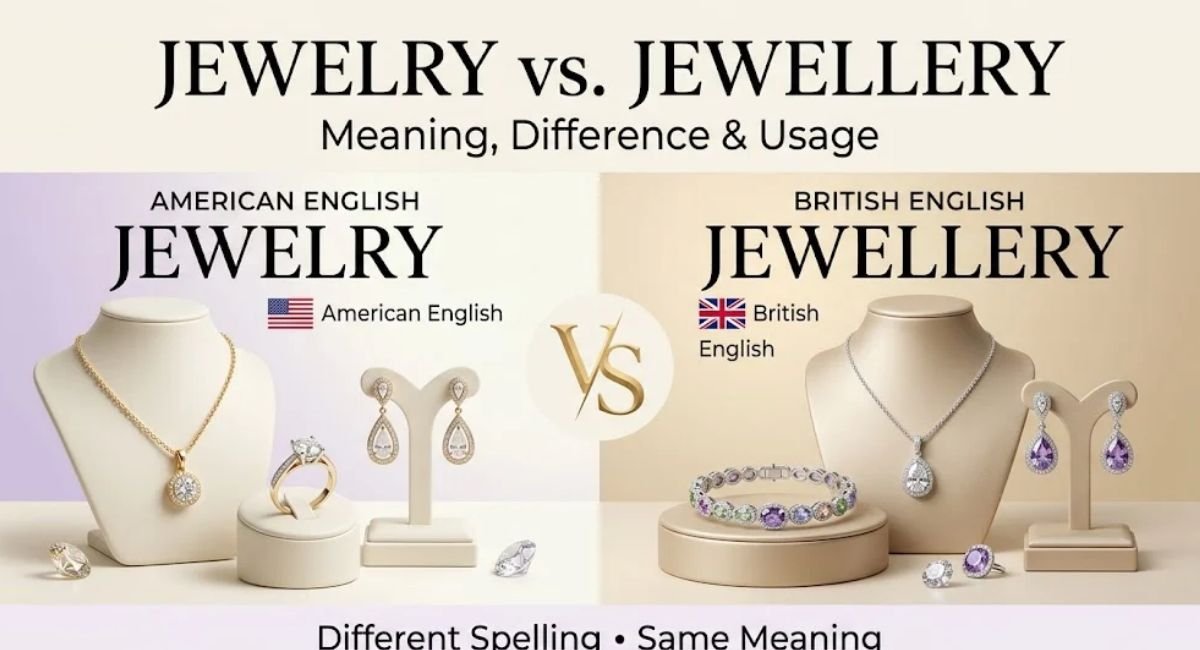
Jewelry vs. jewellery is a spelling difference between American and British English. Both words mean decorative objects worn on the body, such as rings, necklaces, earrings, and bracelets. Americans generally write jewelry, while British writers use jewellery. Neither spelling is wrong. Both words are normally uncountable nouns and share the same accepted pronunciations.
Jewelry vs. Jewellery Meaning in English
Imagine shopping for a necklace on two websites. An American store advertises “Gold Jewelry,” while a British store displays “Gold Jewellery.” The products could be identical. Only the spelling has changed.
Jewelry and jewellery refer to objects worn for decoration, personal expression, or cultural significance. Common examples include rings, earrings, necklaces, bracelets, brooches, and anklets. These objects may be made from gold, silver, platinum, gemstones, glass, wood, or beads.
The word doesn’t necessarily suggest luxury. A handmade friendship bracelet can be jewellery, just as an expensive diamond necklace can. The difference lies in the material, craftsmanship, or purpose—not in whether the object qualifies as jewellery.
Jewellery can also carry meaning beyond appearance. A wedding ring may symbolise commitment, an inherited necklace may preserve a family memory, and a traditional ornament may reflect cultural identity.
Jewelry and Jewellery Meaning in Urdu
In Urdu, both jewelry and jewellery can be translated as زیورات (zewarat) or زیور (zewar).
Zewarat is commonly used when referring to jewellery collectively, while zewar can refer to an ornament or jewellery more generally.
| English | Urdu | Roman Urdu |
| Jewellery | زیورات | Zewarat |
| Ornament / jewellery | زیور | Zewar |
| Gold jewellery | سونے کے زیورات | Sonay ke zewarat |
| Silver jewellery | چاندی کے زیورات | Chandi ke zewarat |
Consider these examples:
English: She bought beautiful jewellery for the wedding.
Urdu: اس نے شادی کے لیے خوبصورت زیورات خریدے۔
English: My mother keeps her gold jewellery in a safe place.
Urdu: میری والدہ اپنے سونے کے زیورات محفوظ جگہ پر رکھتی ہیں۔
There is no separate Urdu translation for the American spelling jewelry. Both spellings refer to the same concept.
Jewelry vs. Jewellery: American and British Spelling
The spelling distinction is straightforward: American English uses jewelry, and British English uses jewellery.
The British form contains an additional l before the final part of the word. The American spelling is shorter, but this does not make it a simplified version of the meaning.
| Feature | American English | British English |
| Standard spelling | Jewelry | Jewellery |
| Person who makes or sells it | Jeweler | Jeweller |
| Example business name | Jewelry store | Jewellery shop |
| Example product category | Gold jewelry | Gold jewellery |
| Meaning | Decorative wearable objects | Same |
| Grammar | Normally uncountable | Normally uncountable |
Which Countries Use Jewelry or Jewellery?
The spelling jewelry is standard in the United States. The spelling jewellery is standard in the United Kingdom and is also widely used in Australia, New Zealand, India, and Pakistan.
These are conventions, not rules about nationality. An Australian company selling primarily to American customers might use jewelry on its US website. Likewise, an international publication may follow one spelling style across all its content.
Which Spelling Should You Choose?
Choose jewelry when writing for an American audience and jewellery when following British English conventions.
For a product page, consider the market being served. For an academic assignment, follow the institution’s style requirements. In an article, keep your chosen spelling consistent unless you are specifically comparing the two forms or quoting an original title.
How to Pronounce Jewelry and Jewellery
Although their spellings differ, jewelry and jewellery do not have separate pronunciations determined by country. Both two-syllable and three-syllable forms are heard in English.
| Pronunciation | IPA | Simple guide |
| Three syllables | /ˈdʒuː.əl.ri/ | JOO-uhl-ree |
| Two syllables | /ˈdʒuːl.ri/ | JOOL-ree |
The capital letters in the simple guides indicate stress. The strongest emphasis falls at the beginning of the word.
Why Is Jewellery Difficult to Pronounce?
The challenge comes from the sequence of sounds near the middle of the word. In natural speech, the unstressed vowel can become very short or disappear, producing a two-syllable pronunciation.
A learner who carefully says three syllables is not necessarily wrong. Nor is someone who naturally uses two. The important thing is to recognise both accepted patterns rather than trying to pronounce every written letter separately.
Is Jewelry a Noun? Grammar and Countability Rules
Jewelry and jewellery are nouns. More specifically, they are normally mass nouns, also called uncountable nouns.
This is one of the most important features of the word because it differs from the grammar of individual objects such as ring, bracelet, and necklace.
You can count rings directly:
- One ring
- Two rings
- Five rings
But in standard everyday English, you don’t usually count jewellery in the same way.
Instead, say one piece of jewellery, two pieces of jewellery, or five items of jewelry.
Why Do We Say “Jewellery Is” Instead of “Jewellery Are”?
An uncountable noun normally takes singular verb agreement.
Correct: Her jewellery is expensive.
Incorrect: Her jewellery are expensive.
Even when a jewellery collection contains dozens of items, the noun itself is grammatically singular.
You can change the construction to make the individual objects the subject:
Correct: Her necklaces and bracelets are expensive.
Correct: Several pieces of her jewellery are expensive.
The verb changes because the grammatical subject changes.
What Is the Plural of Jewelry?
In ordinary standard English, jewelry and jewellery do not have a regular plural.
The form jewelries may occasionally appear in specialised or nonstandard contexts, but learners should not use it as the everyday plural.
Use pieces of jewelry, items of jewellery, or the names of individual objects instead.
Jewelry vs. Jewel vs. Jewels
These words are related, but their grammar and meanings are different.
A jewel is a countable noun that can refer to a precious stone or a valuable ornament. Jewels is its regular plural.
Jewellery is the broader mass noun for wearable decorative objects.
For example:
- The crown contains several valuable jewels.
- She inherited a collection of jewellery.
- The necklace has a blue jewel at its centre.
A jewel may be part of a piece of jewellery, but the words cannot always replace each other.
Common Prepositions With Jewellery
Jewellery has no special mandatory preposition. The correct choice depends on what you want to express.
| Expression | Meaning |
| Jewellery made of gold | Material |
| Jewellery for weddings | Intended occasion |
| Jewellery with gemstones | Design feature |
| A collection of jewellery | Group of objects |
| Jewellery from India | Origin |
| Jewellery on display | Exhibition or presentation |
Jewellery is not a verb, so it has no verb tenses. Related actions can be expressed with verbs such as wear, make, design, adorn, and decorate.
Jewelry vs. Jewellery Example Sentences
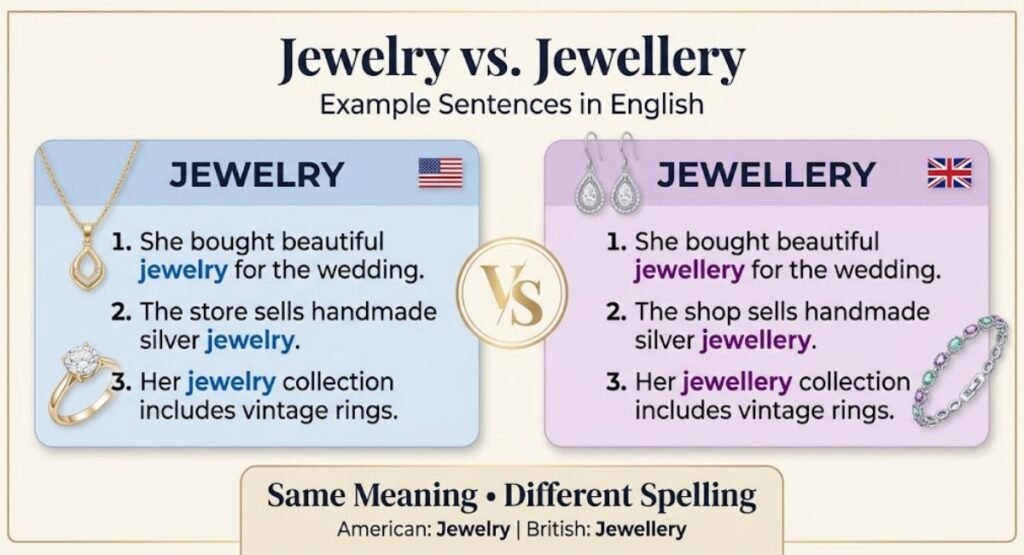
The following examples show how the word works in different situations.
Everyday English
- My grandmother keeps her favourite jewellery in a small wooden box.
- I rarely wear jewellery when I’m working from home.
- She bought two pieces of jewellery at the weekend market.
Shopping and Fashion
- The American boutique sells handmade silver jewelry.
- His jewellery collection includes several vintage brooches.
- The designer paired a simple black dress with colourful statement jewellery.
Formal and Professional English
- The insurance company requested photographs of the missing jewellery.
- The museum displayed jewellery discovered during an archaeological excavation.
- The retailer updated its jewelry descriptions to include metal composition and care instructions.
Cultural and Personal Contexts
- The bride wore traditional jewellery passed down through her family.
- The necklace is inexpensive, but it has great sentimental value.
- Some people choose jewellery to celebrate important personal milestones.
These sentences illustrate an important point: jewellery can describe everyday accessories, historical objects, sentimental possessions, and valuable goods. Its meaning is broader than expensive gemstones.
Synonyms of Jewelry and Jewellery: Important Differences
Not every decorative object is jewellery, and not every word associated with jewellery is an exact synonym.
The distinction becomes clearer when we compare the terms in context.
Jewellery vs. Ornaments
Ornaments refers to objects used for decoration. They may be worn, displayed on furniture, or hung on a tree.
A bracelet can be described as an ornament, but a Christmas tree ornament is not normally jewellery.
Use jewellery when you specifically mean decorative objects worn by people.
Jewellery vs. Accessories
Accessories is broader than jewellery. It includes handbags, belts, scarves, hats, and other items that complement an outfit.
A necklace is both jewellery and a fashion accessory. A handbag is an accessory, but it is not normally jewellery.
Use accessories when discussing several types of fashion additions together.
Jewellery vs. Adornments
Adornments describes decorative additions to a person, object, or place.
It can sound more formal or literary than jewellery.
For example, “The ceremonial adornments reflected local traditions” has a broader meaning than a sentence referring specifically to necklaces and bracelets.
Jewellery vs. Gems
A gem is a precious or decorative stone, particularly one valued for its appearance.
A loose ruby is a gem, but it is not necessarily a finished piece of jewellery.
A ring containing a ruby is jewellery.
This distinction matters in descriptions of gemstones, jewellery manufacturing, and retail products.
Jewellery vs. Trinkets
Trinkets are small decorative objects, often of modest monetary value.
The word can suggest something inexpensive or not particularly important, although a trinket may have sentimental value.
Calling a valuable heirloom necklace a trinket could sound dismissive.
| Word | Best used for | Main difference |
| Jewellery | Wearable decorative objects | Broad category |
| Ornaments | Decorative objects generally | Not necessarily wearable |
| Accessories | Items complementing an outfit | Includes non-jewellery items |
| Adornments | Decorative additions | Broader, sometimes formal |
| Gems | Precious or decorative stones | Material rather than finished item |
| Trinkets | Small decorative objects | Often suggests modest value |
Does Jewellery Have an Antonym?
Jewellery does not have a standard direct antonym.
This is because it names a category of objects rather than a quality with a natural opposite. Words such as hot and cold are antonyms, but jewellery does not work in the same way.
You can, however, express contrasting ideas.
Unadorned: She preferred an unadorned appearance.
Plain: He chose a plain outfit without decorative accessories.
Without jewellery: She attended the event without jewellery.
These are contextual contrasts, not exact dictionary antonyms. This distinction is especially important for learners who may assume every English noun must have an opposite.
Jewelry and Jewellery Word Origin
The word jewellery has a longer history than the modern American–British spelling distinction.
According to historical dictionary evidence, Middle English forms such as juelrie developed from Anglo-French and Old French forms related to jewel. The English word was used for precious ornaments and jewel work by the late medieval period.
The deeper origin of jewel is less certain. Etymologists have proposed connections with Medieval Latin jocale and Latin jocus, associated with play or amusement. Other explanations have also been proposed, so the precise ancient derivation should not be presented as settled fact.
Today, jewelry and jewellery are established regional spellings. The historical relationship does not make one spelling more authentic or correct than the other.
Common Jewelry vs. Jewellery Mistakes
Mistake 1: Writing Jewelery or Jewlery
The standard forms are jewelry in American English and jewellery in British English.
The spellings jewelery and jewlery are common learner errors rather than the recommended forms for edited English.
A useful memory aid is to learn the words alongside their related occupations:
- American: jewelry, jeweler
- British: jewellery, jeweller
Mistake 2: Saying “A Jewellery”
Because jewellery is normally uncountable, it doesn’t take a directly.
Incorrect: She bought a jewellery.
Correct: She bought a piece of jewellery.
Even better, when the object is known: She bought a necklace.
The last version is often more natural because it identifies the object directly.
Mistake 3: Saying “Many Jewelries”
In standard everyday English, say many pieces of jewellery rather than many jewelries.
Compare:
Incorrect: The shop sells many jewelries.
Correct: The shop sells many types of jewellery.
Correct: The shop sells rings, bracelets, and necklaces.
The most natural sentence depends on whether you’re discussing different kinds of jewellery or individual products.
Mistake 4: Mixing Regional Spellings
Consider this product description:
“Our jewellery collection includes handmade gold jewelry and silver bracelets.”
The meaning is clear, but the spelling switches unnecessarily.
For a British audience, write:
“Our jewellery collection includes handmade gold jewellery and silver bracelets.”
For an American audience, use jewelry in both places.
Mistake 5: Assuming Jewellery Must Be Expensive
The word jewel is often associated with valuable gemstones, but jewellery has a broader meaning.
A plastic-bead necklace and a diamond necklace can both be jewellery. The difference is in their materials, value, and craftsmanship.
This is why expressions such as costume jewellery, fashion jewellery, and fine jewellery are useful: they identify more specific categories.
Jewelry vs. Jewellery in Shopping, Fashion, and Professional Writing
For an online retailer, the spelling choice is an editorial and localisation decision.
A US-focused store might use the category name “Women’s Jewelry,” while a UK-focused store would typically choose “Women’s Jewellery.” Neither phrase describes a different product category.
The distinction also appears in related terms. American product descriptions often use jewelry box and jeweler, while British descriptions use jewellery box and jeweller.
There is another useful distinction for shoppers: fine jewellery usually refers to pieces made with precious metals and often gemstones, while costume jewellery generally refers to decorative pieces made from less expensive materials. These are commercial categories, not separate dictionary meanings of jewellery.
For formal documents, consistency matters. An insurance inventory, for example, may need to identify individual objects precisely:
“The insured items include one gold necklace, two silver bracelets, and a diamond ring.”
That is more informative than simply writing “several pieces of jewellery,” especially when the value and identity of each item matter.
Jewelry vs. Jewellery Practice Quiz
Test your understanding with these five questions.
Vocabulary Knowledge Check
0/5 answered
1. Which spelling is standard in American English?
Jewelry
Jewellery
Jewelery
2. Which sentence is grammatically correct?
She bought three jewelries.
She bought three pieces of jewellery.
She bought a jewellery.
3. Which word refers specifically to a precious stone?
Accessory
Jewel
Jewellery box
4. Which spelling is standard in British English?
Jewlery
Jewelry
Jewellery
5. Which statement is accurate?
Jewellery must contain diamonds.
Jewellery is always expensive.
Jewellery can be made from inexpensive materials.
Conclusion
The difference between jewelry and jewellery is spelling, not meaning. American English uses jewelry, while British English uses jewellery. Both describe decorative objects worn on the body, from inexpensive beaded bracelets to valuable gold necklaces.
For learners, the grammar is just as important as the spelling. Jewellery is normally uncountable, so expressions such as a piece of jewellery and several items of jewelry are more natural than a jewellery or jewelries.
When writing, choose the spelling appropriate for your audience. When speaking, remember that both two- and three-syllable pronunciations are recognised.
Frequently Asked Questions
Is jewelry or jewellery the correct spelling?
Both jewelry and jewellery are correct English spellings. Jewelry is the standard spelling in American English, while jewellery is preferred in British English. Both refer to decorative items such as rings, necklaces, and bracelets. Choose the spelling that matches your intended audience and use it consistently throughout your writing.
What is the difference between jewelry and jewellery?
The main difference between jewelry and jewellery is regional spelling, not meaning. American English generally uses jewelry, while British English uses jewellery. Both words describe decorative objects worn for personal adornment. They follow the same grammatical rules and share accepted pronunciations, so neither spelling changes the meaning of a sentence.
Is jewellery British English or American English?
Jewellery is the standard British English spelling, commonly used in the United Kingdom and countries such as Australia, New Zealand, India, and Pakistan. American English generally uses jewelry instead. Both forms are grammatically correct, but writers should follow their audience’s regional spelling conventions, especially in academic, professional, and commercial content.
How do you pronounce jewelry and jewellery?
Jewelry and jewellery share accepted pronunciations despite their different spellings. A common three-syllable pronunciation is /ˈdʒuː.əl.ri/, approximately “JOO-uhl-ree.” A two-syllable variant is /ˈdʒuːl.ri/, approximately “JOOL-ree.” Both place the main stress on the first syllable. Pronunciation varies with accent and speaking style rather than spelling alone.
Is jewelries a correct plural form?
Jewelries is generally not the standard plural form in everyday English because jewelry and jewellery are normally uncountable nouns. Instead, use expressions such as “two pieces of jewelry” or “several items of jewellery.” The related word jewel is countable, so its regular plural, jewels, is grammatically correct.


One Comment