

Timeout vs. Time Out: Meaning in English & Examples
Timeout is a noun describing a pause or an event caused by reaching a time limit. Time out is a phrasal verb meaning to stop after a specified period. Time-out is another accepted noun spelling. Use timeout for a technical error, time out for an action, and time-out when your writing style requires it.
Understanding the difference between timeout and time out in English can save you from a surprisingly common writing mistake. Consider two messages: “Your session has a timeout” and “Your session timed out.” They describe related situations, but one names a time-limit event while the other tells you what happened.
The distinction matters beyond computer screens. Basketball coaches call timeouts, parents may use time-outs, and busy people take time out of their schedules. The words are closely related, yet their spelling and grammatical roles change with the situation. Once you understand those differences, choosing the right form becomes much easier.
Timeout vs. Time Out: What’s the Difference?
The most useful distinction is between a noun and a verb. Timeout is commonly a noun, while time out is a verb phrase when it means to reach a time limit and stop waiting or operating.
Compare these sentences:
“The request ended in a timeout.”
“The request timed out.”
The first sentence names the event. The second describes what the request did. Both are natural in technical English, although the second is often more direct when reporting an error.
| Expression | Grammatical role | Example |
| Timeout | Noun | The server reported a timeout. |
| Time out | Phrasal verb | The request may time out. |
| Timed out | Past-tense verb | The connection timed out. |
| Time-out | Alternative noun spelling | The referee granted a time-out. |
| Take time out | Verb + noun phrase | She took time out to rest. |
There is one important complication: not every occurrence of time out is a phrasal verb. In “take time out of your day,” the word time functions as a noun. This is why the familiar advice that “one word is a noun and two words are always a verb” is incomplete.
Timeout Meaning in Sports, Technology, and Everyday English
A timeout generally involves stopping an activity or reaching a limit associated with time. The reason for the stoppage depends on the setting. In sports, someone may request it deliberately. In computing, it may happen automatically when a configured limit is reached.
The word is also used conversationally when someone wants to interrupt a discussion. These meanings share a basic idea, but they should not be treated as interchangeable.
Timeout in Basketball and Other Sports
A timeout is an official interruption of play permitted under a sport’s rules. In basketball, teams may use timeouts to discuss tactics, organize a possession, or make adjustments.
Imagine a team trailing by two points with only a few seconds remaining. The coach calls a timeout to draw up a final play. Here, timeout names a regulated stoppage, not a general rest period.
The noun may also be hyphenated as time-out. A publication’s style guide determines which spelling it prefers.
Timeout in Computers and Websites
A technical timeout occurs when an operation reaches a configured waiting or inactivity limit. This is different from a system simply being slow.
Suppose a browser sends a request to a server. If the response does not arrive within the applicable time limit, the request may time out. The application might then display an error, retry the request, or take another action.
Three expressions are especially useful:
- Connection timeout: A time limit associated with establishing or maintaining a connection, depending on the system.
- Request timeout: A request reaches its configured waiting limit.
- Session timeout: A session reaches a configured inactivity or duration limit.
These expressions are related but not identical. A session timeout may sign a user out, while a request timeout may affect only one operation.
Timeout in Parenting
A time-out may refer to a temporary break from an activity, sometimes used in response to a child’s behavior. The hyphenated noun is familiar in parenting discussions.
For example, “The child took a short time-out before returning to the game.”
The word describes the pause itself. It does not establish whether a particular parenting method is appropriate or effective, which is a separate question.
Timeout in Casual Conversation
Someone may say “Timeout!” when they want everyone to stop for a moment.
“Timeout! You’re talking about two different problems.”
This is an informal request for a pause. It can be useful in a confusing conversation, but it may sound abrupt in a formal meeting. In professional communication, “Could we pause for a moment?” is often more courteous.
Time Out Meaning as a Verb
As a phrasal verb, time out commonly describes a process that reaches its time limit and stops waiting or operating. It is especially common in computing and networking.
“The payment request will time out after thirty seconds.”
Here, time out follows the auxiliary verb will, so it remains in its base form. Writing will timeout is not the standard choice in edited technical English.
What Does Timed Out Mean?
Timed out is the past-tense and past-participle form of time out.
“The server timed out before returning the requested information.”
This sentence indicates that the relevant waiting limit was reached. It does not, by itself, establish why the response was delayed. The cause could involve network conditions, server processing, configuration, or another technical issue.
What Does Take Time Out Mean?
Take time out means to set aside time for something, often away from regular duties or activities.
“Amira took time out of her afternoon to help a colleague.”
This expression does not describe a timeout error. Grammatically, took is the verb and time is its noun object.
Compare:
“The meeting was paused for a short break.”
“The online meeting session timed out.”
Both involve a stoppage, but only the second describes an operation reaching a time limit.
Timeout vs. Time Out Pronunciation
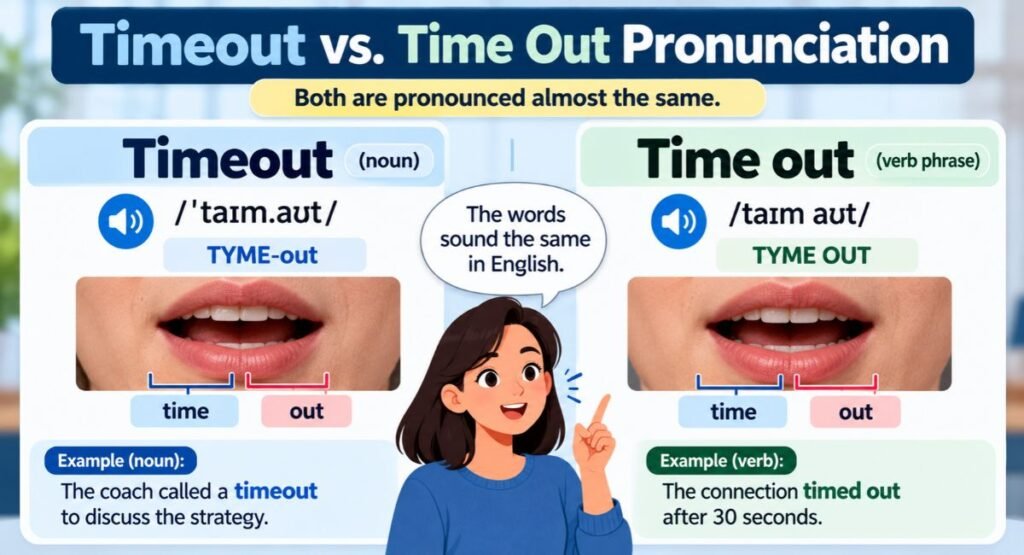
The noun timeout and the verb phrase time out contain the same basic sounds. The difference between their written forms does not require a pause in speech.
| Expression | Simple phonetics | IPA |
| Timeout | TYME-out | /ˈtaɪm.aʊt/ |
| Time out | TYME OUT | /taɪm aʊt/ |
| Time-out | TYME-out | /ˈtaɪm.aʊt/ |
The first part rhymes with climb, and the second sounds like the word out. Some speakers emphasize the first part of the noun, while sentence rhythm may change the stress of the verb phrase.
For learners, the important point is that pronunciation alone may not tell you which spelling to use. You need the surrounding sentence to identify the grammatical function.
Timeout vs. Time Out Grammar Rules
The spelling distinction becomes clearer when you look at sentence structure. Nouns can follow articles, take plural endings, and modify other nouns. Verbs change form according to tense and agreement.
Timeout as a Countable Noun
When timeout names an individual event, it is countable.
“The application recorded three timeouts.”
“The coach requested another timeout.”
The plural is timeouts, not times out. However, times out is correct as a present-tense verb, as in “The session times out after inactivity.”
This distinction is particularly useful because the two forms can look similar in writing.
Timeout as a Noun Modifier
Technical English often places timeout before another noun.
“The developer increased the timeout duration.”
“The system displayed a timeout error.”
In these examples, timeout identifies the type of duration or error. The one-word spelling is conventional in many software and networking contexts.
Time Out Verb Forms
| Form | Example |
| Base form | The request may time out. |
| Third-person singular | The session times out automatically. |
| Past tense | The connection timed out. |
| Present participle | The application keeps timing out. |
| Future | The operation will time out. |
The two-word structure remains separate in every form.
In ordinary technical descriptions, the verb is often intransitive: “The connection timed out.” Some technical contexts also use it transitively: “The system timed out the request.”
Prepositions Used With Time Out
Common patterns include time out after, take time out from, and take time out of.
“The session will time out after fifteen minutes.”
“She took time out from work to travel.”
“He took time out of his day to help a neighbor.”
Notice that the last two sentences use take time out, not the technical phrasal verb. Their grammatical structures are different even though the words appear together.
Original Timeout vs. Time Out Example Sentences
The following sentences show how the expressions work in different settings.
Technology Examples
- The online form displayed a timeout error before I could submit it.
- The connection timed out while the application was downloading a file.
- The administrator changed the timeout setting from thirty to sixty seconds.
- The request will time out if the service does not respond within the configured limit.
The first and third examples use timeout as a noun or noun modifier. The second and fourth use the verb time out.
Sports Examples
- The coach called a timeout to discuss the final play.
- The team had no timeouts remaining near the end of the game.
Both examples use the countable noun.
Everyday Conversation Examples
- “Timeout! I think we’ve misunderstood the question.”
- I took time out of my weekend to help my sister move.
- She took some time out from studying before her final exam.
The first example requests a pause. The other two describe setting aside time for another activity.
Formal Writing Examples
- The technical report documented repeated database timeouts during testing.
- The authentication session timed out after the configured inactivity period.
- The engineering team reviewed the timeout threshold before deploying the update.
These sentences are suitable for professional technical writing because they distinguish events, actions, and settings precisely.
Synonyms of Timeout and How Their Meanings Differ
Words such as break, pause, and delay may appear similar to timeout, but replacing one with another can change the meaning of a sentence.
| Word | How it differs from timeout |
| Break | Usually suggests rest or a temporary stop rather than a defined time-limit event. |
| Pause | Emphasizes stopping briefly, often with the intention of continuing. |
| Interruption | Describes something that disturbs or stops an activity, whether planned or unexpected. |
| Delay | Means an event takes longer than expected; it does not necessarily stop. |
| Suspension | Often refers to an official or temporary halt. |
| Recess | Usually describes an authorized break in school or formal proceedings. |
| Intermission | Refers to a planned interval in a performance or event. |
| Expiration | Describes the end of a validity period, which may result from a timeout but is not always one. |
Timeout vs. Break
A worker takes a break to rest. A basketball team calls a timeout under the rules of the game. Although both involve stopping, break does not communicate the same official or technical meaning.
Timeout vs. Pause
A paused video is generally expected to continue when someone presses play. A timed-out request may have failed and may need to be started again. Therefore, pause is not always a suitable replacement for timeout.
Timeout vs. Delay
A delayed response might eventually arrive. A timed-out request has reached its applicable waiting limit. A delay can contribute to a timeout, but the two expressions identify different events.
Timeout vs. Expiration
A login session may expire because of inactivity. A subscription may expire because its paid period ends. Only the first situation is commonly associated with an inactivity timeout.
Antonyms and Opposite Expressions of Timeout
There is no universal opposite of timeout. The most suitable expression depends on the intended meaning.
| Context | Opposite expression | Example |
| Sports | Resumption of play | Play resumed after the timeout. |
| Computing | Successful completion | The request completed successfully. |
| Online accounts | Active session | The user’s session remained active. |
| General activity | Continuation | The discussion continued without interruption. |
| Networking | Maintained connection | The connection remained active throughout the transfer. |
These are contextual opposites rather than exact dictionary antonyms. For example, successful completion contrasts with a failed request, but it is not the opposite of a basketball timeout.
Origin and Etymology of Timeout
Timeout is formed from the English words time and out. The compound is established in sporting terminology, where it refers to an official interruption of play.
The term also has a technical meaning in computing, where it refers to limits on waiting or inactivity. Both uses involve time and stopping, but they operate differently.
The exact dates of the earliest recorded sporting use, the closed spelling timeout, and the first computing use are not established here. Assigning specific dates or claiming a precise historical sequence without dated dictionary evidence would be misleading.
Common Mistakes With Timeout, Time Out, and Timed Out
A common problem is choosing the spelling based only on sound. Because the expressions are pronounced similarly, learners may overlook the difference between nouns and verbs.
Mistake: Using Timeout as a Verb
Incorrect: The website will timeout.
Correct: The website will time out.
The sentence needs a verb after will, so the two-word form is appropriate.
Mistake: Writing Timedout as One Word
Incorrect: The connection timedout.
Correct: The connection timed out.
The past-tense form remains two words.
Mistake: Writing Timesout Instead of Times Out
Incorrect: The session timesout after inactivity.
Correct: The session times out after inactivity.
The third-person singular verb is times out. It is different from the plural noun timeouts.
Mistake: Treating Time-Out as Incorrect
Incorrect assumption: Only timeout can be used as a noun.
Correct understanding: Timeout and time-out are both accepted noun spellings. Their use varies by context and editorial style.
Mistake: Assuming Every Timeout Is a Rest Break
A technical timeout does not mean the system is resting. It indicates that a configured time limit has been reached.
Likewise, a sports timeout is an official stoppage, not necessarily a relaxation period.
How to Choose the Correct Spelling
When you are unsure, read the complete sentence rather than focusing on the expression alone.
Quick Grammar Check
Is it naming an event or setting?
Use timeout in common technical writing: “A timeout occurred.”
Is it describing an action?
Use time out: “The request will time out.”
Is it a hyphenated noun in a sports or parenting context?
Time-out may be appropriate: “The referee granted a time-out.”
Does it mean setting aside time?
Use the expression take time out: “She took time out to rest.”
This approach works better than memorizing a rigid rule that ignores the difference between a phrasal verb and an open noun phrase.
Timeout vs. Time Out Practice Quiz
Choose the correct expression in each sentence before checking the answers.
1. The connection will _____ after thirty seconds.
timeout
time out
time-out
2. The application recorded three _____ yesterday.
timeouts
times out
timed outs
3. My session _____ before I saved the form.
timedout
timed out
timeout
4. The coach requested a _____ during the game.
timed out
times out
timeout
5. She took _____ from her studies to visit her family.
time out
timeout
timed out
Check answersReset
Conclusion
The difference between timeout and time out is primarily grammatical. Timeout commonly names a pause, time-limit event, or technical setting. Time out describes an action when used as a phrasal verb, while time-out is another accepted noun spelling.
The most useful habit is to identify whether you need a noun or a verb. Remember that take time out is a separate expression meaning to set aside time. These distinctions will help you write naturally in everyday English, sports discussions, and technical communication.
Frequently Asked Questions
Timeout is commonly one word as a noun. Time out is two words. Is timeout one word or two words?
Timeout is commonly written as one word when used as a noun, especially in technology. Time out is written as two words when functioning as a phrasal verb. The hyphenated spelling, time-out, is also an accepted noun form. The correct choice depends on the sentence’s grammar and writing style.
What is the difference between timeout and time out?
The main difference is grammatical. Timeout is generally a noun describing a pause or an event caused by reaching a time limit. Time out is commonly a phrasal verb describing an operation that stops after a specified period. For example, “A timeout occurred” uses a noun, while “The connection timed out” uses a verb.
Is time-out grammatically correct in British English?
Yes, time-out is an accepted noun spelling in British English. It can describe an official pause in sports or a temporary break from an activity. Timeout is also used, particularly in technical contexts. The preferred spelling depends on the publication’s editorial style, so writers should follow a consistent convention.
Should I write connection timeout or connection timed out?
Both expressions are correct, but they serve different grammatical purposes. Connection timeout is a noun phrase describing a time-limit event or setting. Connection timed out describes what happened to the connection. For example, “A connection timeout occurred” names the event, while “The connection timed out” explains the action.
What is the past tense of time out?
The past tense of the phrasal verb time out is timed out, written as two separate words. For example, “The website timed out before the page loaded.” The present-tense forms include time out and times out, while the continuous form is timing out. Timedout, written as one word, is not standard English.





One Comment