
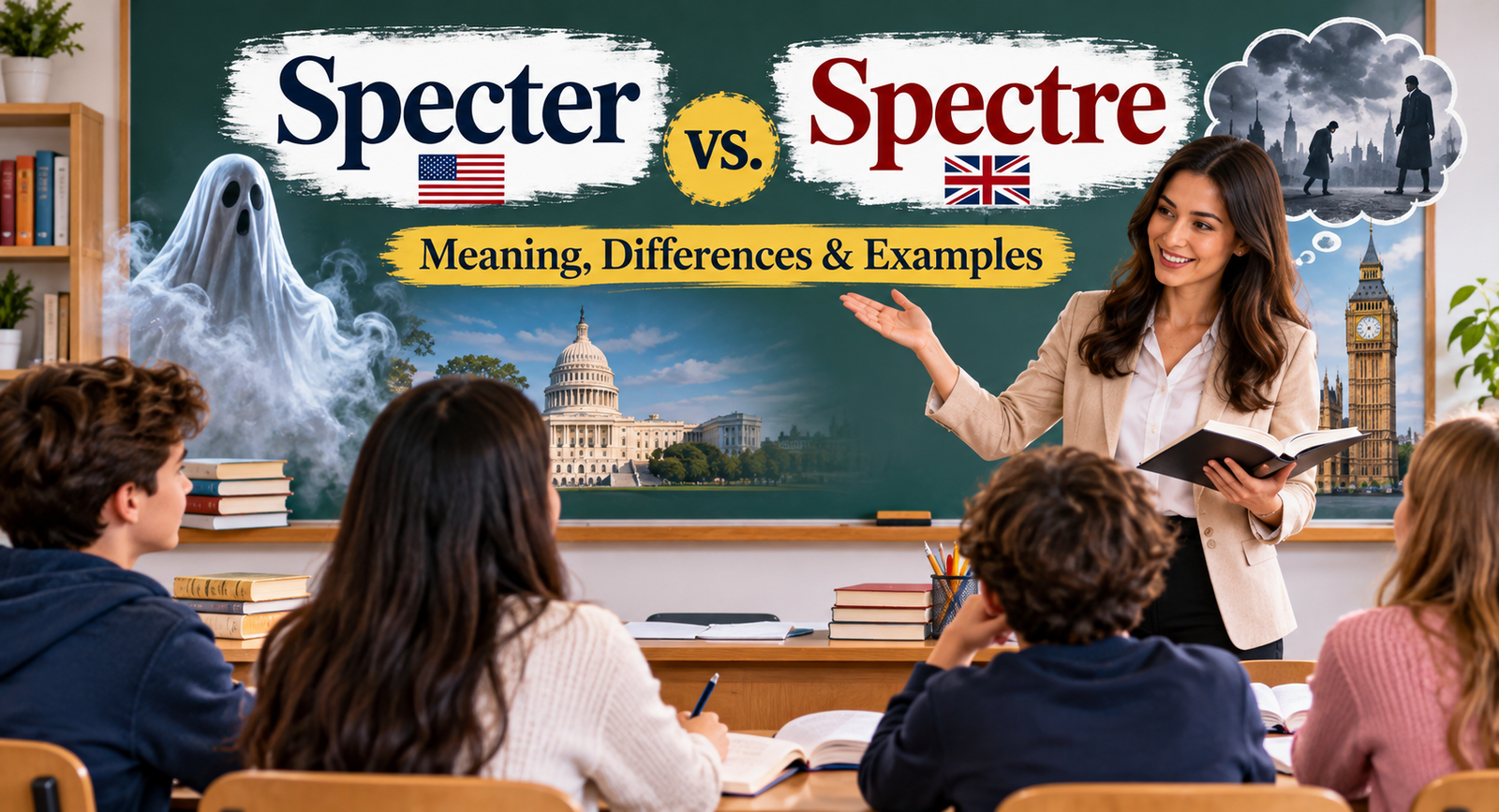
Specter vs. Spectre: Meaning, Differences & Examples
Specter and spectre are two spellings of the same English noun. Specter is the standard American spelling, while spectre is the British spelling. Both words can describe a ghost or a frightening possibility, such as war, unemployment, or financial collapse. Their meaning is identical, but the preferred spelling depends on the variety of English you use.
The difference between spectre and spectre is straightforward, yet choosing the right word involves more than remembering American and British spelling conventions. Both forms can describe something supernatural or an unwelcome possibility that continues to trouble someone’s thoughts.
You might read about a spectre haunting an old house in a British novel or the specter of recession worrying investors in an American newspaper. Although these examples describe different situations, the underlying idea is similar: something frightening, whether real, imagined, or anticipated.
Understanding how this word works in different contexts will help you recognise its meaning, choose appropriate alternatives, and avoid common spelling and usage mistakes.
Specter vs. Spectre: What Is the Difference?
The difference between specter and spectre is regional spelling. American English generally uses specter, while British English uses spectre. Neither spelling changes the word’s definition, grammatical function, or underlying pronunciation.
Both versions can refer to an apparition or an unpleasant possibility that causes worry. The correct spelling therefore depends primarily on your intended audience and the spelling conventions followed by your publication.
| Feature | Specter | Spectre |
| Preferred variety | American English | British English |
| Meaning | Ghost or frightening possibility | Ghost or frightening possibility |
| Part of speech | Noun | Noun |
| Plural | Specters | Spectres |
| Syllables | Two | Two |
| Example | The specter of recession | The spectre of recession |
Cambridge Dictionary and Oxford Learner’s Dictionaries recognise these regional spelling differences and the word’s literal and figurative meanings.
When to Use Specter in American English?
Use specter when writing according to American English conventions. It appears in discussions about economic uncertainty, political developments, fictional ghosts, and personal fears. The spelling is appropriate in American news reporting, essays, and creative writing.
For example, “The specter of another recession unsettled investors” suggests concern about a possible economic downturn. The sentence does not claim that a recession has already begun. Instead, it describes the anxiety created by that possibility.
When to Use Spectre in British English?
Spectre is the usual spelling in British English. It is also common in Australian and New Zealand English, although individual publications may follow their own editorial conventions.
A British writer might use the sentence, “The spectre of further job losses troubled the community.” Its meaning is identical to the American version with specter. The spelling simply follows a different regional convention.
A useful reminder is that American English often uses -er where British English uses -re. Compare center and centre or theater and theatre. This pattern is helpful for remembering the spelling, although it is not a universal rule for English vocabulary.
What Does Specter Mean in English?
Specter has two established meanings. The older, literal sense refers to a ghost or apparition. The figurative sense describes a frightening possibility, especially something unpleasant that people believe might happen in the future.
The figurative meaning is particularly useful because it suggests a fear that remains present, even when the feared event has not occurred. This distinguishes the expression from simply reporting that something dangerous has happened.
Specter Meaning as a Ghost
In supernatural stories, a specter is a ghostly figure or apparition. The term often creates a mysterious or unsettling atmosphere, which makes it suitable for Gothic fiction, fantasy, and descriptions of supposedly haunted places.
Consider this sentence:
“The caretaker claimed that a pale specter appeared near the abandoned staircase every midnight.”
Here, specter describes an apparition. The writer could replace it with ghost, but specter creates a more literary impression. It encourages the reader to imagine something eerie and difficult to explain.
The word itself does not prove that a supernatural event occurred. It can describe a fictional ghost, a reported sighting, or an appearance within a dream.
Specter Meaning as a Frightening Possibility
The figurative meaning describes the prospect of something undesirable. Common examples include the specter of war, the specter of unemployment, and the specter of financial collapse.
Consider:
“The specter of bankruptcy influenced every decision the struggling company made.”
This does not necessarily mean that bankruptcy is inevitable. It means the possibility is sufficiently troubling to affect decisions.
The expression is useful when a threat seems to linger over a situation. A risk might be calculated or briefly mentioned, but a specter is usually presented as something emotionally troubling or difficult to ignore.
Spectre Meaning in British English
Spectre has the same meanings as specter. British writers can use it to describe an apparition or an anticipated danger. The spelling does not make the word more supernatural, formal, or serious than its American equivalent.
In the sentence “A spectre stood beside the ruined chapel,” the meaning is literal. In “The spectre of another conflict dominated the negotiations,” the meaning is figurative. Context, rather than spelling, determines the interpretation.
Why the Figurative Meaning Matters
Many learners associate spectre only with ghosts. That interpretation can cause confusion when the word appears in a newspaper headline about economics, public policy, or international relations.
For instance, “The spectre of inflation” does not suggest a supernatural presence. It describes anxiety about inflation or the possibility that inflation may become a problem.
A useful reading strategy is to look at the noun following of. If it names an unwanted event or condition, such as recession, famine, or unemployment, the figurative meaning is usually intended.
How to Pronounce Specter and Spectre?
Both spellings have two syllables, with the stress on the first syllable. Within the same accent, specter and spectre are pronounced identically. Regional differences mainly concern whether speakers pronounce the final r.
| Pronunciation | Simple phonetics | IPA |
| American English | SPEK-ter | /ˈspek.tɚ/ |
| British English | SPEK-tuh | /ˈspek.tə/ |
Cambridge Dictionary records the American and British pronunciations and identifies the same regional differences for both spellings.
Pronunciation in English
American English Pronunciation
In many American accents, the final syllable contains an audible r sound. The first syllable receives the stress, while the second is shorter and unstressed.
The pronunciation does not change when an American speaker reads the British spelling spectre. It remains the same word, regardless of how it is written.
British English Pronunciation
In standard southern British English, the final r is generally not pronounced when the word appears alone. This creates a softer final syllable compared with common American pronunciation.
However, not all British accents are non-rhotic. Speakers of rhotic accents may pronounce the r, and pronunciation can also change in connected speech. It would therefore be inaccurate to claim that every British speaker omits the final r.
Is Specter a Noun? Grammar and Plural Forms
Specter and spectre are countable nouns. Both can appear in singular and plural forms, function as the subject or object of a sentence, and take articles such as a and the.
They are not standard English verbs. Forms such as spectering or spectered are not part of their ordinary grammatical use. Instead, writers combine the nouns with verbs such as haunt, loom, appear, or raise.
Singular and Plural Forms
| Form | American English | British English |
| Singular | Specter | Spectre |
| Plural | Specters | Spectres |
| Indefinite form | A specter | A spectre |
| Possessive singular | Specter’s | Spectre’s |
For example, “Several specters appeared in the abandoned mansion” uses the American plural form. In British English, the sentence would normally use spectres.
The figurative meaning can also be pluralised. A writer might refer to “the twin spectres of unemployment and poverty” when discussing two distinct sources of fear.
How to Use “The Specter of” Correctly
One of the most useful constructions is:
The specter/spectre of + noun or noun phrase
Examples include:
- The specter of war
- The spectre of widespread unemployment
- The specter of bankruptcy
- The spectre of another drought
- The specter of losing public support
The expression identifies the event, condition, or outcome that people fear.
Writers also use longer combinations, including “raise the spectre of” and “be haunted by the specter of”. These phrases are recorded in established learner dictionaries.
Oxford Learner’s Dictionaries
Common Expressions With Specter and Spectre
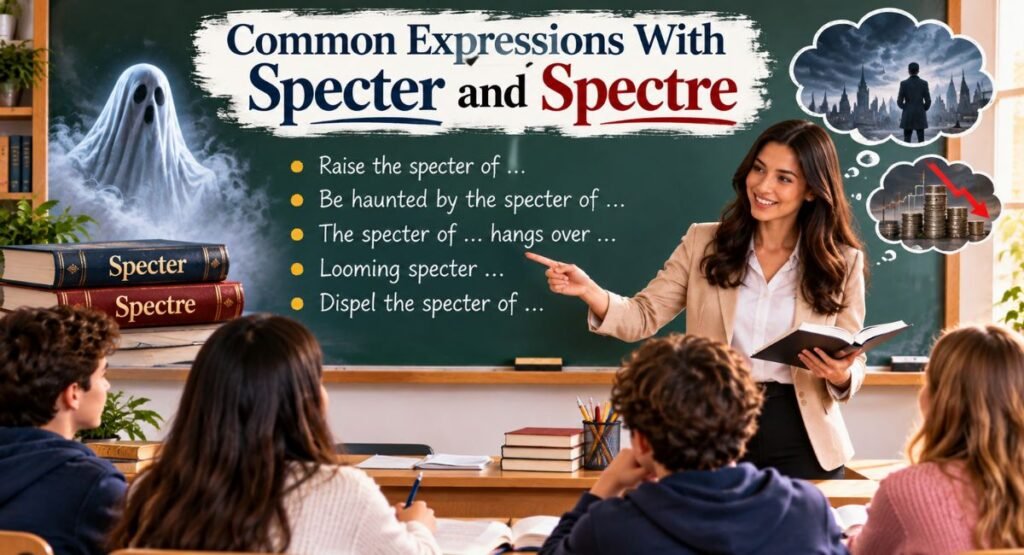
Knowing a word’s definition is useful, but knowing which words naturally accompany it makes writing considerably more fluent. Specter frequently appears in combinations describing the emergence, persistence, or removal of a fear.
These expressions are not identical. Some introduce a new concern, while others suggest that a worry has remained unresolved for a long time.
| Expression | Meaning | Original example |
| Raise the spectre of | Introduce concern about a possible danger | The announcement raised the spectre of further closures. |
| Loom over | Remain as a threatening possibility | The specter of debt loomed over the family. |
| Be haunted by | Remain troubled by a fear or memory | He was haunted by the specter of failure. |
| Hang over | Continue to affect a situation | The spectre of conflict hung over the meeting. |
| Dispel the specter of | Remove or reduce a particular fear | The agreement helped dispel the specter of immediate layoffs. |
Raise the Spectre of vs. Looming Specter
“Raise the spectre of” usually introduces or revives concern about something. For example, a government announcement might raise the spectre of higher taxes if it causes people to consider that possibility.
A “looming specter” emphasises a danger that appears to be approaching or becoming increasingly significant. The expression is more dramatic and should be used when the context supports that degree of concern.
In an objective report, a simpler expression such as “increased the risk of” may be more appropriate. Specter is useful for conveying apprehension, but it should not replace a precise explanation of likelihood.
Specter vs. Spectre Example Sentences in Different Contexts
The following original examples show how both spellings work in fiction, journalism, workplace communication, and personal reflection. The grammatical patterns remain the same; only the regional spelling changes.
American English Examples Using Specter
- The specter of a prolonged recession made small-business owners cautious about borrowing money.
- A shadowy specter appeared beside the lighthouse shortly before dawn.
- The specter of losing his scholarship troubled Daniel throughout the semester.
- Investors remained concerned about the specter of renewed inflation.
- In the novel, a specter follows the protagonist through the deserted railway station.
- The specter of another failed harvest encouraged farmers to reconsider their planting plans.
British English Examples Using Spectre
- The spectre of further job losses unsettled employees at the factory.
- A silent spectre appeared in the castle’s western corridor.
- The spectre of conflict overshadowed the diplomatic talks.
- Residents faced the spectre of another winter with unusually high energy bills.
- The mysterious spectre vanished when the chapel bells began to ring.
- The spectre of a funding shortage forced the charity to reconsider its future projects.
How the Tone Changes With Contex?
Compare these three sentences:
- Casual: “I’m worried I might lose my job.”
- Neutral: “There is a risk of further job losses.”
- Literary or dramatic: “The specter of unemployment hung over the household.”
All three relate to uncertainty about employment, but their emotional effect differs.
The first describes a personal feeling directly. The second identifies a possible outcome without strong imagery. The third suggests a persistent fear affecting the household.
This difference is important for English learners because choosing a more dramatic word does not automatically produce better writing. The strongest choice is the one that fits the situation.
Specter vs. Ghost, Phantom, and Apparition
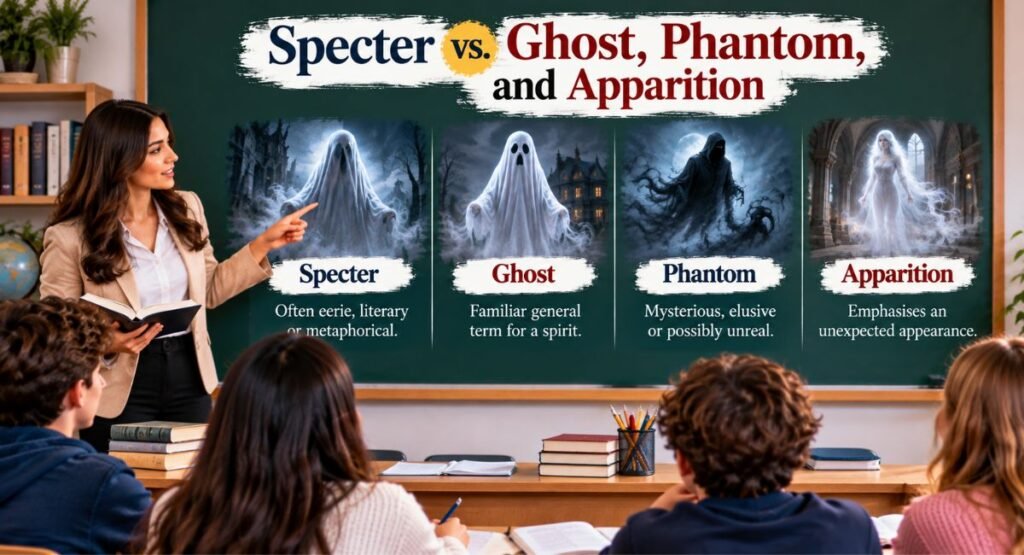
Specter has several closely related synonyms, but they do not always communicate the same impression. Understanding these distinctions helps writers choose language that matches the intended tone.
The differences are especially noticeable in fiction. Ghost is relatively familiar, while specter and apparition can sound more literary. Phantom often suggests something elusive or difficult to establish as real.
| Word | Main nuance | Suitable context |
| Ghost | Familiar general term for a spirit | Everyday language, horror stories |
| Specter | Often eerie, literary or metaphorical | Gothic fiction, figurative threats |
| Phantom | Mysterious, elusive or possibly unreal | Fantasy, mysterious sightings |
| Apparition | Emphasises an unexpected appearance | Supernatural reports, fiction |
| Wraith | Shadowy, often associated with death | Dark fantasy, Gothic writing |
| Spirit | Broad supernatural meaning, not necessarily frightening | Religious, spiritual or fictional contexts |
Is Specter Stronger Than Ghost?
Specter is not automatically more frightening than ghost. Its effect depends on the sentence. However, it often sounds more formal, old-fashioned, or literary, which can create a heightened atmosphere.
“The children claimed they saw a ghost” sounds natural in everyday speech. “The children encountered a specter” sounds more like a sentence from a supernatural novel.
The underlying claim may be similar, but the writing style is noticeably different.
Specter vs. Threat, Risk, and Dread
The figurative meaning of specter deserves separate attention because its closest alternatives are not always true synonyms. Risk describes the possibility of an undesirable event, while threat identifies potential danger.
Dread is different: it refers to the emotional experience of intense fear. Specter can describe the feared possibility itself, especially when that possibility seems to affect people’s thoughts or decisions.
| Word | Distinction |
| Specter | A frightening possibility that seems to linger |
| Threat | Something with the potential to cause harm |
| Risk | The possibility of an undesirable outcome |
| Menace | A dangerous or intimidating presence |
| Dread | Strong fear or apprehension |
| Foreboding | A sense that something bad may happen |
| Omen | A sign believed to predict an event |
When Is “Risk” Better Than “Specter”?
Use risk when the sentence focuses on probability, exposure, or practical consequences. It is often clearer in technical, scientific, financial, and safety-related writing.
For example, “The project faces a significant risk of delays” is direct and appropriate for a project report.
“The specter of delays hangs over the project” emphasises anxiety rather than measurable likelihood. It may suit commentary, but it is less precise when reporting a formal risk assessment.
Does Specter Have an Antonym?
There is no universal antonym for specter because its literal and figurative meanings work differently. A ghost does not have a straightforward opposite in ordinary English.
When specter refers to a frightening possibility, contextual opposites include reassurance, safety, confidence, security, and peace of mind.
For example, “The specter of bankruptcy troubled the owners” contrasts naturally with “The new financing agreement gave the owners greater financial security.”
The second sentence does not contain a dictionary antonym of specter. Instead, it describes a reassuring condition that contrasts with the original fear.
Word Origin: Where Do Specter and Spectre Come From?
Specter and spectre trace back to French spectre and Latin spectrum, words associated with an image, appearance, or apparition. The Latin connection ultimately relates to specere, meaning to look or observe.
The word entered English around 1600 with a supernatural meaning. According to the Online Etymology Dictionary, the figurative sense referring to an object of dread is documented from 1774.
How the Meaning Developed
The connection between the literal and figurative meanings is a metaphor.
A ghost may seem to follow or haunt someone. Similarly, an unresolved fear can seem to follow a person through everyday life, affecting their thoughts even when no immediate danger is visible.
This explains why the word works naturally in expressions such as “the specter of failure” or “the spectre of war”. The feared possibility is described as though it were an unwelcome presence.
Specter, Spectrum, and Spectral
These related words share historical roots but have different modern uses.
Specter means a ghost or frightening possibility. Spectrum can describe a range, including a range of colours, frequencies, or opinions. Spectral is an adjective meaning ghostlike or, in technical contexts, relating to a spectrum.
For example, “spectral light” belongs to scientific vocabulary, while “a spectral figure” belongs to the language of supernatural appearances.
The shared history does not make these words interchangeable.
Why Is It Specter in America and Spectre in Britain?
The spelling distinction is part of a broader pattern in English. Several words traditionally ending in -re became standardised with -er endings in American English.
Noah Webster’s influence on American spelling helped establish this pattern in words such as center and theater. British English generally preserved the corresponding -re endings.
The difference between specter and spectre therefore reflects a historical spelling convention, not a change in meaning.
Etymology, Origin & Meaning
Is Spectre Incorrect in American English?
No. American readers can understand spectre, and the spelling may appear in quotations, titles, proper names, or writing influenced by British conventions.
However, specter is the standard choice when following general American spelling conventions. Similarly, spectre is preferable for ordinary British English writing.
An editor should not automatically change a proper name or official title merely to match a regional spelling preference.
Common Mistakes With Specter and Spectre
Most mistakes involving this word arise from confusing its meaning, spelling, or tone. Learners may also confuse it with visually similar words or assume that the British form has a special meaning.
The following corrections address problems that are especially relevant to this particular word pair.
Mistake: Treating Specter and Spectre as Different Words
Incorrect assumption: Specter means a ghost, but spectre means fear.
Correct usage: Both spellings can represent either meaning.
For example, “the specter of recession” and “the spectre of recession” communicate the same idea. The spelling depends on the English variety being used.
Mistake: Confusing Specter With Scepter
Scepter is a different noun. It refers to a ceremonial staff associated with royal authority. In British English, the corresponding spelling is sceptre.
Compare:
- “The monarch carried a ceremonial scepter.”
- “The specter of rebellion worried the monarch.”
The first sentence describes an object. The second describes a feared possibility.
The similar spellings make this distinction particularly important when proofreading.
Mistake: Assuming Specter Means Something Will Definitely Happen
A specter represents a feared possibility. It does not automatically establish that the event will occur.
“The specter of bankruptcy troubled the company” communicates anxiety about bankruptcy. It does not prove that bankruptcy proceedings have started or that failure is inevitable.
When explaining actual events, choose more precise expressions. For example, “The company filed for bankruptcy” describes a specific occurrence rather than a fear.
Mistake: Using Specter for Every Minor Concern
Although figurative language permits exaggeration, specter may sound unnatural when describing trivial situations.
“The specter of forgetting my shopping list haunted me” is understandable as humour, but it would be unusually dramatic in a normal conversation.
“I was worried about forgetting my shopping list” is simpler and more appropriate.
Mistake: Overusing “The Specter of”
Repeated use of the same dramatic expression can weaken an article. A paragraph mentioning the specter of inflation, the specter of unemployment, and the specter of recession may begin to sound repetitive.
Vary the language according to the specific meaning. Use risk for uncertain outcomes, threat for potential harm, concern for worry, and specter when the metaphor of lingering fear genuinely adds something.
A Special Case: Spectre in James Bond
The British spelling is particularly recognisable because of Spectre. In the James Bond franchise, SPECTRE is also the name of a fictional criminal organisation.
The organisation’s name is traditionally expanded as “Special Executive for Counter-intelligence, Terrorism, Revenge and Extortion.” It is a fictional acronym, not an alternative dictionary definition of the ordinary English noun.
This distinction matters because a reader searching for Spectre may be looking for the film or organisation rather than the meaning of the word. Proper names retain their established spelling and capitalisation regardless of a reader’s regional spelling conventions.
How to Remember Specter vs. Spectre
The easiest method is to connect the spelling with familiar American and British word pairs.
| American English | British English |
| Specter | Spectre |
| Center | Centre |
| Theater | Theatre |
| Fiber | Fibre |
| Liter | Litre |
Remember the meanings separately from the spelling. Both words can describe an apparition, and both can describe a frightening possibility. The only spelling decision is which regional convention the writing follows.
To check your understanding, consider two sentences: “A spectre appeared at the castle window” and “The specter of recession worried the board.” The first is literal and follows British spelling; the second is figurative and follows American spelling.
Conclusion
Specter vs. spectre is a regional spelling distinction rather than a difference in meaning. Specter is standard in American English, while spectre is preferred in British English. Both refer to a ghost or a frightening possibility that causes concern.
The most useful skill is recognising how the word changes meaning according to context. In fiction, it can describe a supernatural appearance. In journalism or formal discussion, it often suggests a lingering fear about an uncertain future event.
Choose the spelling appropriate for your audience, use the word when its slightly dramatic tone fits, and select simpler alternatives when direct language communicates the idea more effectively.
Frequently Asked Questions About Specter vs. Spectre
Is it specter or spectre in American English?
Specter is the standard spelling in American English, while spectre is the preferred spelling in British English. Both words have the same meanings and refer to a ghost, supernatural apparition, or frightening possibility. American writers normally use specter in journalism, academic work, and professional communication when following American spelling conventions.
What is the difference between specter and spectre?
The difference between specter and spectre is regional spelling rather than meaning. Specter is standard in American English, while spectre is preferred in British English. Both are nouns describing a ghost or a feared possibility. Their grammatical uses are the same, and either spelling can express the literal or figurative meaning.
Do specter and spectre have the same pronunciation?
Yes, specter and spectre are pronounced identically within a given accent. Both have two syllables, with stress on the first syllable. Many American speakers pronounce the final r, while speakers of non-rhotic British accents generally omit it at the end of the word. These differences concern accents, not spelling.
Is spectre a ghost or a symbol of fear?
Spectre can mean both a ghost and a frightening possibility. Its literal meaning describes a supernatural apparition, particularly in literary contexts. Figuratively, it refers to an unpleasant event that people fear might happen, such as war or unemployment. The words surrounding spectre help readers determine which meaning is intended.
Can specter and spectre be used interchangeably?
Yes, specter and spectre are interchangeable in meaning, but they follow different regional spelling conventions. American writers generally use specter, while British writers prefer spectre. Both forms can describe a ghost or frightening possibility. In professional writing, choosing one spelling convention and using it consistently is usually the best approach.
Editorial Note and Sources
This article was prepared with AI assistance and revised using dictionary references. The definitions, pronunciation, grammatical classifications, and historical claims were checked against established English-language reference sources. Original example sentences illustrate usage and are not presented as dictionary quotations.
For the final published byline, use the actual author’s name and include “Reviewed by [reviewer’s name and verified qualification]” only after a qualified person has performed that review. Google encourages clear and accurate authorship and content-creation information rather than fabricated credentials.

Hi, this is a comment.
To get started with moderating, editing, and deleting comments, please visit the Comments screen in the dashboard.
Commenter avatars come from Gravatar.