

Alma Mater Meaning, Spelling & Capitalization Rules
Alma mater means a school, college, or university someone previously attended. The Latin expression literally means “nourishing mother”. Understanding Alma Mater – Meaning, Spelling & Capitalization is straightforward: write it as two words, normally use lowercase, and follow official title conventions when referring to a university’s school song.
Alma Mater Meaning in Urdu
The meaning of alma mater in Urdu is سابقہ تعلیمی ادارہ, which refers to a school, college, or university where someone studied in the past. A fuller Urdu explanation is وہ اسکول، کالج یا یونیورسٹی جہاں کسی نے پہلے تعلیم حاصل کی ہو.
The expression does more than identify a school. It describes a person’s previous connection with that institution. For instance, someone who studied at the University of Manchester may later call it their alma mater when discussing their education, attending a reunion, or visiting former teachers.
| English expression | Urdu meaning |
| Alma mater | سابقہ تعلیمی ادارہ |
| My alma mater | میرا سابقہ تعلیمی ادارہ |
| Former university | سابقہ یونیورسٹی |
| Return to my alma mater | اپنے سابقہ تعلیمی ادارے میں واپس جانا |
| Support my alma mater | اپنے سابقہ تعلیمی ادارے کی مدد کرنا |
| Alma mater song | تعلیمی ادارے کا رسمی ترانہ |
Consider the sentence, “I visited my alma mater after ten years.” A natural Urdu translation is “میں دس سال بعد اپنے سابقہ تعلیمی ادارے گیا۔” Here, the speaker is describing a return to an institution they previously attended.
Now consider, “The graduates sang their alma mater.” In American educational usage, this can refer to the institution’s official song. The appropriate Urdu translation would therefore involve تعلیمی ادارے کا ترانہ rather than سابقہ تعلیمی ادارہ. Context determines which meaning is intended.
What Does Alma Mater Mean in Simple English?
In everyday terms, alma mater means your old school, college, or university. It is especially common when graduates talk about their educational background, university memories, alumni activities, or returning to an institution where they once studied.
The expression is slightly formal, but it is not limited to academic writing. You might encounter it in newspaper biographies, graduation speeches, alumni newsletters, university fundraising campaigns, or conversations about former teachers. It often suggests a continuing connection, although someone does not need to feel proud of an institution to call it their alma mater.
Can Your High School Be Your Alma Mater?
Yes. A high school can be your alma mater because the expression is not restricted to universities. It can describe a school, college, or university where someone previously studied.
For example, a former pupil might say, “My alma mater invited me to speak at its anniversary celebration.” The expression is appropriate even if the institution is a secondary school. In casual conversation, however, “my old school” may sound more natural.
Do You Have to Graduate to Have an Alma Mater?
No. The usual dictionary definition focuses on an institution where someone studied, so graduation is not always required. A person who attended a university but transferred elsewhere may still refer to it as an alma mater.
That does not mean alma mater establishes a qualification. If someone’s educational credentials are relevant, distinguish between attending and graduating. “She attended the University of Leeds” and “She graduated from the University of Leeds” communicate different facts.
Can You Have More Than One Alma Mater?
Yes. Someone who studied at several institutions may refer to more than one as an alma mater. For example, a person who completed an undergraduate degree at one university and postgraduate studies at another might consider both institutions part of their educational history.
The normal English plural is alma maters. Someone might say, “The researchers returned to their respective alma maters for guest lectures.” This is more precise than assuming every person must identify only one former institution.
Alma Mater Spelling: One Word or Two?
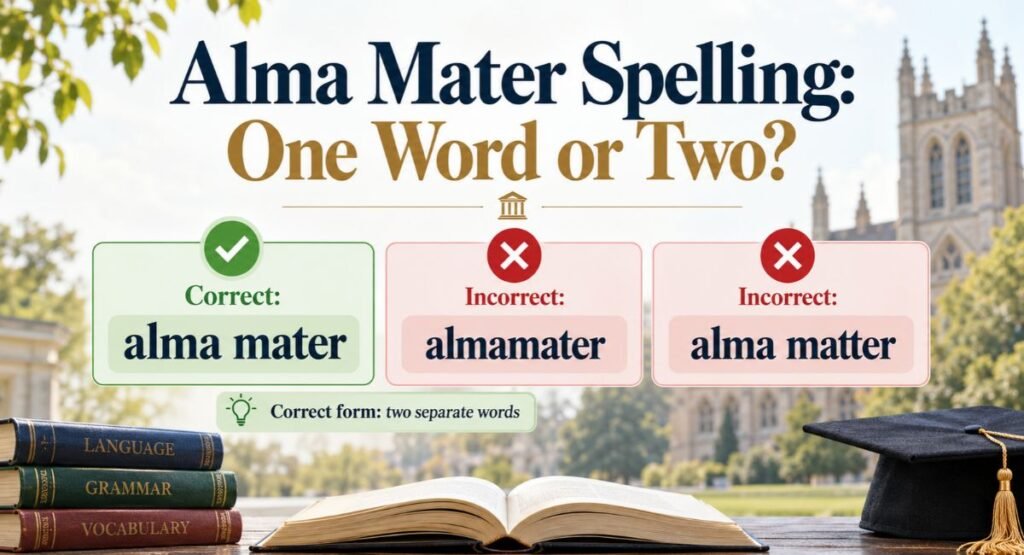
The correct spelling is alma mater, written as two separate words. It is not normally hyphenated, and the words are not combined into one.
One common mistake is writing alma matter. The error is understandable because mater looks similar to matter, but the Latin expression contains only one “t” in its second word.
Alma Mater vs. Alma Matter
Correct: “My alma mater organised a reunion.”
Incorrect: “My alma matter organised a reunion.”
The Latin word mater means mother. The English word matter refers to something entirely different, such as an issue, situation, or substance.
Remembering the literal meaning, “nourishing mother”, can help you avoid the spelling mistake.
Is Almamater Correct?
No. In standard English, alma mater is written as two words.
Correct: “She returned to her alma mater.”
Incorrect: “She returned to her almamater.”
This spacing remains the same in essays, professional biographies, graduation programmes, and university communications.
Should Alma Mater Be Italicised?
In ordinary English prose, alma mater does not require italics. It is an established borrowed expression and can be written in regular type.
The situation changes when the words form the title of an official school song. Universities may format their song titles differently, using italics or quotation marks according to their editorial conventions.
Is Alma Mater Capitalised? The Correct Rules
When alma mater refers to a former educational institution, it is normally lowercase. The phrase functions as a common noun expression rather than the institution’s official name.
For example, “She returned to her alma mater as a lecturer” is standard. The university itself might have a capitalised name, but the expression describing the person’s relationship with it remains lowercase.
When Should You Use Lowercase?
Use lowercase when referring generally to someone’s former school, college, or university.
Correct: “He donated money to his alma mater.”
Correct: “The scientist returned to her alma mater.”
Correct: “Several alumni visited their alma mater.”
These sentences describe educational institutions, not formally titled works. Capital letters are unnecessary unless the expression begins a sentence.
When Should Alma Mater Be Capitalised?
Capitals may be appropriate when Alma Mater forms the official title of a university song.
For example, Texas State University’s editorial guide capitalises the name of its song and places it in quotation marks. Other universities follow different conventions for school-song references.
The distinction is between the general expression and an actual title. Capitalisation alone does not automatically transform every reference to a school song into a proper name.
Capitalisation and Formatting Examples
| Context | Example | Recommended form |
| Former university | She visited her alma mater. | Lowercase |
| Alumni communication | Support your alma mater. | Lowercase |
| Beginning of sentence | Alma mater is a Latin phrase. | Initial capital |
| Article heading | Alma Mater Meaning and Examples | Title case |
| Official song titled Alma Mater | The choir performed “Alma Mater”. | Follow official title style |
| Generic school-song reference | Students sang their alma mater. | Usually lowercase |
A useful real-world comparison comes from university style guides. George Mason University capitalises and italicises its official song title. Notre Dame, by contrast, uses lowercase for the general phrase referring to a school song and identifies its own song by its distinct title.
The best approach is to treat a former-institution reference as lowercase and reproduce an official song title according to the relevant institution’s published style.
How to Pronounce Alma Mater
Alma mater has several accepted pronunciations in English. It normally contains four syllables, with the strongest stress on the beginning of mater.
The phrase originated in Latin, but English speakers use established English pronunciations. Differences between dictionary variants do not change its meaning.
British English Pronunciation
One recognised British pronunciation is:
- Simple phonetics: AL-muh MAH-tuh
- IPA: /ˌæl.mə ˈmɑː.tə/
Another dictionary-recognised British form uses /ˈmeɪ.tə/ for the second word, giving a pronunciation approximately like AL-muh MAY-tuh.
Both are accepted variants. A learner can use either recognised form without changing the meaning.
American English Pronunciation
One common American pronunciation is:
- Simple phonetics: AL-muh MAH-ter
- IPA: /ˌæl.mə ˈmɑː.t̬ɚ/
American dictionaries also recognise a variant beginning with /ˌɑːl.mə/.
The final r is generally pronounced in rhotic American accents. The main word stress remains on mater.
Common Pronunciation Mistakes
Some learners place equal emphasis on all four syllables. The natural stress pattern gives greater emphasis to the beginning of mater.
Another mistake is assuming that mater must always sound like the English word matter. Dictionary recordings show accepted variations, so listening to a reliable pronunciation source is better than guessing from spelling.
Alma Mater Grammar: Part of Speech, Plural and Prepositions
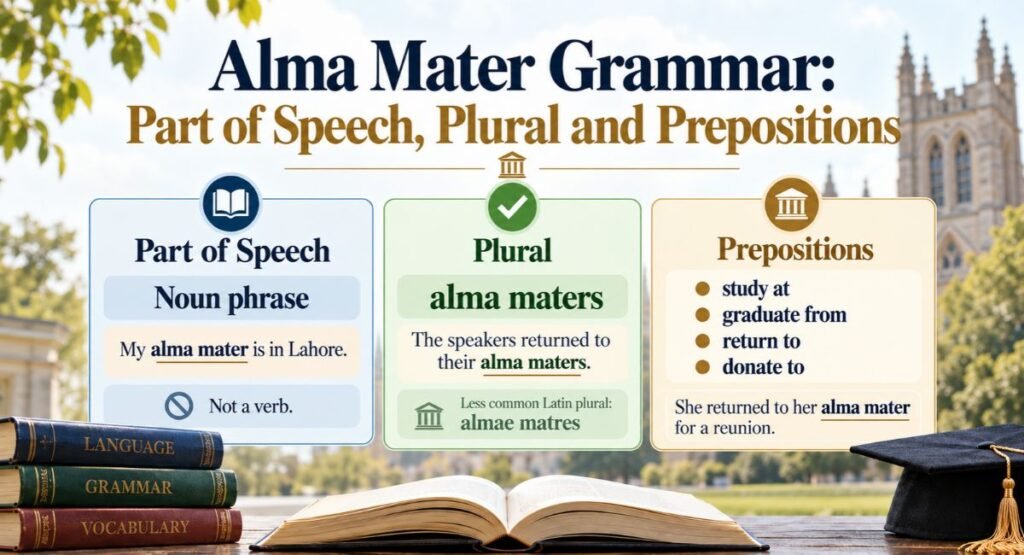
Alma mater functions as a noun phrase. It usually names a former educational institution, although American English also uses it for a school’s official song.
The expression commonly appears with possessives such as my, your, her, his, our, and their. These identify the person or group connected with the institution.
Is Alma Mater a Noun or a Verb?
Alma mater is a noun expression, not a standard English verb. It therefore has no ordinary past-tense or present-participle forms.
To describe actions involving an alma mater, use verbs such as attend, study, graduate, visit, return, teach, or donate.
| Verb or construction | Example |
| Attend | She attended the university that later became her alma mater. |
| Study at | He studied at his alma mater for three years. |
| Graduate from | She graduated from her alma mater in 2018. |
| Return to | They returned to their alma mater for a reunion. |
| Teach at | He now teaches at his alma mater. |
| Donate to | Former students donated to their alma mater. |
Incorrect: “I alma matered at that university.”
Correct: “I studied at that university.”
Is Alma Mater Countable or Uncountable?
Alma mater is normally treated as a countable expression, although it most often occurs in the singular with a possessive.
For example, “My alma mater invited me to a reunion” identifies one institution.
In the plural, it can refer to several institutions: “The visiting professors represented different alma maters.”
It is not generally used as an uncountable abstract quality.
What Is the Plural of Alma Mater?
The usual English plural is alma maters.
Example: “Both graduates returned to their respective alma maters.”
A learned Latin plural, almae matres, also exists. However, the English form alma maters is generally easier to understand and more suitable for modern everyday writing.
Prepositions Used with Alma Mater
The expression frequently appears with verbs followed by familiar prepositions.
We say return to an alma mater, graduate from an alma mater, study at an alma mater, and donate to an alma mater.
These prepositions depend on the associated verb rather than on a special rule belonging to alma mater.
For example, “She returned to her alma mater” follows the same grammatical pattern as “She returned to her university.”
Alma Mater in a Sentence: Original Examples
The following examples show how alma mater appears in ordinary conversation, professional biographies, academic writing, and graduation ceremonies.
Everyday Conversation
1. “I visited my alma mater during the summer holidays.”
The speaker returned to a former educational institution.
2. “My brother and I attended the same alma mater.”
Both siblings previously studied at the same institution.
Academic and Educational Writing
3. “The researcher returned to her alma mater as a visiting lecturer.”
A former student later accepted a teaching appointment there.
4. “The university encouraged graduates to support their alma mater.”
The institution invited former students to contribute to its development.
Professional Biographies
5. “The engineer mentioned his alma mater during the interview.”
He discussed an institution where he previously studied.
6. “Her biography identifies her alma mater and research interests.”
The biography includes her educational background.
Graduation and Alumni Events
7. “Graduates gathered to celebrate their alma mater’s anniversary.”
Former students attended an institutional celebration.
8. “The choir performed the university song titled ‘Alma Mater’.”
This sentence refers to a song bearing that title rather than to the educational institution itself.
Formal and Casual Communication
9. “His alma mater recognised his contribution to medical research.”
His former educational institution acknowledged his professional achievements.
10. “I still meet friends from my alma mater whenever I visit the city.”
The speaker maintains friendships with people from a former school or university.
Alma Mater Synonyms and Related Words
Alma mater has several related expressions, but they are not always exact synonyms. The phrase specifically describes an institution through a person’s previous educational connection.
Understanding these differences helps writers choose words that fit both the meaning and tone of a sentence.
Alma Mater vs. Former School
Former school identifies an institution someone attended previously. Alma mater communicates a similar idea but often sounds more formal or ceremonial.
Example: “I visited my former school.”
Compare: “I returned to my alma mater for the reunion.”
Alma Mater vs. University
University identifies a particular kind of educational institution. Alma mater describes someone’s relationship with an institution where they previously studied.
Example: “The university opened a new library.”
Compare: “My alma mater opened a new library.”
The second sentence establishes a personal educational connection.
Alma Mater vs. College
College identifies an educational establishment, although its precise meaning differs between countries. Alma mater can refer to a college previously attended.
Example: “The college offers business courses.”
Compare: “My alma mater offers business courses.”
Alma Mater vs. Educational Institution
Educational institution is a broad administrative term. It can describe schools, colleges, universities, and other organisations providing education.
Alma mater is more specific because it relates an institution to someone’s educational past.
For example, a government report may discuss educational institutions, while a graduate may discuss returning to their alma mater.
Alma Mater vs. Alumni
These terms are related but do not refer to the same thing.
Alma mater is the institution. Alumni are former students.
For example, “The alumni returned to their alma mater” describes people visiting their former institution.
The singular terms alumnus and alumna traditionally refer to male and female former students. Alum is a common gender-neutral alternative, while alumni is widely used for groups.
The distinction matters in sentence construction: a university can be someone’s alma mater, but a person is not an alma mater.
Does Alma Mater Have an Antonym?
Alma mater has no exact lexical antonym. It names a particular relationship between a person and an educational institution.
Expressions such as current school or prospective university may provide contrasts, but they are not true opposite words.
| Contextual contrast | Meaning and example |
| Current school | The school attended now: “My current school is in Leeds.” |
| Current university | The university where someone studies: “My current university offers evening courses.” |
| Prospective university | An institution someone is considering: “She visited a prospective university.” |
| Future university | An institution someone expects to attend: “He is choosing his future university.” |
Someone’s current university may later become their alma mater. The difference depends on the person’s educational history, not on opposite dictionary meanings.
Alma Mater Origin and Latin Meaning
Alma mater literally means “nourishing mother” in Latin.
Alma is the feminine form of the Latin adjective almus, associated with nourishing or fostering. Mater means mother.
The expression reflects the image of a source that provides care, support, or development. In educational usage, the metaphor associates a school or university with intellectual growth.
Historical Meaning of Alma Mater
In Latin, the expression was associated with nurturing maternal figures, including certain Roman goddesses.
The educational meaning developed later. The Online Etymology Dictionary records the use of alma mater for a school or university in English from 1710.
That date identifies recorded English usage; it does not establish that the phrase or its educational associations were invented in that year.
Alma Mater and the University of Bologna
The University of Bologna is associated with the Latin designation Alma Mater Studiorum, often translated as “Nourishing Mother of Studies”.
This designation illustrates the link between nurturing imagery and education.
However, it would be inaccurate to claim that the university invented the expression alma mater. Its Latin components and earlier associations predate modern English educational usage.
Why Does Alma Mater Suggest School Pride?
Alma mater frequently appears in graduation speeches, university anniversaries, fundraising campaigns, and alumni reunions.
These settings may give the phrase associations with gratitude, loyalty, or shared memories.
Yet pride is not part of its essential definition. Someone can accurately describe an institution as their alma mater without feeling particularly attached to it.
Common Alma Mater Mistakes and Corrections
Several errors are specific to this expression, particularly its Latin spelling, capitalization, and relationship with alumni.
Mistake: Writing Alma Matter
Incorrect: “My alma matter organised an event.”
Correct: “My alma mater organised an event.”
Mater is Latin for mother, not the English word matter.
Mistake: Capitalising Every Occurrence
Incorrect in ordinary usage: “I visited my Alma Mater.”
Correct: “I visited my alma mater.”
The expression is normally lowercase when it refers to a former institution.
Mistake: Assuming It Only Means University
Incorrect assumption: “Only universities can be alma maters.”
Correct understanding: The term can describe a school, college, or university someone previously attended.
Mistake: Assuming Graduation Is Compulsory
Incorrect assumption: “Someone who transferred universities cannot refer to the first as an alma mater.”
More accurate: Previous attendance can be sufficient, although graduation is commonly associated with the term.
When qualifications matter, use explicit wording about attendance and graduation.
Mistake: Confusing Alma Mater with Alumni
Incorrect: “She is an alma mater of the university.”
Correct: “She is an alumna of the university.”
Also correct: “The university is her alma mater.”
One expression refers to an institution; the other refers to a former student.
Mistake: Using Alma Mater as a Verb
Incorrect: “He alma matered at the college.”
Correct: “He studied at the college.”
Alma mater is a noun expression. Use an established verb to describe the educational activity.
How to Use Alma Mater in Different Writing Situations
The phrase is useful in several contexts, but it is not always more effective than simpler language.
Professional Biography
A biography might state, “The scientist returned to her alma mater as a professor.”
This works because the relationship between the individual’s former education and professional career is relevant.
For educational qualifications, however, naming the institution and degree directly is more informative.
CV or Résumé
A CV usually benefits from clear education entries rather than elaborate language.
Instead of writing “My alma mater is the University of Manchester”, list the university, qualification, and relevant dates.
The phrase may still fit a personal statement where the educational connection itself matters.
Graduation Speech
Alma mater is particularly natural in ceremonial writing.
Example: “We leave our alma mater with memories, friendships, and lessons that will shape our future.”
Its formal tone suits a speech addressed to fellow graduates.
Everyday Conversation
In casual conversation, “my old school” or “the university I attended” may sound more natural.
For example, “I visited my old university yesterday” is direct and informal.
“I visited my alma mater yesterday” communicates much the same idea but has a more formal tone.
Neither is inherently better; the appropriate choice depends on the context.
Conclusion
Alma mater is a Latin expression meaning “nourishing mother”. In modern English, it usually refers to a school, college, or university someone previously attended.
The correct spelling consists of two words, normally written in lowercase when referring to an educational institution. The expression can also mean a school’s official song, for which capitalization and formatting depend on the relevant title and style guide.
Understanding its different meanings, accepted pronunciations, plural form, and relationship with alumni will help you use alma mater accurately in educational, professional, and everyday writing.
Frequently Asked Questions?
What Does Alma Mater Mean in Simple English?
Alma mater means a school, college, or university someone previously attended, especially one from which they graduated. The phrase comes from Latin and literally means “nourishing mother”. In modern English, people commonly use it when discussing educational backgrounds, graduation memories, alumni events, and connections with former institutions.
Should Alma Mater Be Capitalized or Lowercase?
Alma mater is normally lowercase when referring to someone’s former school, college, or university. It may be capitalized when Alma Mater is the official title of a school song. Capitalization can also depend on institutional editorial rules, so writers preparing official university materials should follow the relevant style guide.
Can Your High School Be Your Alma Mater?
Yes, your high school can be your alma mater. The expression applies to schools, colleges, and universities someone previously attended. Although it is especially common in university and alumni contexts, it is not restricted to higher education. Graduation is often associated with the term but is not always required.
Is Alma Mater the Same as Alumni?
No. Alma mater refers to an educational institution someone previously attended, while alumni refers to former students. For example, university alumni may return to their alma mater for a reunion. The terms are closely related through education, but one identifies the institution and the other identifies people.
What Is the Plural of Alma Mater?
The standard English plural of alma mater is alma maters. For example, two graduates from different universities may visit their respective alma maters. The Latin plural almae matres also exists but is uncommon in contemporary everyday English. Alma maters is usually the clearest and most natural choice.






One Comment