
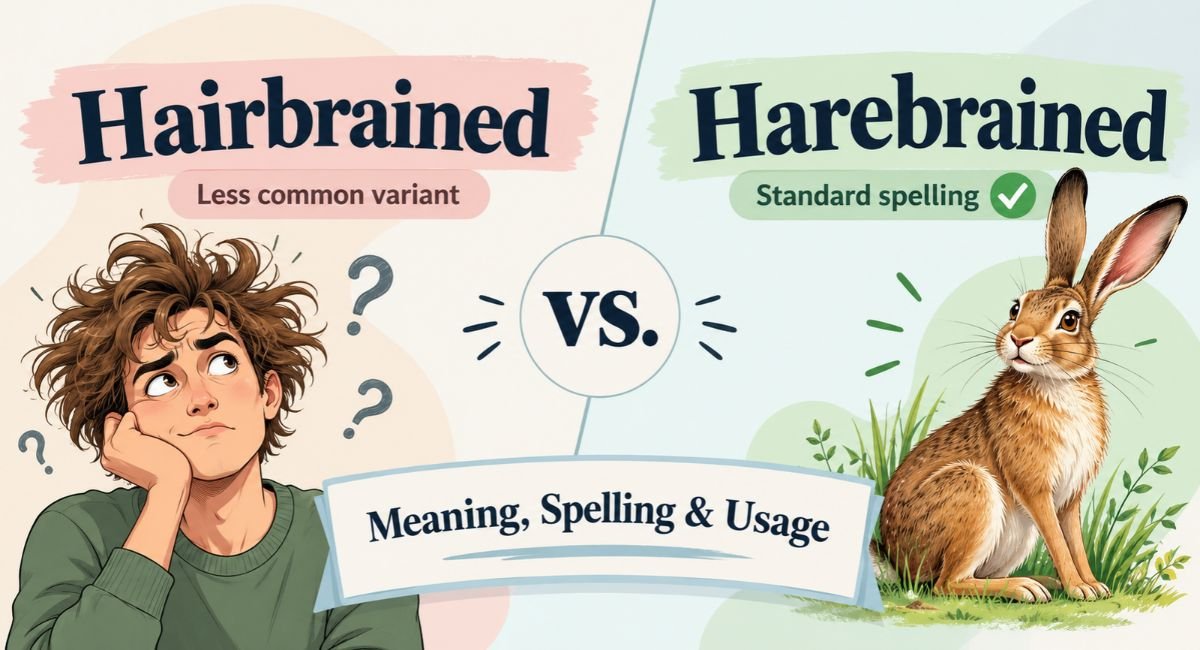
Hairbrained vs. Harebrained: Meaning & Examples
Hairbrained vs. harebrained is a spelling comparison involving an adjective meaning foolish, impractical, or poorly thought out. Harebrained is the standard modern spelling, while hairbrained is a historically established but less common variant. Both have the same pronunciation and meaning. The expression commonly describes unrealistic schemes, unwise decisions, and plans lacking careful consideration.
What Does Harebrained Mean in English?
Harebrained is an informal adjective used to describe an idea, plan, or person that appears foolish or lacking practical judgement. It suggests that someone has overlooked obvious difficulties or failed to consider whether an idea can realistically succeed. Imagine a group of friends deciding to open a restaurant without calculating expenses, finding suitable premises, or learning anything about food service. Someone might describe their proposal as harebrained because enthusiasm has replaced careful preparation.
The word often carries an amused or disapproving tone rather than expressing a serious judgement about intelligence. A friend might jokingly say, “That’s another harebrained idea!” after hearing an unrealistic holiday plan. However, the same expression can sound insulting during a business meeting. The adjective describes the speaker’s assessment of someone’s judgement, so its effect depends on context, evidence, and the relationship between the people involved.
What Does Hairbrained Mean in English?
Hairbrained is an alternative spelling of harebrained and has the same basic meaning. It describes foolish decisions, impractical schemes, or behaviour that appears poorly considered. Although some writers treat it as an error, the spelling has historical evidence dating back to the sixteenth century. This matters because harebrained is not simply a recent mistake made by people unfamiliar with the word. It belongs to a longer history of English spelling variation.
Nevertheless, harebrained is the recommended spelling for contemporary writing. It appears as the principal form in major dictionaries and is widely recognised in educational and professional contexts. Hairbrained may still appear in historical passages, literary quotations, and informal writing. Recognising it is useful, but deliberately choosing harebrained generally avoids unnecessary spelling questions. Historical acceptance does not mean that both forms are equally preferred by modern editors.
Hairbrained vs. Harebrained: Key Differences Explained
The central distinction in hairbrained vs. harebrained concerns spelling rather than meaning. Both forms describe foolish or poorly considered actions, and both are pronounced identically. Harebrained is the standard modern form, while hairbrained is an established but less common variant. Neither word represents a separate degree of foolishness or a different category of behaviour. The choice matters mainly when a writer wants to follow conventional spelling or preserve the original wording of a historical source.
| Feature | Harebrained | Hairbrained |
| Meaning | Foolish or impractical | Same meaning |
| Standard modern spelling | Yes | Less preferred |
| Historical usage | Recorded | Recorded |
| Pronunciation | HAIR-braynd | HAIR-braynd |
| Part of speech | Adjective | Adjective |
| Formal writing | Recommended spelling | Usually avoided |
| Hyphenated form | Hare-brained | Hair-brained |
The spelling difference is not a strict American-versus-British rule. The standard form is understood in both varieties, while historical variants appear across older English texts. Canadian government writing guidance also recognises both spellings and prefers hyphenation in Canadian usage. For most contemporary articles, using harebrained consistently is straightforward. Writers following a particular editorial style guide should check whether it recommends harebrained or hare-brained.
How to Pronounce Hairbrained and Harebrained
Hairbrained and harebrained are pronounced alike because hair and hare are homophones. Both versions contain two syllables, with the first receiving the main stress. The final syllable sounds like the word brained, which rhymes with trained. The spelling difference does not introduce an extra sound or change the meaning. This explains why someone who learns the expression through conversation may later be uncertain about which spelling belongs in written English.
| Word | Simple pronunciation | American IPA | British IPA |
| Harebrained | HAIR-braynd | /ˈher.breɪnd/ | /ˈheə.breɪnd/ |
| Hairbrained | HAIR-braynd | /ˈher.breɪnd/ | /ˈheə.breɪnd/ |
The difference between the American and British IPA transcriptions reflects regional vowel pronunciation, not a difference between the spellings. Learners should stress the first syllable and pronounce the second naturally. The word is not normally divided into three syllables. Remembering that hare and hair sound alike can help with pronunciation, while remembering the animal-related origin can help with spelling.
Part of Speech and Grammar Rules for Harebrained
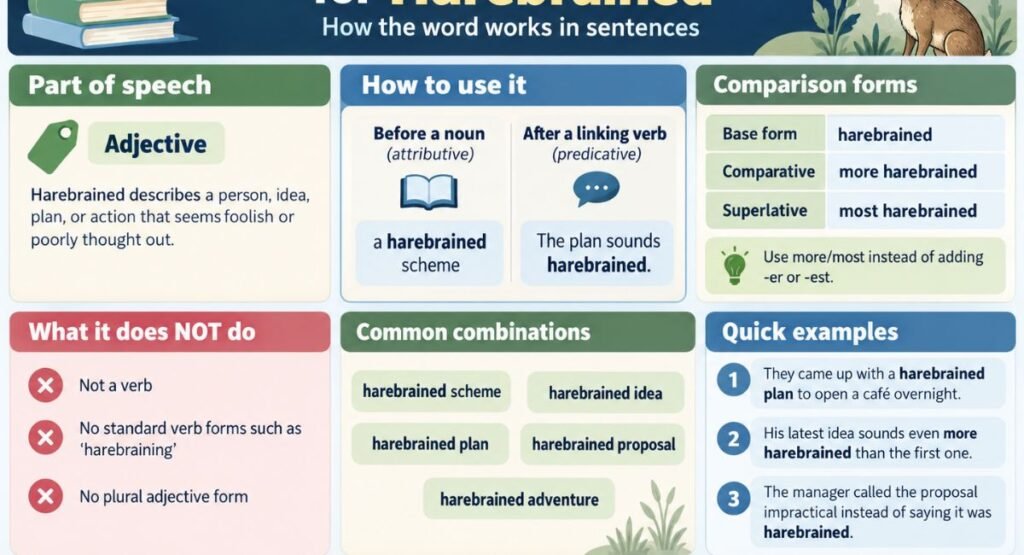
Harebrained is an adjective. It describes a person, idea, plan, or action rather than naming a physical object or expressing an action as a verb. In “a harebrained scheme,” the adjective appears before the noun. In “The scheme sounds harebrained,” it follows a linking verb. Both sentence structures are correct. Because the word functions as an adjective, it does not take a plural ending when describing several ideas or people.
Harebrained has no ordinary verb tense forms, so expressions such as harebraining are not standard ways to describe making a foolish decision. The word is also not classified as a countable or uncountable noun in its usual grammatical function. Comparisons generally use more harebrained and most harebrained. For example, “The second plan was more harebrained than the first” is natural English. This construction is preferable to inventing forms such as harebraineder.
Common Expressions and Prepositions With Harebrained
The adjective frequently appears in expressions such as harebrained scheme, harebrained idea, harebrained plan, and harebrained proposal. These combinations usually criticise the practicality or reasoning behind something. A harebrained scheme might involve an unrealistic attempt to earn money, while a harebrained adventure could describe an impulsive journey undertaken without proper preparation. The noun following the adjective helps readers understand whether the criticism concerns planning, behaviour, or decision-making.
Harebrained does not require one particular preposition, but it fits naturally into common sentence patterns. Someone might propose “a harebrained plan to start a business” or discuss “a harebrained idea for a school project.” The prepositions belong to the wider phrases rather than being fixed grammatical requirements of harebrained itself. This distinction helps learners avoid memorising unnecessary rules and encourages more natural sentence construction.
What Does a Harebrained Scheme Mean?
A harebrained scheme is a plan considered foolish, unrealistic, or inadequately thought through. The phrase often suggests that someone has become excited about an idea without examining practical obstacles. Suppose three friends plan to open a restaurant without researching costs, hiring staff, or securing a location. Their enthusiasm may be genuine, but their proposal could reasonably be described as a harebrained scheme because it lacks essential preparation.
Still, harebrained reflects a judgement rather than an objective guarantee of failure. Unusual ideas sometimes succeed after careful development and testing. A proposal is more appropriately described as harebrained when its weaknesses are identifiable, such as unrealistic assumptions, missing resources, or overlooked consequences. Using the adjective merely because an idea is unconventional can unfairly dismiss creativity. Good writing distinguishes impracticality from originality instead of treating them as the same quality.
Harebrained Idea vs. Creative Idea
A creative idea introduces an original approach, while a harebrained idea is considered foolish because it lacks sound reasoning or practical preparation. Imagine a student designing a low-cost water filtration system using accessible materials. The project may be ambitious, but it is not automatically harebrained. If the student proposes distributing an untested system as safe drinking-water equipment without evaluating its effectiveness, the plan becomes more reasonably open to criticism.
The difference lies in judgement, not imagination. Creative thinking can involve uncertainty and experimentation, but responsible planning considers limitations and possible consequences. Harebrained suggests that important details have been neglected. Writers should therefore choose creative, imaginative, unconventional, or experimental when describing originality alone. Reserving harebrained for genuinely poorly considered decisions makes the adjective more precise and prevents it from becoming a generic insult.
Harebrained vs. Reckless: What Is the Difference?
Harebrained and reckless sometimes overlap, but they emphasise different problems. Reckless focuses on disregarding danger or serious consequences, while harebrained suggests foolishness or impractical judgement. Driving through heavy traffic at dangerous speeds is reckless because it creates an obvious safety risk. Planning to travel across a country without checking transport connections, accommodation, or available funds might be called harebrained because the entire arrangement appears poorly considered.
Some behaviour can be both harebrained and reckless. Attempting a dangerous mountain climb without essential equipment could involve inadequate planning as well as disregard for safety. However, not every harebrained idea exposes anyone to physical danger. A poorly conceived advertising campaign may simply waste money. Identifying the difference helps writers describe the actual concern rather than relying on several negative adjectives that may not mean exactly the same thing.
Harebrained Example Sentences in Different Contexts
The following original examples show how harebrained works in informal conversation, storytelling, education, and professional contexts. The adjective commonly appears before a noun, although it can also follow a linking verb. Its tone varies: friends may use it humorously, while a manager may sound dismissive when criticising a colleague’s proposal. These examples demonstrate both grammatical usage and the importance of choosing an appropriate tone.
- The students developed a harebrained plan to complete their entire project in one evening.
- His harebrained investment idea ignored several important financial risks.
- We abandoned the harebrained scheme after calculating the actual expenses.
- The proposal sounded harebrained because nobody had checked whether the equipment was available.
- Their harebrained adventure began with a broken bicycle and an outdated map.
- The manager rejected the harebrained suggestion and requested a realistic alternative.
- Buying a boat without learning how to operate it seemed harebrained.
- His latest business proposal was more harebrained than the previous one.
- The editor replaced hairbrained with harebrained to follow the publication’s spelling convention.
- Everyone laughed when Daniel revealed his harebrained plan to build a swimming pool on the roof.
In a friendly conversation, “What a harebrained idea!” may express amusement rather than hostility. In a workplace, the same wording might offend the person who proposed it. Instead of calling a colleague’s suggestion harebrained, a manager could say, “The proposal needs a more realistic budget and implementation schedule.” The alternative identifies specific concerns and makes criticism more constructive without changing the underlying assessment.
Synonyms of Harebrained With Meaning Differences
Harebrained has several related synonyms, but each highlights a slightly different weakness. Foolish is a broad description of poor judgement, while rash suggests acting too quickly. Reckless focuses on ignoring consequences, and impractical emphasises difficulty carrying out a plan. Understanding these differences is important because a proposal can be unrealistic without being dangerous, and an action can be risky without being foolishly planned.
| Synonym | Meaning and subtle difference |
| Foolish | Showing poor judgement or common sense |
| Silly | Lacking seriousness or good sense, sometimes playfully |
| Reckless | Ignoring danger or possible consequences |
| Rash | Acting too quickly without sufficient thought |
| Foolhardy | Taking unnecessary risks with excessive confidence |
| Absurd | Extremely unreasonable or contrary to logic |
| Ridiculous | So unreasonable that it invites disbelief or amusement |
| Impractical | Unsuitable or difficult to carry out in reality |
| Unrealistic | Based on expectations unlikely to match actual conditions |
| Ill-conceived | Developed without adequate planning or consideration |
| Far-fetched | Unlikely or difficult to believe |
| Senseless | Lacking a reasonable purpose or justification |
A business proposal may be impractical because funding is unavailable, even if the original goal is worthwhile. A driver may behave recklessly despite understanding the risks involved. A harebrained plan usually suggests poor judgement or a lack of careful consideration. Selecting the most accurate synonym helps writers explain what is wrong with a decision rather than merely expressing disapproval.
Antonyms of Harebrained With Examples
The clearest antonyms of harebrained describe sensible judgement, careful planning, or realistic expectations. Sensible is a useful general opposite because it suggests practical reasoning. Prudent emphasises caution, while rational highlights logical thinking. Practical and feasible are especially helpful when evaluating whether a proposal can succeed. These words overlap, but they express different strengths, so the best choice depends on what is being contrasted.
| Antonym | Meaning and example |
| Sensible | Reasonable: “They selected a sensible solution.” |
| Wise | Showing good judgement: “It was a wise decision.” |
| Prudent | Carefully considering risks: “She made a prudent investment.” |
| Rational | Based on reasoning: “The committee reached a rational conclusion.” |
| Practical | Suitable for actual conditions: “They developed a practical alternative.” |
| Realistic | Based on achievable expectations: “The team created a realistic schedule.” |
| Well-considered | Carefully evaluated: “The proposal was well-considered.” |
| Feasible | Possible to implement: “The revised project was feasible.” |
These antonyms are not completely interchangeable. A plan might be feasible but still financially unwise. A decision might be rational yet involve considerable risk. Sensible often provides the closest general contrast to harebrained, while practical or well-considered may be more precise in technical or professional writing. Recognising these differences strengthens vocabulary understanding and helps readers avoid replacing one broad adjective with another.
Word Origin and Etymology of Harebrained
Harebrained combines hare, the animal, with brained, referring figuratively to mental capacity or judgement. The expression reflects an old comparison between human foolishness and the supposedly skittish behaviour of hares. The American Heritage Dictionary records its earliest known use in 1548. The word’s history reflects human perceptions and figurative language, not a scientific conclusion about the intelligence or behaviour of hares.
Hairbrained also has historical roots. In sixteenth-century English, hair and haire could function as alternative spellings of hare, particularly in some regional varieties. Consequently, early examples of hairbrained do not necessarily represent confusion with the hair growing on someone’s head. Later reinterpretations involving hair-sized brains have been suggested, but it is not possible to establish exactly when such associations influenced the spelling. The documented history supports harebrained as standard without treating the alternative as entirely baseless.
Harebrained or Hare-Brained: Which Spelling Is Correct?
Both harebrained and hare-brained are established written forms. Cambridge Dictionary favours the single-word spelling, while some dictionaries and editorial traditions use the hyphenated form. Canada’s Language Portal specifically recognises hare-brained and hair-brained and notes a preference for hyphenation in Canadian spelling. These variations concern orthographic convention rather than differences in meaning or pronunciation. A writer should therefore follow the relevant style guide when a publication has a specific requirement.
For general educational writing, harebrained is a straightforward choice because it is familiar and widely recognised. Hair-brained has also appeared historically, but it is not the most useful default for modern articles. When quoting older literature, retain the original spelling rather than silently replacing it. The purpose of standardisation is to help readers, not to erase genuine historical variation. Maintaining a consistent spelling throughout an article usually provides the clearest presentation.
Common Mistakes When Using Hairbrained and Harebrained
One common mistake is assuming that hairbrained must be correct because the expression supposedly describes someone with a brain as small as a hair. The established standard form is connected with hare, the animal. Another mistake is claiming that hairbrained is an entirely invented modern error. Historical spelling evidence shows that the alternative has existed for centuries. Accurate explanations should recognise both the preferred modern form and the older variant rather than presenting an oversimplified rule.
Learners sometimes misuse harebrained by applying it to every ambitious or unconventional idea. However, unusual does not necessarily mean foolish. A carefully researched invention may be imaginative without being impractical. The adjective can also sound unnecessarily insulting in formal settings. When evaluating someone’s proposal, words such as unrealistic, inadequately planned, or financially unworkable may communicate the concern more accurately and professionally than calling the proposal harebrained.
How to Remember Hairbrained vs. Harebrained
A useful memory trick is to associate the standard spelling with hare, the long-eared animal. Historically, the expression drew on figurative ideas about the behaviour of hares, which helps explain why the first part is spelled hare rather than hair. Imagine a hare suddenly darting in an unexpected direction, then connect that image with an impulsive or poorly considered decision. This is a spelling aid, not a factual claim that hares lack intelligence.
To practise, complete these sentences: “That was a ___ scheme,” “The proposal sounded ___,” and “His second plan was more ___ than the first.” The recommended spelling in each case is harebrained. Then try replacing the adjective with impractical, reckless, or ill-conceived and consider whether the meaning changes. This exercise builds spelling accuracy while teaching the judgement and tone conveyed by the word.
Conclusion
The difference between hairbrained vs. harebrained lies mainly in spelling preference and historical usage. Harebrained is the standard adjective describing foolish, impractical, or poorly considered ideas, while hairbrained is a less common variant with documented historical evidence. Both have the same pronunciation and grammatical function. The adjective is generally informal and can sound critical, so context matters. For most modern writing, harebrained is the safest spelling, while more precise alternatives may suit professional communication.
Frequently Asked Questions
What is the main difference between hairbrained and harebrained?
Harebrained is the standard spelling of an adjective describing foolish, impractical, or poorly considered ideas and behaviour. Hairbrained is a less common alternative spelling with historical evidence. Both forms share the same meaning and pronunciation. For modern academic, professional, and general writing, harebrained is usually the recommended spelling.
Is hairbrained an incorrect spelling?
Hairbrained is not simply an invented modern misspelling. It has appeared in English for centuries, and some dictionaries recognise it as an alternative form. However, harebrained is the established standard spelling today. Writers should generally choose harebrained unless preserving the original wording of a historical quotation or following another documented convention.
What does a harebrained scheme mean?
A harebrained scheme is a plan that appears foolish, unrealistic, or inadequately thought through. The expression suggests that important practical difficulties, costs, or possible consequences have been overlooked. It is usually informal and may express humour or criticism. An unconventional idea is not necessarily harebrained if it has been carefully planned.
Why is harebrained spelled with hare instead of hair?
The standard spelling comes from hare, the animal, combined with brained. The expression reflects a historical figurative association between hares and impulsive behaviour. Hairbrained also has historical evidence because hair was once used as an alternative spelling of hare. Nevertheless, harebrained became the standard form in modern English.
Is harebrained one word or hyphenated?
Both harebrained and hare-brained are established English spellings. Some dictionaries prefer the single-word form, while certain editorial conventions use a hyphen. Canadian writing guidance also recognises hyphenated usage. For most general writing, harebrained is a practical choice, but writers should follow their publication’s style guide consistently.




One Comment