
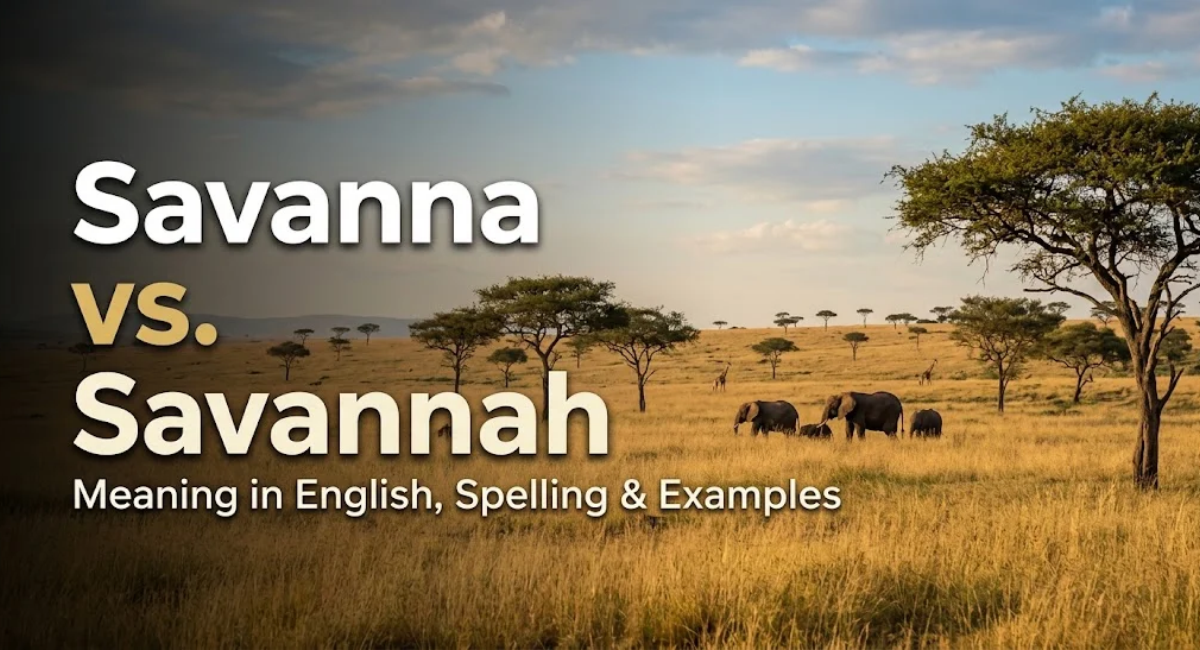
Savanna vs. Savannah Meaning in English & Examples
Savanna and savannah are two accepted spellings of the same English noun. Both describe a large, grassy landscape, usually with scattered trees, commonly found in warm regions. They have identical pronunciations and meanings. The spelling savanna is common in ecological writing, while savannah is also widely recognised. Capitalised Savannah can refer to a city or person’s name.
Understanding Savanna vs. savannah meaning in English begins with a simple fact: the final letter h does not change the word’s meaning or pronunciation. Whether you read about elephants crossing a savanna or lions resting in the savannah, both expressions describe the same kind of landscape. The spelling difference matters far less than the context in which the word appears.
There is one important exception. When Savannah appears with a capital letter, it may refer to the historic city in Georgia, a person’s first name or another proper name. That distinction often causes more confusion than the spelling variation itself. This guide explains both forms, shows how they work in real sentences and explores why similar words such as prairie and grassland cannot always replace them.
What Do Savanna and Savannah Mean in English?
A savanna is an open landscape dominated by grasses, often with scattered trees and shrubs. It is particularly associated with tropical and subtropical environments, where seasonal rainfall, fire and grazing animals can influence the vegetation. Tree cover varies considerably: some savannas look almost treeless, while others contain enough trees to resemble open woodland.
The popular image of a savanna often includes giraffes, zebras and acacia-like trees beneath a wide African sky. That picture is useful, but it does not capture every savanna ecosystem. Similar grass-dominated landscapes also occur in South America, Australia and parts of Asia. They differ in their plant communities, rainfall patterns and animal life.
| Feature | Savanna | Savannah |
| Meaning | A grassy landscape or ecosystem | The same meaning |
| Pronunciation | /səˈvænə/ | /səˈvænə/ |
| Part of speech | Noun | Noun |
| Plural | Savannas | Savannahs |
| Ecosystem use | Lowercase | Lowercase |
| Proper name | May be a name if officially spelled this way | Savannah, Georgia; personal name |
Savanna vs. Savannah: Which Spelling Should You Use?
Imagine you are writing a school essay about African wildlife. Your textbook uses savanna, but another educational website uses savannah. Do you need to correct one of them? No. Both forms are standard English spellings, and the difference does not identify two separate ecosystems.
The shorter form is familiar in American scientific and environmental writing, while the longer form is frequently seen in British publications and general descriptions. However, these are usage tendencies, not strict geographical rules. Both spellings appear in British and American dictionary entries, so it would be inaccurate to claim that one is exclusively British or American.
A Practical Spelling Decision Guide
| Writing situation | Recommended approach |
| Geography homework | Use either accepted spelling, following your textbook or teacher’s preference. |
| Scientific article | Follow the spelling convention of the journal or publication. |
| British English article | Savannah is acceptable; savanna is also recognised. |
| American English article | Savanna is acceptable; savannah is also recognised. |
| Savannah, Georgia | Always use the city’s official spelling and capitalisation. |
| A person’s name | Use the spelling chosen by that person, such as Savannah or Savanna. |
One small editing habit makes a difference: once you choose a spelling for the ecosystem, keep it consistent throughout the article. Switching between savanna and savannah every few sentences is not necessarily grammatically incorrect, but it can distract readers.
Savanna Meaning in Simple English and Other Languages
For a beginner, the easiest definition is a large grassy area in a warm region, often with scattered trees. This description works well in everyday conversation, although ecologists use more detailed criteria when identifying different types of savanna.
The expression grassland is a useful starting point, but it is broader than savanna. A meadow in England and a prairie in North America are also grassy landscapes. They do not automatically become savannas simply because they contain grass.
Savanna Meaning in Urdu, Hindi, French and Spanish
| Language | Word or explanation |
| English | Savanna / Savannah |
| French | Savane |
| Spanish | Sabana |
| Portuguese | Savana |
| Hindi | सवाना; explanatory phrase: घास का मैदान |
| Urdu | سوانا; explanatory phrase: گھاس کا میدان |
The Hindi and Urdu phrases meaning grassland are broader explanations, not precise ecological equivalents in every context. When translating a scientific text, retain the specific savanna concept rather than replacing it with a word for any grassy area.
For example, the sentence “Elephants live in the African savanna” should communicate a particular habitat. Translating it merely as “Elephants live in a field” would change the meaning. The original sentence refers to a natural ecosystem, not agricultural land or an ordinary grassy field.
How to Pronounce Savanna and Savannah
The two spellings sound exactly alike in standard British and American English. Both have three syllables, and the emphasis falls on the middle syllable. The additional h in savannah is not pronounced, so you should never add a fourth syllable when saying the word.
Pronunciation guide
Simple pronunciation
suh-VAN-uh
IPA
/səˈvæn.ə/
Three syllables • Stress on the second syllable
The vowel sound /æ/ in the stressed syllable is the sound heard in words such as cat and hat. The first and final syllables contain a relaxed vowel called schwa, represented by /ə/. Cambridge records the same pronunciation for British and American speakers.
A common pronunciation error is reading the first syllable as though it were the word save. Another is placing the main emphasis on the beginning. To avoid both mistakes, practise stressing the middle syllable while keeping the other two lighter.
Savanna Grammar: Singular, Plural and Countable Usage
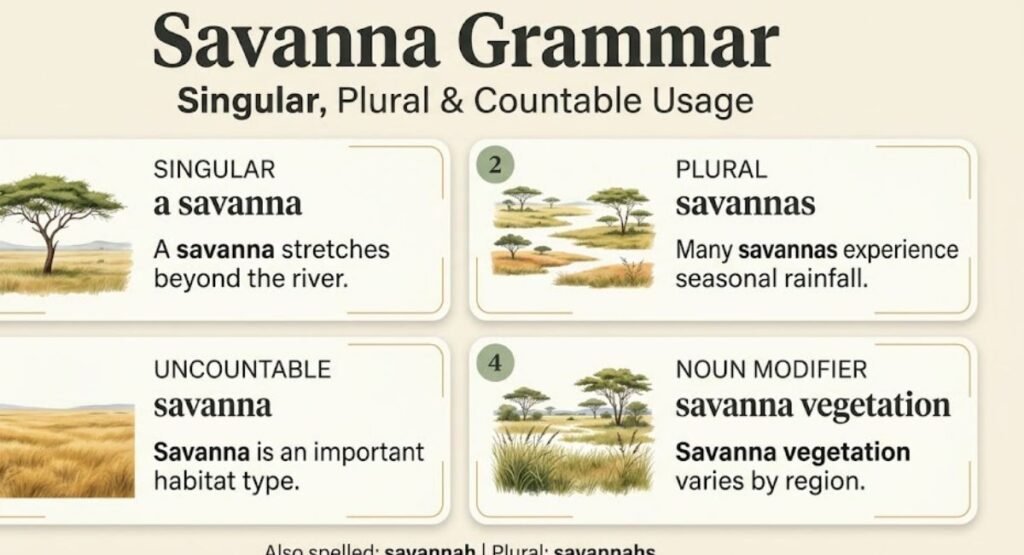
Both spellings function as nouns. When describing one particular landscape, you can use a savanna or a savannah. When discussing several examples, the plural forms are savannas and savannahs. You may also encounter the word used without an article when it refers to savanna vegetation or habitat in general.
Oxford Learner’s Dictionaries specifically lists both countable and uncountable usage, confirming that the grammar depends on what the writer intends to describe.
| Grammar form | Original example |
| Singular | A savanna stretches beyond the river. |
| Plural | Tropical savannas occur in several parts of the world. |
| Uncountable | Savanna is an important habitat type. |
| Definite article | The savannah provides food for grazing animals. |
| Noun modifier | Savanna vegetation changes with local environmental conditions. |
Is Savanna a Verb or an Adjective?
Savanna is not ordinarily used as a verb, so it has no standard past tense or continuous form. You would not write the animals savannaed to describe movement through grassland. Instead, choose an action verb such as crossed, travelled, grazed or explored.
In expressions such as savanna wildlife and savanna vegetation, the word works as a noun modifier. It tells readers what type of wildlife or vegetation is being discussed. This is different from saying that the word has become a regular descriptive adjective with its own comparative forms.
Which Prepositions Go With Savanna?
English speakers select a preposition according to the action or relationship being described.
- In the savanna: Describes being within the ecosystem. “Several antelope species live in the savanna.”
- Across the savanna: Emphasises movement over a wide area. “The herd moved across the savannah.”
- Through the savanna: Describes a route passing through it. “The researchers travelled through the savanna.”
- On the savanna: Can describe animals or activities across the landscape. “The animals grazed on the savanna.”
There is no special grammatical rule that requires one preposition for every sentence containing savanna. Choose the one that expresses your intended meaning.
Savanna and Savannah Example Sentences
Seeing both forms in context makes their shared meaning much easier to remember. The following sentences cover everyday speech, geography lessons, environmental research and descriptive writing.
Everyday English Examples
- We spotted a giraffe walking beside a small group of trees on the savanna.
- My younger sister asked why there were so few tall trees on the savannah.
- The grass turned a deeper green after rain fell across the savanna.
- Our teacher showed us a photograph of elephants crossing an African savannah.
Scientific and Formal Examples
- Researchers compared tree density across several savanna sites.
- The study examined how seasonal fires affect vegetation in a tropical savanna.
- Changes in grazing pressure may influence the balance between grasses and shrubs in some savannah ecosystems.
- Conservation planning must consider both wildlife and the communities that depend on savanna landscapes.
Travel and Descriptive Examples
- From the viewing platform, the savannah seemed to continue beyond the distant hills.
- A cool breeze moved through the dry grass as the sun disappeared over the savanna.
- Our guide pointed towards a distant tree where several birds had gathered.
Proper-Name Examples
- We travelled to Savannah, Georgia, during our holiday.
- Savannah prepared a presentation about grassland ecosystems.
- Savanna is also used as a person’s first name, without the final h.
The last three examples reveal a detail that simple spelling comparisons often miss. Savanna and Savannah can both be personal names. The person’s actual name determines the spelling, while the official name of the Georgia city is always Savannah.
Savanna vs. Prairie, Steppe and Grassland
One reason this word deserves more explanation than a dictionary definition is that several related landscape terms look interchangeable when they are not. The differences involve climate, geography, vegetation and sometimes the history of how people have described a region.
A prairie, for example, may contain tall grasses and few trees, but the word usually refers to temperate grasslands, especially in North America. A savanna is more commonly associated with tropical or subtropical conditions. Calling an African savanna a prairie may create a misleading geographical impression.
| Word | What makes it different? |
| Grassland | The broadest related term; covers several ecosystems dominated by grasses. |
| Prairie | Commonly refers to temperate grassland, particularly in North America. |
| Steppe | Usually describes a relatively dry, often temperate grassland with few trees. |
| Veld | A southern African landscape term that can cover different kinds of open vegetation. |
| Meadow | Often refers to a smaller grassy area, sometimes managed for hay or pasture. |
| Plain | Describes relatively flat land, regardless of whether grasses dominate. |
| Open woodland | Emphasises spaced trees and may overlap with savanna vegetation. |
Why Grassland Is Not Always an Exact Substitute
Consider these two sentences:
“The scientists studied changes in the grassland.”
“The scientists studied changes in the savanna.”
The first is broad. The second identifies a more specific ecological setting. Neither sentence is inherently better, but savanna supplies information that grassland does not.
The reverse is also important. If you are describing a meadow in Scotland, calling it a savanna would probably be inaccurate. Similar appearance does not guarantee the same ecological classification.
Does Savanna Have an Antonym?
Unlike words such as hot and cold, savanna has no single established opposite. It names a category of landscape rather than a quality that can be directly reversed. Some vocabulary websites may present forest or desert as antonyms, but these are better understood as contrasting environments.
A dense rainforest, for instance, usually has a much more continuous canopy than an open savanna. A desert may have far less continuous grass cover, while tundra environments are associated with colder climates and different vegetation.
| Related contrast | How to use it accurately |
| Rainforest | Compare canopy structure, rainfall and vegetation. |
| Dense forest | Contrast closely spaced trees with an open savanna landscape. |
| Desert | Compare vegetation cover and moisture conditions. |
| Tundra | Contrast typical climate and plant communities. |
A useful sentence is: “The rainforest had a dense canopy, while the nearby savanna contained open grassy areas.” This expresses a meaningful difference without falsely implying that rainforest is the dictionary antonym of savanna.
Where Does the Word Savanna Come From?
The history of the word leads from English back through Spanish to an Indigenous Caribbean language. Oxford Learner’s Dictionaries traces savannah to the Spanish word sabana, derived from Taíno zavana. The dictionary dates its entry into English to the middle of the sixteenth century.
This origin is worth knowing because the word did not begin as a modern scientific invention. Its history is connected to earlier descriptions of open grassy landscapes in the Americas. As English usage developed, the term became established in geographical descriptions and later in ecological terminology.
The coexistence of savanna and savannah reflects established spelling variation in English. It is not necessary to invent a historical story explaining why British writers supposedly added an h. Without evidence for a precise origin of that regional difference, the accurate explanation is that both spellings are accepted today.
Common Mistakes With Savanna and Savannah
The most frequent mistake is treating the two spellings as separate ecosystem words. A student might write that savanna means grassland, while savannah means a city. That is not correct. Lowercase savannah can also describe grassland; capitalised Savannah is the form used for the Georgia city.
Another common error is assuming that savanna is wrong in British English or that savannah is always wrong in American English. Standard dictionaries recognise both. Some editors or publications may strongly prefer one, but a style preference should not be confused with a universal spelling rule.
| Incorrect assumption or usage | Correct explanation |
| “Savannah only means a city.” | Lowercase savannah also names the ecosystem. |
| “Savanna and savannah sound different.” | Both have the same standard pronunciation. |
| “All grasslands are savannas.” | Savanna is a more specific ecological category. |
| “We visited savannah, Georgia.” | Write Savannah, Georgia. |
| “Savanna is a verb.” | Savanna is a noun. |
| “The h means a different kind of grassland.” | The final h does not change the ecological meaning. |
There is also a subtler translation mistake. The English word savanna should not automatically be translated as any word meaning field. Doing so can lose its ecological meaning. A cultivated field, a grazing meadow and a tropical savanna are different kinds of places.
The Savannah Name: Why Context Matters
The Georgia city provides a useful real-world example of why capitalisation deserves attention. In “The elephants crossed the savannah”, the word is a common noun. In “We drove to Savannah”, it is a proper noun referring to a specific location.
The distinction is visible in writing but not necessarily in speech. Because the pronunciation is the same, listeners rely on the sentence and the surrounding conversation to understand which meaning is intended.
There is another interesting complication: Savannah and Savanna are both possible first-name spellings. You cannot correct someone’s name merely because a dictionary prefers a particular spelling for the grassland. Proper names follow their established form.
A Short Savanna or Savannah Practice Test
Choose the spelling that fits each sentence. Remember that some sentences about the ecosystem can accept both lowercase forms, whereas proper names must follow their established spelling.
1. The elephants moved across the ______.
savanna
Savannah
2. We visited ______, Georgia.
savanna
Savannah
3. Many tropical ______ contain scattered trees.
savannas
Savannahs
4. Scientists studied ______ vegetation.
savanna
Savannah
Conclusion
Savanna and savannah describe the same grassy landscape or ecosystem. The additional h changes neither the meaning nor the pronunciation. Both spellings appear in reputable English dictionaries, and the best choice in formal writing is usually the form required by your publication or style guide.
What matters most is the intended meaning. A savanna is not simply any open field, and it should not automatically be confused with a prairie, steppe or meadow. Capitalised Savannah may also be a place or personal name. Once you recognise these distinctions, using either spelling becomes straightforward.
Frequently Asked Questions
Is savanna the same as savannah?
Yes, savanna and savannah are two accepted English spellings of the same noun. Both describe a grassy ecosystem, often with scattered trees, found mainly in tropical and subtropical regions. The difference is primarily spelling preference, not meaning. However, capitalised Savannah can also refer to a city, person or other proper name.
Which spelling is correct in British English, savanna or savannah?
Both savanna and savannah are accepted in British English, although savannah is commonly associated with British usage. Savanna is particularly common in American ecological writing. Neither spelling is universally required for the ecosystem. For school assignments, academic papers or professional articles, follow the preferred style guide and maintain consistency throughout the text.
Do savanna and savannah have the same pronunciation?
Yes, savanna and savannah have the same standard pronunciation in British and American English. Both are pronounced /səˈvænə/, approximately “suh-VAN-uh”. The word contains three syllables, with emphasis on the second syllable. The final letter h in savannah is silent and does not create an additional sound.
What is the difference between a savanna and a prairie?
A savanna is generally a tropical or subtropical grassland ecosystem, often containing scattered trees and experiencing seasonal rainfall. A prairie usually refers to temperate grassland, particularly in North America. Although both landscapes are dominated by grasses, their climates, vegetation and ecological characteristics can differ. Therefore, the words are not exact synonyms.
Why is Savannah sometimes capitalised?
Savannah is capitalised when it functions as a proper name, such as Savannah, Georgia, the Savannah River or a person’s first name. When describing a grassland ecosystem, savanna and savannah are normally written in lowercase, except at the beginning of a sentence or where title-capitalisation rules apply.



One Comment