
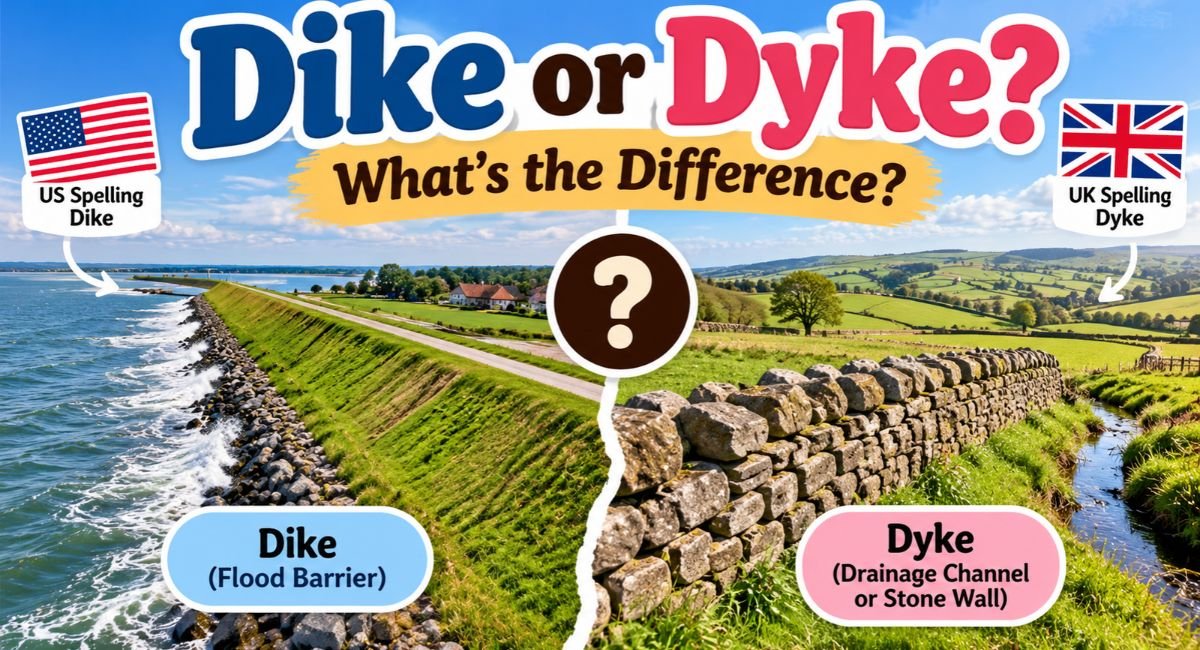
Dike or Dyke – What’s the Difference? Meaning & Examples
Have you ever seen the words dike and dyke in different books and wondered whether one was a spelling mistake? Dike or Dyke – What’s the Difference? Both words are pronounced the same way, and both can describe a barrier built to keep water away from land.
However, the spelling you encounter often depends on whether you’re reading American or British English. The words also have meanings connected with geology, drainage channels, Scottish stone walls, and social identity. Understanding these contexts will help you choose the right word rather than simply memorizing two definitions.
Dike or Dyke – What’s the Difference? Quick Definition
A dike is commonly a raised barrier built to prevent flooding. In geology, it can also describe a sheet of rock formed when molten material enters a fracture and solidifies. Dyke is an alternative spelling, particularly familiar in British English, and can additionally refer to a drainage channel or stone boundary wall.
The two spellings are generally interchangeable when referring to the same geographical feature. However, context and regional conventions influence which form sounds more natural.
| Feature | Dike | Dyke |
| Pronunciation | /daɪk/ | /daɪk/ |
| Main meaning | Flood barrier | Flood barrier |
| Regional preference | North American English | British English |
| Geological meaning | Igneous rock intrusion | Igneous rock intrusion |
| Additional meanings | Regional ditch or channel | Ditch, stone wall, social identity term |
| Plural | Dikes | Dykes |
| Part of speech | Noun; also verb | Noun; also verb |
Oxford Learner’s Dictionaries confirms the North American preference for dike in its geographical senses, while recognizing both spellings.
What Does Dike Mean in English?
Dike Meaning in Flood Protection
Imagine a village beside a river. During ordinary weather, the water remains inside the riverbanks. After several days of heavy rainfall, the river rises and threatens nearby homes. A raised earthen barrier constructed to keep that water away from the village is called a dike.
Dikes may be constructed using compacted earth, rock, and other engineering materials. They are designed according to local conditions, including expected water levels and ground stability. They do not eliminate flood risk entirely: erosion, overtopping, or structural failure can still cause flooding.
The Netherlands provides a familiar real-world example. Because significant areas of the country are vulnerable to flooding, its water-management system includes dikes, drainage infrastructure, pumping stations, and other protective works. A dike is therefore not simply a mound of dirt; it can be part of a carefully managed flood-defense network.
Dike Meaning in Geology
A geological dike has nothing to do with protecting houses from water. It is a sheet-like body of igneous rock that cuts across surrounding rock structures.
Picture a crack developing underground. Magma enters that crack, cools, and hardens. The resulting rock body may form a dike. Millions of years later, erosion can expose the formation at the surface, where it may appear as a contrasting band of rock crossing older layers.
Geologists often recognize dikes by their cross-cutting relationships. In many cases, the intrusion is younger than the rocks it cuts through. This relationship helps scientists reconstruct geological events.
The U.S. Geological Survey describes dikes as sheet-like magmatic bodies that intrude fractures and solidify.
Dike as a Verb
Although dike is most familiar as a noun, it can also function as a verb meaning to surround, protect, or drain land using a dike.
For example, “The workers diked the low-lying fields” means that they constructed protective earthworks or drainage arrangements around the land. The forms diked and diking follow ordinary spelling rules for verbs ending in a silent e.
This verb is relatively uncommon in everyday conversation. Most readers will find “The workers built a dike around the fields” clearer than “The workers diked the fields.”
What Does Dyke Mean in English?
Dyke as a British English Spelling
In British English, dyke is a familiar spelling for a water-control embankment. An American report might describe engineers repairing a dike, while a British report might describe workers repairing a dyke. In this context, the structure itself does not change because of the spelling.
That does not mean every British publication uses dyke or every American publication uses dike. Technical terminology, local names, historical conventions, and editorial style can affect the choice.
Dyke Meaning as a Drainage Channel
Here is a detail that often surprises learners: a dyke is not always a raised barrier.
In some varieties of British English, a dyke is a channel or ditch that carries water away from land. A farmer might clear vegetation from a dyke to improve drainage. In this case, the word refers to the channel through which water moves, not a wall holding water back.
This explains why the phrase “clear the dyke” can make sense in one setting, while “strengthen the dyke” makes sense in another. The first may involve removing obstructions from a drainage channel; the second may involve reinforcing a protective embankment.
Dyke Meaning in Scotland
In Scottish English, dyke can refer to a wall, particularly one made from stones arranged without mortar. Such walls are familiar features of rural landscapes and may divide fields or mark property boundaries.
Consider the sentence, “The sheep stood beside the old stone dyke.” The speaker is probably referring to a boundary wall, not a flood barrier.
This regional meaning shows why dictionary definitions alone sometimes fail to explain real-world vocabulary. The surrounding words—sheep, field, stone, and boundary—help readers identify the intended sense.
Dyke as a Social Identity Term
The word dyke also has a separate meaning connected with lesbian identity. Historically, it has been used as a derogatory label for lesbians, sometimes particularly those perceived as masculine.
Some lesbian individuals and communities have reclaimed the word and use it positively to express identity, pride, or solidarity. That does not make it universally acceptable. A word someone chooses for themselves may still be inappropriate when applied to another person without their consent.
In neutral writing about an individual, lesbian is generally the safer term when that description is relevant and accurate. When discussing a named event, organization, or quotation that uses dyke, preserve the established wording and explain the context where necessary.
How to Pronounce Dike and Dyke Correctly
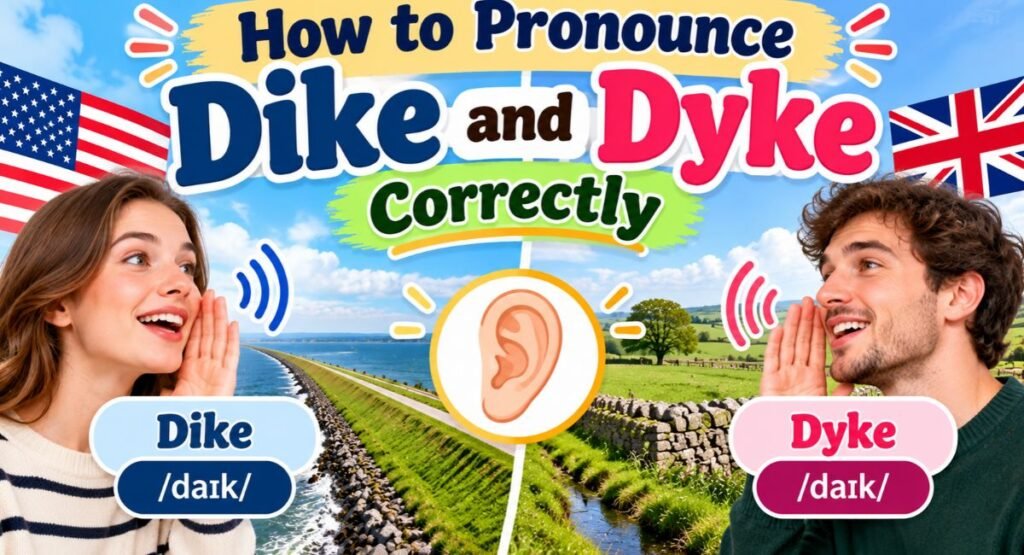
Dike and Dyke Pronunciation in American and British English
Both spellings are pronounced /daɪk/. They have one syllable and rhyme with bike, hike, and like.
The pronunciation contains three main sounds: /d/, the vowel sound /aɪ/, and the final consonant /k/. The letter y in dyke does not create an additional syllable, and the final e is silent.
Why Dike and Dyke Are Homophones
Dike and dyke are homophones because they sound identical despite their different spellings. A listener cannot determine which spelling a speaker intends from pronunciation alone.
If someone says, “They repaired the dyke yesterday,” you need additional information to understand whether the person is discussing a flood barrier, drainage channel, or another regional feature.
This is an important distinction for learners: spelling differences do not always signal pronunciation differences, and identical pronunciation does not guarantee identical meanings in every context.
Dike and Dyke Grammar Rules
Using Dike and Dyke as Countable Nouns
Both words are countable nouns when referring to physical structures. You can use them with singular and plural determiners.
| Grammar form | American spelling | Alternative spelling |
| Singular | A dike | A dyke |
| Plural | Two dikes | Two dykes |
| Definite form | The dike | The dyke |
| Possessive | The dike’s surface | The dyke’s surface |
The singular noun takes a singular verb: “The dike protects the village.” The plural takes a plural verb: “The dikes protect the villages.”
The same agreement rules apply to dyke and dykes.
Verb Forms of Dike and Dyke
Both spellings have documented verb uses, although they are uncommon outside specialized or regional contexts.
| Base form | Past tense | -ing form |
| Dike | Diked | Diking |
| Dyke | Dyked | Dyking |
These forms describe protecting, enclosing, or draining land with a dike or dyke. For general readers, using build, repair, reinforce, or maintain with the noun often produces a clearer sentence.
Common Word Combinations
The verbs used with these nouns can reveal what kind of structure is being discussed. Engineers may build, inspect, or reinforce a flood-control dike. Maintenance workers may clear a drainage dyke. Geologists may map, date, or examine an igneous dike.
Notice that “the dike breached” describes a failure of a protective structure, while “the dike intruded into older rock” belongs to geological discussion. The same spelling can occur in very different subject areas.
Dike vs. Dyke in American and British English
American English: When to Use Dike
For American readers, dike is usually a suitable spelling when discussing flood-control structures or geological intrusions.
For example, a US geology textbook may refer to a basalt dike, while a civil engineering report may describe a coastal dike.
The spelling dyke can still appear in American writing, particularly in proper names, quotations, and social or cultural contexts.
British English: When to Use Dyke
In British geographical writing, dyke is a familiar alternative. It can describe a flood barrier or, in certain regions, a drainage channel or boundary wall.
British geological publications may also use dyke for an igneous intrusion. A British reader encountering “a basalt dyke cutting through sandstone” would understand a geological formation rather than a drainage structure.
A Practical Spelling Decision
| Writing situation | Usually appropriate choice |
| US flood-control report | Dike |
| US geology lesson | Dike |
| British coastal description | Dyke |
| British geological writing | Dyke |
| Scottish dry-stone boundary wall | Dyke |
| Established place name | Preserve official spelling |
| Identity-related self-description | Respect the individual’s chosen terminology |
These are usage guidelines, not absolute rules.
Dike or Dyke Example Sentences With Meanings
Original Sentences Using Dike
- The town inspected its river dike before the spring floods.
- Engineers added protective material to the damaged dike.
- A narrow dike separates the agricultural land from the tidal water.
- The students photographed an igneous dike crossing the exposed rock.
- After the storm, maintenance crews checked the dike for erosion.
The first, second, third, and fifth sentences concern flood protection. The fourth uses the geological meaning. This distinction matters more than the spelling itself.
Original Sentences Using Dyke
- The farmer repaired a broken section of the stone dyke.
- Workers removed fallen branches from the drainage dyke.
- The coastal dyke was inspected after unusually high tides.
- The geologist identified a dark dyke cutting through the surrounding granite.
- An old dyke marks the boundary between the neighboring fields.
The words stone, drainage, coastal, and geologist provide clues about the meaning. The examples demonstrate how one spelling can describe different features without being grammatically incorrect.
Dike vs. Levee, Dam, Embankment, and Ditch
A dictionary may list several of these words as synonyms. However, replacing one with another can change the meaning of a sentence.
Dike vs. Levee
A levee is commonly an embankment built to prevent flooding along a river or another body of water. A dike may serve a similar purpose, and the terms overlap in many engineering contexts.
Regional terminology affects the preferred word. In some US flood-management discussions, levee is especially familiar, while dike may be used for other protective embankments. The terms should not be treated as universally interchangeable in technical documents.
Dike vs. Dam
A dam commonly spans a river or watercourse and is designed to hold back, store, or regulate water. A flood-control dike generally runs along an area that needs protection, separating land from water.
Imagine a reservoir held back by a large concrete structure. That structure is a dam. Now imagine an earthen barrier running alongside a river to protect farmland. That is a typical dike.
The distinction is based on function and engineering context, not merely on construction material.
Dike vs. Embankment
An embankment is a raised structure built from earth, stone, or other materials. It may support a railway, carry a road, or control water.
A flood-control dike is one type of embankment. However, a railway embankment is not automatically a dike, because its primary purpose is to support transport infrastructure.
Dyke vs. Ditch
A ditch is a channel excavated into the ground. It may collect rainwater, drain agricultural land, or direct water toward another channel.
In some regional British usage, dyke can mean much the same thing. Elsewhere, dyke may mean a raised embankment. The contrast between a channel and a barrier is one of the most useful details to learn about this word.
Does Dike or Dyke Have an Antonym?
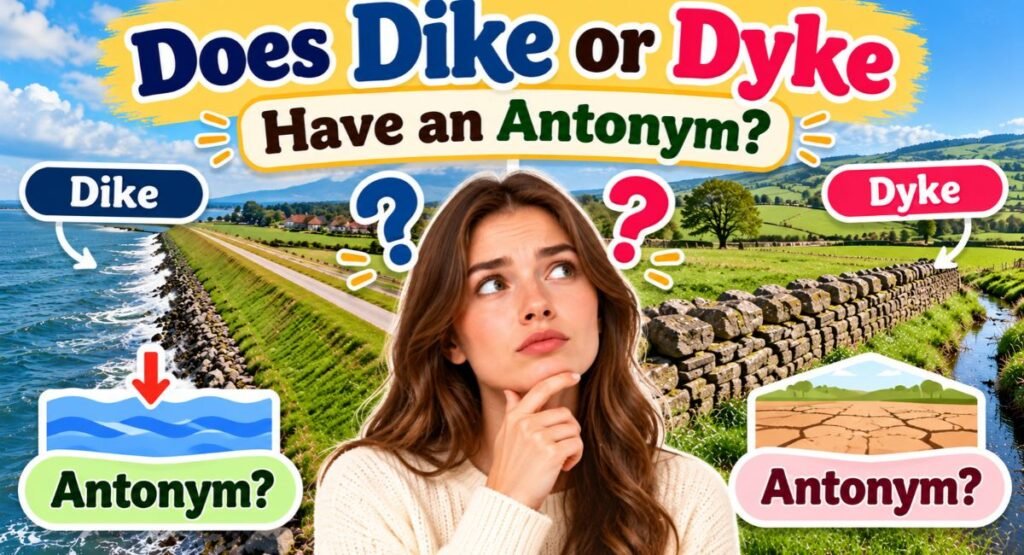
Neither word has a standard direct antonym in its geographical sense.
A breach is a gap or break in a protective barrier, but it is not the opposite of the noun dike. Similarly, a ditch may contrast physically with a raised embankment, yet it can also be one of the meanings of dyke.
For vocabulary exercises, it is better to explain these contrasting concepts than to present misleading antonyms.
Dike and Dyke Word Origin and Etymology
The Historical Roots of Dike and Dyke
The history of these words helps explain their apparently contradictory meanings. The geographical term is connected with older Germanic vocabulary for ditches, trenches, and earthworks.
Oxford Learner’s Dictionaries traces the Middle English geographical word to Old Norse dík, meaning a ditch or trench, with the embankment sense influenced by related Middle Low German and Middle Dutch forms.

Oxford Learner’s Dictionaries
A ditch and an embankment may seem like opposites, but excavation often produces both: digging creates a channel, while the removed soil can be piled alongside it. That relationship helps explain why related words developed meanings associated with both lowered channels and raised banks.
The Origin of the Social Meaning
The social slang meaning has a different and uncertain history. Historical forms include bulldyke, but dictionaries do not establish a single definitive origin.
It would therefore be misleading to claim that the identity-related meaning definitely developed from the geographical word. The historical evidence does not support such a simple explanation.
Common Mistakes When Using Dike or Dyke
Mistake: Thinking the Two Spellings Always Describe Different Things
A learner may assume that a dike is a flood barrier and a dyke must be something else. In fact, both spellings can describe the same kind of flood-control structure.
A better approach is to identify the subject first and then consider regional spelling preferences.
Mistake: Calling Every Water-Control Structure a Dike
A canal, ditch, dam, levee, and dike can all be involved in water management, but they do not necessarily perform the same function.
For example, “The workers dug a dike to carry water away” may be understood in some regional contexts, but “The workers dug a drainage ditch” is clearer for a general international audience.
Mistake: Using the Wrong Geological Meaning
Consider the sentence, “The volcanic dike stopped the river from flooding.”
This is confusing because volcanic dike normally describes an igneous rock formation, not an engineered flood barrier.
A clearer geological example is “The volcanic dike cuts across older sedimentary layers.”
Mistake: Ignoring the Social Meaning
A writer may encounter dyke in a cultural or identity-related discussion and assume it refers to geography. That interpretation would miss the intended meaning entirely.
Conversely, writers should avoid applying the identity-related term casually to someone who has not chosen it for themselves. Context and respectful language matter.
Mistake: Changing Established Names
Proper names should not be automatically altered to match American or British spelling preferences.
For instance, Devils Postpile National Monument contains geological features whose terminology should be described accurately, while a place name containing Dyke should retain its official spelling regardless of the publication’s house style.
How to Remember Dike and Dyke
The easiest way to remember the difference is to focus on three questions.
First, what is being described? A flood barrier, drainage channel, stone wall, geological intrusion, or identity-related term?
Second, where is the English being used? American writing often favors dike, while British writing commonly uses dyke for several geographical meanings.
Third, what does the surrounding sentence tell you? Words such as flood, magma, ditch, and stone wall can quickly reveal the intended meaning.
A useful memory aid is that the spelling may change, but the sound stays the same.
Conclusion
The answer to Dike or Dyke – What’s the Difference? depends on more than a simple spelling rule. Both words can refer to a flood-control embankment, and both are pronounced /daɪk/. American English commonly favors dike, while dyke is familiar in British geographical and regional usage.
The important distinctions emerge from context. A geological dike is a rock formation, a Scottish dyke may be a stone wall, and a regional drainage dyke may be a channel rather than a raised barrier. The word also has a separate social meaning that requires awareness and care.
Once you understand these specific uses, choosing the appropriate word becomes much easier.
Frequently Asked Questions
Is dike or dyke the correct spelling?
Both dike and dyke are correct English spellings. Dike is generally preferred in American English, especially in geography and geology. Dyke is common in British English and may also describe a drainage channel or stone wall in regional usage. The appropriate spelling depends on context and audience.
Do dike and dyke have the same pronunciation?
Yes, dike and dyke have the same pronunciation in standard American and British English. Both are pronounced /daɪk/ and rhyme with bike, hike, and like. They are homophones, meaning their spelling differs but their pronunciation is identical. The intended meaning must be determined from the surrounding context.
What is the difference between a dike and a dam?
A dike is typically a raised barrier constructed to protect land from flooding, often alongside a river or coastline. A dam usually crosses a river or watercourse to store, hold back, or regulate water. Although both are water-management structures, their typical locations and engineering purposes differ.
What does dyke mean in Scottish English? In Scottish English, dyke commonly refers to a wall, particularly a traditional dry-stone wall built without mortar. These walls often separate fields, mark property boundaries, and contain livestock. The meaning differs from the flood-control definition, showing how regional English can give the same word distinct geographical uses.
Can the word dyke be offensive? Yes. Dyke has historically been used as a derogatory term for lesbians. However, some lesbian individuals and communities have reclaimed it as a positive expression of identity and pride. Because its reception varies, avoid applying the term to someone unless you know they use or welcome it.





One Comment