

Constant vs Consistent: Meaning & Examples
Constant means continuing, happening very frequently, or remaining unchanged. Consistent means following a regular pattern, maintaining similar standards, or agreeing with other information. The main difference between constant vs consistent is that constant emphasizes persistence or an unchanged condition, while consistent emphasizes regularity, reliability, or agreement.
Imagine two students preparing for an exam. One studies for hours at unpredictable times, sometimes missing several days. The other studies for thirty minutes every evening. The first student may spend long periods studying, while the second follows a consistent routine. The difference is not simply how much work they do, but how their efforts are organized.
Understanding constant vs. consistent helps you describe habits, workplace performance, communication, scientific measurements, and relationships more precisely. Although the words sometimes overlap, replacing one with the other can change the message. This guide explains their meanings, pronunciation, grammar, synonyms, antonyms, and common mistakes through practical examples.
What Does Constant Mean in English?
Constant is an adjective with two important everyday meanings. First, it can describe something that happens continuously or very frequently. Second, it can describe something that remains unchanged. The intended meaning usually becomes clear from the noun being described. Constant interruptions suggest frequent disturbances, while constant temperature refers to a temperature that stays at the same level.
Consider the sentence, “The office was full of constant noise.” This does not necessarily mean there was an uninterrupted sound every second. It may describe repeated conversations, ringing telephones, and other frequent disturbances. By contrast, “The machine maintained a constant speed” means its speed stayed unchanged under the conditions being discussed.
Constant Meaning in Simple English
A simple way to understand constant is to think of something that keeps happening or stays the same. The word can describe positive experiences, such as constant encouragement, or unpleasant situations, such as constant complaints. It does not automatically tell us whether the activity is useful, reliable, or successful.
For example, an employee may receive constant emails but still lack important information. The emails arrive frequently, yet their usefulness depends on what they contain. Constant describes the frequency of communication, not necessarily its quality.
What Does Consistent Mean in English?
Consistent is an adjective describing something that follows a similar pattern, maintains comparable standards, or agrees with other information. It commonly appears with nouns such as effort, performance, behaviour, quality, and results. A consistent routine follows an established pattern, while consistent product quality means customers receive products that meet similar standards.
The word also has a meaning unrelated to regular schedules. When a report is consistent with available evidence, its claims agree with or do not contradict that evidence. This meaning is particularly common in academic writing, scientific reports, legal discussions, and professional communication.
Consistent Meaning in Simple English
Consistent often means doing something in a similar way over time. A person who visits the gym every Monday, Wednesday, and Friday has a consistent exercise schedule. The activity does not continue throughout the day, but it follows a predictable routine.
Consistency is not always positive. Someone might consistently arrive late, make the same spelling mistakes, or forget to save their work. These behaviours are undesirable, yet they still follow recognizable patterns. The word describes regularity or similarity rather than guaranteeing good results.
Constant vs Consistent: What Is the Main Difference?
The difference between constant and consistent becomes easier to understand when you separate frequency from regularity. Constant often tells us that something continues, happens repeatedly, or remains fixed. Consistent tells us that something follows a similar pattern or maintains comparable standards.
A restaurant may receive constant customer enquiries throughout the day, but its service could be inconsistent. Some customers might receive quick responses, while others wait for hours. In contrast, a restaurant that responds within its stated service hours can offer consistent communication without answering enquiries continuously.
| Feature | Constant | Consistent |
| Main meaning | Continuing, very frequent, or unchanged | Regular, similar, or in agreement |
| Main emphasis | Persistence or stability | Pattern, reliability, or compatibility |
| Frequency | Often continuous or very frequent | May follow regular intervals |
| Quality | Does not imply good quality | Can describe stable quality, good or bad |
| Example | Constant interruptions | Consistent weekly updates |
| Common opposite | Intermittent or variable | Irregular or inconsistent |
Constant Effort vs Consistent Effort
Constant effort emphasizes sustained or very frequent work. Consistent effort emphasizes maintaining a regular level of commitment over time. Both descriptions can be appropriate, but neither guarantees success.
Imagine a writer who spends an entire weekend working on a manuscript and then does not write for three weeks. During that weekend, the effort may be almost constant, but the writing routine is not especially consistent. Another writer who completes five hundred words every morning demonstrates a consistent writing habit.
The distinction is important because the amount of time spent on an activity and the regularity of that activity are separate things.
Constant Communication vs Consistent Communication
Constant communication suggests ongoing or very frequent contact. Consistent communication suggests predictable contact or communication that follows similar standards.
A manager who sends twenty unexpected messages one day and none for the rest of the week may communicate intensely but irregularly. Another manager who shares a clear update every Friday demonstrates a consistent communication pattern.
This does not make one communication style universally better. Urgent situations may require constant contact, while routine projects may benefit from regular updates. The appropriate word depends on the situation.
Constant Growth vs Consistent Growth
Constant growth generally emphasizes that growth continues during the period being described. Consistent growth suggests a relatively steady or repeated growth pattern. The two expressions may refer to the same business, but they highlight different characteristics.
For example, a company whose revenue increases every quarter at approximately the same rate can reasonably describe its growth as consistent. If its revenue increases throughout a period but at widely varying rates, the growth may be ongoing without following a particularly consistent pattern.
When exact performance matters, percentages and time periods communicate more than either adjective alone.
Can Something Be Constant but Inconsistent?
Yes. A business can experience constant demand while producing inconsistent results. Customer orders might arrive continuously, yet product quality could vary between deliveries.
The same distinction applies to learning. A student may spend many hours practising a language but use different methods each day. Their practice might be frequent, while their progress remains uneven.
The important point is that high frequency does not guarantee similar results. Constant activity and consistent performance measure different characteristics.
Can Someone Be Consistent Without Being Constant?
Absolutely. Someone who studies every evening, works out three times weekly, or submits reports every Friday can be consistent without performing those activities constantly.
Consistency often involves repeating an action according to an expected pattern. The intervals between activities do not make the routine inconsistent.
This is why “She studies consistently” and “She studies constantly” create different impressions. The first suggests regular study habits. The second suggests that studying occupies a very large part of her time.
Constant vs Consistent Pronunciation
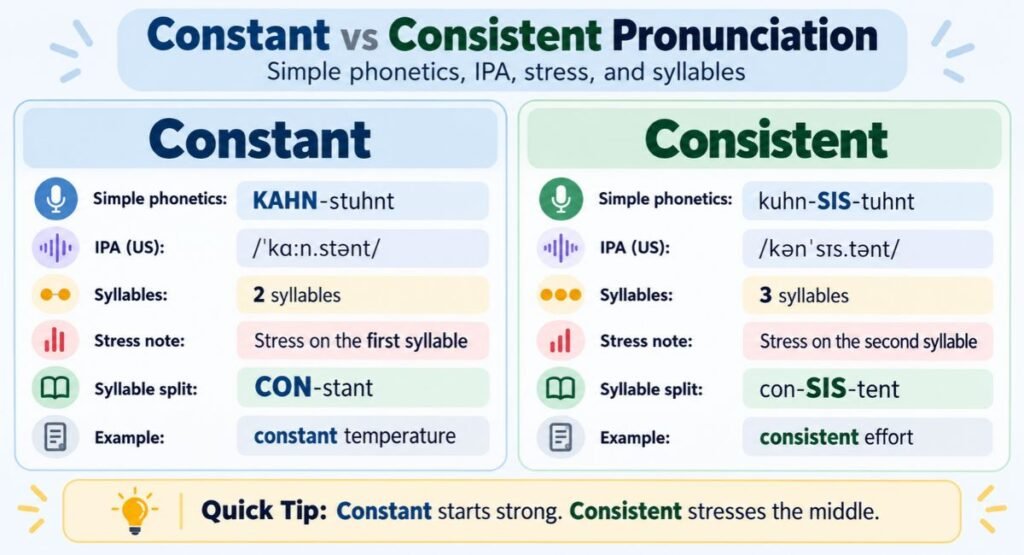
Constant and consistent share several letters, but their pronunciation differs in syllable count and stress. Constant has two syllables, with stress on the first. Consistent has three syllables, with stress on the second.
| Word | Simple Pronunciation | American IPA | Syllables |
| Constant | KAHN-stuhnt | /ˈkɑːn.stənt/ | Two |
| Consistent | kuhn-SIS-tuhnt | /kənˈsɪs.tənt/ | Three |
In British English, constant is commonly pronounced /ˈkɒn.stənt/. Consistent is commonly pronounced /kənˈsɪs.tənt/ in both British and American English.
The simplified pronunciation guides are approximate, so listening to recordings from a reliable learner’s dictionary is helpful.
Common Pronunciation Mistakes
A common mistake is placing the strongest stress on the first syllable of consistent. The stress actually falls on the second syllable.
Learners may also pronounce unstressed vowels too strongly. In natural English, unstressed syllables often contain reduced vowel sounds. Practising the words within short sentences can help make their rhythm more familiar.
Parts of Speech and Grammar Rules
Both constant and consistent are adjectives. They can appear before nouns or after linking verbs such as be, seem, and remain. However, constant can also be used as a countable noun, particularly in mathematics and science.
Neither adjective has verb forms of its own. The related verb consist belongs to the same word family as consistent, but it has a different grammatical function and should not be treated as a verb form of the adjective.
Constant as an Adjective
Constant can appear before a noun:
- “The workers faced constant interruptions.”
- “The machine operated at a constant speed.”
- “She received constant encouragement.”
It can also appear after a linking verb:
- “The temperature remained constant.”
- “The pressure stayed constant throughout the experiment.”
The first group describes repeated events or stable conditions. The second group emphasizes something remaining unchanged.
Constant as a Countable Noun
In mathematics and science, a constant is a value that remains fixed within the relevant calculation or defined conditions.
For example, in the expression y = 2x + 5, the number 5 is a constant term.
Constant is countable in this sense, so expressions such as “a constant,” “the constant,” and “several constants” are grammatically correct.
The noun can also be used figuratively. In the sentence “Change has been a constant in her career,” constant refers to something that has remained a recurring feature.
Consistent as an Adjective
Consistent is used before nouns and after linking verbs:
- “The team delivered consistent results.”
- “Her behaviour remained consistent.”
- “The formatting is consistent throughout the document.”
Unlike constant, consistent is not normally used as a noun in standard English. Its related noun is consistency.
Prepositions Used With Consistent
Consistent with expresses agreement or compatibility.
“The findings are consistent with earlier observations.”
Consistent in describes regularity in an activity or behaviour.
“She is consistent in meeting deadlines.”
Consistent across describes similarity among several groups, locations, or situations.
“The design remains consistent across all five pages.”
Consistent about can describe someone’s regular approach to a particular matter.
“He is consistent about checking his work before submitting it.”
The preposition with is especially important when discussing evidence, claims, principles, and statements.
Constantly vs Consistently
Constantly and consistently are adverbs, but they communicate different ideas.
Constantly means continually or very frequently:
“The computer constantly displays error messages.”
Consistently means in a similar, regular, or dependable manner:
“The software consistently produces accurate calculations.”
The first sentence emphasizes repeated errors. The second describes a dependable pattern of results.
Related nouns include constancy and consistency. Constancy often refers to steadfastness or remaining unchanged, while consistency can refer to regularity, agreement, or the physical texture of a substance.
Constant vs Consistent Example Sentences
The best way to understand these words is to see how they behave in different situations. Notice that constant frequently describes the amount or continuation of activity, while consistent often describes a pattern, standard, or agreement.
Examples Using Constant
- “The constant noise from the construction site made concentrating difficult.” — Frequent or continuing noise.
- “The laboratory maintained a constant temperature during the experiment.” — An unchanged measurement.
- “She received constant encouragement from her family.” — Continuing emotional support.
- “Constant changes to the schedule confused the employees.” — Frequent changes.
- “The machine operated at a constant speed throughout the test.” — A fixed speed.
- “The manager faced constant requests for assistance during the launch.” — Repeated requests.
Examples Using Consistent
- “Daniel follows a consistent study routine every evening.” — A regular habit.
- “The company maintains consistent product quality.” — Similar standards over time.
- “Her consistent effort helped her become more confident in English.” — Regular commitment.
- “The research findings are consistent with the original prediction.” — Agreement with a prediction.
- “The editor requested consistent formatting throughout the report.” — Uniform presentation.
- “The restaurant consistently delivers orders within its advertised time window.” — Dependable performance.
How Changing One Word Changes the Meaning
Consider the sentence, “He provides constant support.” This suggests that support continues or is available very frequently.
Now compare it with, “He provides consistent support.” This emphasizes dependability. The person offers support according to a recognizable or reliable pattern.
The same difference appears in these expressions:
| Expression | Intended Meaning |
| Constant reminders | Reminders arriving very frequently |
| Consistent reminders | Reminders following a regular pattern |
| Constant effort | Sustained or repeated effort |
| Consistent effort | Regularly maintained effort |
| Constant pressure | Continuing or frequently recurring pressure |
| Consistent pressure | Pressure remaining relatively similar |
| Constant growth | Growth continuing over a period |
| Consistent growth | Growth following a relatively steady pattern |
These examples show why grammar alone cannot determine which adjective is correct. The writer must decide which meaning matters.
Synonyms of Constant and Their Differences
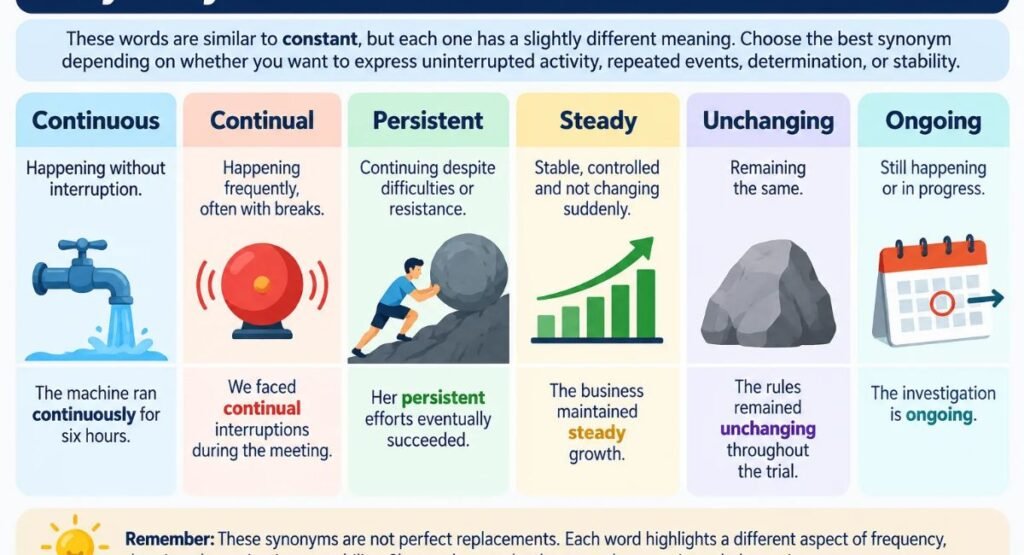
Several words are close to constant, but each emphasizes a different feature. Replacing constant with a synonym can make a sentence more precise when the intended meaning is uninterrupted activity, frequent repetition, determination, or stability.
Constant vs Continuous
Continuous emphasizes something happening without interruption. Constant can also describe uninterrupted activity, but it may refer to events that happen extremely frequently with short breaks.
Example: “The alarm produced a continuous sound for ten minutes.”
Constant vs Continual
Continual commonly describes events that happen repeatedly, often with intervals between them. Constant can express this meaning too, sometimes with a stronger sense of persistence.
Example: “Continual interruptions delayed the meeting.”
Constant vs Persistent
Persistent emphasizes something continuing over time, sometimes despite difficulties or resistance. When used for people, it can suggest determination.
Example: “Her persistent attempts eventually solved the problem.”
Constant vs Steady
Steady emphasizes stability, control, or relatively even movement. Constant generally makes a stronger claim that a relevant value does not change.
Example: “The company experienced steady growth over several years.”
Constant vs Unchanging
Unchanging specifically means remaining the same. It does not normally describe repeated events.
Example: “The membership rules remained unchanging during the review period.”
Constant vs Ongoing
Ongoing means that an activity or process continues. It does not necessarily mean the activity is uninterrupted or unusually frequent.
Example: “The investigation remains ongoing.”
Synonyms of Consistent and Their Differences
Consistent has several related words, particularly when discussing habits, quality, and dependability. These alternatives are useful, but they do not express exactly the same meanings.
Consistent vs Reliable
Reliable emphasizes something or someone that can be trusted to meet expectations. Consistent emphasizes similarity or regularity, which does not always produce desirable outcomes.
Example: “The reliable delivery service usually meets its promised arrival times.”
Consistent vs Regular
Regular emphasizes repeated timing or an established pattern. Consistent can also describe stable quality or agreement between information.
Example: “She attends regular training sessions.”
Consistent vs Uniform
Uniform emphasizes sameness across objects, people, or conditions. Consistent often allows some variation while preserving a recognizable pattern or standard.
Example: “The factory produces components of uniform size.”
Consistent vs Stable
Stable describes something that resists unexpected change or disruption. Consistent emphasizes similarity or an established pattern.
Example: “The system maintained stable performance during the test.”
Consistent vs Predictable
Predictable means that an outcome or behaviour can be anticipated. Consistent behaviour is often predictable, but predictable behaviour is not necessarily good.
Example: “The application responds in a predictable way.”
Consistent vs Coherent
Coherent describes ideas that fit together logically and are easy to follow. Consistent describes ideas that do not contradict one another.
Example: “The writer presented a coherent explanation of the problem.”
An argument can be internally consistent but difficult to follow because it lacks coherence.
Antonyms of Constant and Consistent
Choosing an antonym depends on the intended meaning. Constant describes both frequency and unchanged conditions, while consistent describes regularity, similarity, and agreement. Their opposites therefore vary according to context.
Antonyms of Constant
- Intermittent: Occurring with breaks. “The town experienced intermittent power outages.”
- Occasional: Happening sometimes. “She makes occasional visits to the office.”
- Temporary: Lasting for a limited period. “The restrictions were temporary.”
- Variable: Changing in value. “The experiment involved variable temperatures.”
- Sporadic: Happening irregularly. “Sporadic rainfall affected the harvest.”
- Changing: Not remaining fixed. “The team adapted to changing conditions.”
Antonyms of Consistent
- Inconsistent: Varying in pattern, behaviour, or quality. “His attendance was inconsistent.”
- Irregular: Not following a predictable schedule. “The deliveries became irregular.”
- Unreliable: Not dependable. “The unreliable connection interrupted the meeting.”
- Erratic: Changing unpredictably. “The vehicle showed erratic acceleration.”
- Contradictory: Containing conflicting information. “The witnesses gave contradictory accounts.”
- Uneven: Varying in quality or intensity. “The team delivered an uneven performance.”
Variable is a natural opposite of constant when discussing temperature, whereas intermittent is more suitable for describing noise or interruptions. Contradictory is a useful opposite of consistent when referring to statements or evidence.
Word Origin and Etymology
Constant and consistent have related Latin origins, but their meanings developed differently in English. Their shared historical connection helps explain the overlap, while their modern uses demonstrate why they should not be treated as identical words.
Origin of Constant
Constant entered English through Old French or directly from Latin. It is associated with the Latin word constans, from constare, meaning to stand together or remain firm.
Earlier English uses emphasized steadfastness, loyalty, and firmness. Meanings relating to unchanged conditions, enduring activity, and regular recurrence developed over time.
This history helps explain why constant can describe both a fixed scientific value and continuing support from another person.
Origin of Consistent
Consistent comes from Latin consistens, related to consistere, meaning to stand firm or take a standing position.
The English word developed meanings involving agreement, coherence, and adherence to similar patterns. Today, consistent is used for both dependable behaviour and compatibility between statements or evidence.
Although both words have historical connections with firmness or stability, their modern meanings must be understood through context.
Common Mistakes When Using Constant and Consistent
Learners often make mistakes because they assume that doing something frequently and doing it regularly are the same thing. Other errors involve incorrect prepositions or choosing a word that changes the intended meaning.
Mistake: Using Constant for a Regular Schedule
Less natural: “She is constant in submitting reports every Friday.”
Better: “She is consistent in submitting reports every Friday.”
The corrected sentence emphasizes a predictable weekly routine. Constant would not be the usual choice for that meaning.
Mistake: Using Consistent to Mean Uninterrupted
Less precise: “The alarm made a consistent sound for three hours without stopping.”
Clearer: “The alarm made a continuous sound for three hours.”
Consistent could describe the sound’s pitch or volume, but continuous specifically emphasizes the lack of interruptions.
Mistake: Confusing Frequency With Reliability
Misleading: “He answers emails constantly, so his communication is consistent.”
Clearer: “He answers emails frequently, but his response times are inconsistent.”
Frequent activity does not automatically follow a dependable pattern.
Mistake: Using Constant With Instead of Consistent With
Incorrect: “The results are constant with the earlier findings.”
Correct: “The results are consistent with the earlier findings.”
Use consistent with to show that information agrees with or does not contradict other information.
Mistake: Assuming Consistent Means Perfect
Misleading: “Her work is consistent, so she never makes mistakes.”
Better: “Her work is consistent, although she occasionally makes mistakes.”
Consistent work maintains relatively similar standards. It does not require perfect performance.
Mistake: Assuming Constant Always Means Every Second
Overly literal: “Constant phone calls mean the phone rings without stopping.”
More accurate: “Constant phone calls can mean the phone rings very frequently.”
In everyday English, constant can describe repeated events even when there are short intervals between them.
How to Choose Between Constant and Consistent
When deciding which adjective to use, start with the meaning rather than the spelling. Ask whether you want to describe something continuing, happening very often, remaining unchanged, following a regular pattern, or agreeing with other information.
Use constant when the main idea is persistence, unusually frequent activity, or an unchanged condition. Use consistent when the main idea is similar behaviour, dependable standards, regular patterns, or agreement between facts.
Quick Practice Exercise
Choose constant or consistent for each sentence.
- The scientist maintained a ______ temperature during the experiment.
- Her ______ performance impressed the management team.
- We experienced ______ interruptions throughout the presentation.
- The witness’s account was ______ with the video evidence.
- He follows a ______ exercise schedule every Monday and Thursday.
- The vehicle maintained a ______ speed during the test.
- Customers appreciate ______ product quality.
- The receptionist received ______ phone calls throughout the afternoon.
Answer Key: 1. Constant; 2. Consistent; 3. Constant; 4. Consistent; 5. Consistent; 6. Constant; 7. Consistent; 8. Constant.
The examples contrast unchanged conditions and frequent events with predictable schedules, stable quality, and agreement between evidence.
Constant vs Consistent in Professional and Everyday English
In workplace communication, these words can create noticeably different impressions. Describing an employee as constantly busy emphasizes activity, while describing the employee as consistently effective emphasizes similar performance standards. Neither phrase provides a complete performance evaluation, but each directs attention to a different feature.
In science, constant commonly identifies a fixed value or condition. A researcher might maintain constant pressure throughout an experiment. Consistent is more appropriate when comparing observations or interpreting evidence. Results consistent with a prediction support compatibility with that prediction, but they do not necessarily prove it.
In personal relationships, constant communication suggests frequent contact, while consistent communication suggests a dependable pattern. Both may be valued in different circumstances. Regularity alone does not establish kindness, trust, or relationship quality, just as frequent communication does not automatically indicate commitment.
In education, constant effort and consistent effort also express different ideas. A learner might work intensely for several days and then stop for a long period. Another learner might practise briefly but regularly. These examples illustrate the distinction between sustained activity and repeated patterns without claiming that either approach guarantees better results.
Conclusion
The difference between constant vs consistent comes down to what you want to emphasize. Constant describes persistence, very frequent events, or unchanged conditions. Consistent describes regular patterns, similar standards, or agreement between information.
A person can work constantly without producing consistent results, and someone can perform consistently without working constantly. Remembering this distinction will help you choose natural expressions such as constant pressure, constant temperature, consistent effort, and consistent performance.
Before selecting either word, consider whether your sentence is about how often something happens, whether a condition remains unchanged, or whether a pattern stays similar over time. That simple distinction makes these adjectives much easier to use accurately.
Frequently Asked Questions
What is the main difference between constant and consistent?
Constant describes something that continues, happens very frequently, or remains unchanged. Consistent describes something that follows a regular pattern, maintains similar standards, or agrees with other information. For example, constant communication means frequent contact, while consistent communication means predictable or dependable contact. The difference is persistence versus regularity or reliability.
Can someone be consistent without being constant?
Yes, a person can be consistent without being constant. Someone who studies English for thirty minutes every evening follows a consistent routine, even though they do not study all day. Consistency means maintaining a regular pattern or dependable standard, while constant activity suggests ongoing or very frequent effort.
Is constant or consistent better when describing effort?
Neither word is always better because they describe different aspects of effort. Constant effort emphasizes ongoing or very frequent work, while consistent effort emphasizes regular commitment over time. For example, studying every evening demonstrates consistent effort, whereas studying almost continuously might be described as constant effort. Both expressions are grammatically correct.
What is the difference between constantly and consistently?
Constantly means continually or very frequently, while consistently means in a regular, similar, or dependable manner. For example, a printer that constantly breaks down experiences repeated failures. A printer that consistently produces clear documents maintains similar output quality. The first emphasizes frequency, while the second emphasizes a repeated standard or pattern.
Can constant and consistent be used interchangeably?
Constant and consistent can sometimes describe the same situation, but they are not generally interchangeable. Constant support emphasizes continuing assistance, while consistent support emphasizes dependable assistance. Likewise, constant temperature means an unchanged value, whereas consistent performance means similar standards over time. Choosing the correct word depends on the meaning you want to communicate.





One Comment