
Fourty or Forty? Correct Spelling, Meaning & Pronunciation
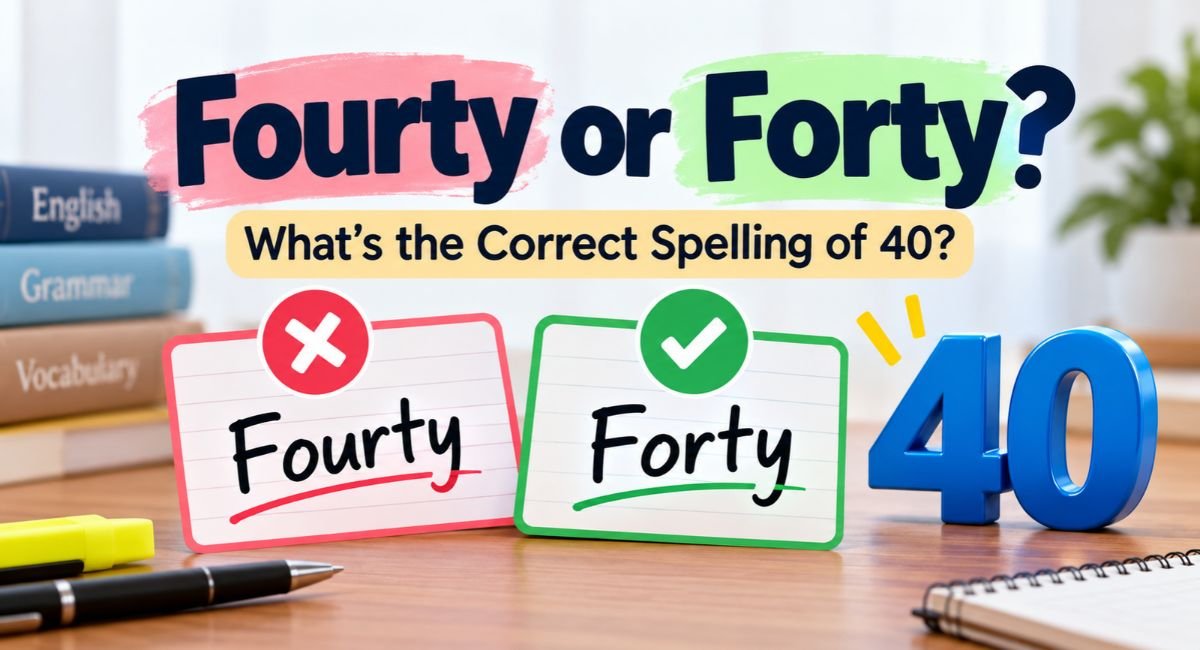
Forty is the correct spelling of the number 40 in English. Fourty is a common misspelling, not a British or American alternative. Although four and fourteen contain the letter U, forty does not. The rule also applies to forty-one, forty-five, and fortieth. Remember: forty is always spelled without a U.
Fourty or Forty: Which Spelling Is Correct?
If you’ve ever written fourty and wondered whether it looks right, there’s a good reason for the confusion. We write four with a U, and we keep that U in fourteen. Yet when we reach 40, the letter disappears. The correct spelling is forty, and the same rule applies whether you’re writing in British, American, Canadian or Australian English.
You might encounter fourty in social media posts, handwritten notes or older texts. That doesn’t make it a standard alternative. Modern English dictionaries recognise forty as the correct form. The distinction matters when writing an application, preparing an assignment or sending a professional email, where even a small spelling error can distract readers from your message.
What Does Forty Mean in English?
Forty is the cardinal number representing 40, or four groups of ten. It comes after thirty-nine and before forty-one. We use it to count objects, describe ages, measure time and express quantities. If a classroom contains forty chairs, it has 40 chairs. If a journey takes forty minutes, its duration is 40 minutes.
The number itself is exact, but the words surrounding it can change how precisely a sentence should be understood. Compare “forty people attended” with “about forty people attended”. The first reports a count of 40; the second gives an estimate. That small difference is worth noticing, especially when writing reports, recording survey results or describing measurements.
Forty Meaning in Other Languages
The number 40 has the same mathematical value in every language, but the words used to express it differ. Knowing these equivalents is useful when translating instructions, discussing prices or learning to count in another language.
| Language | Word for 40 |
| English | Forty |
| French | Quarante |
| Spanish | Cuarenta |
| German | Vierzig |
| Urdu | چالیس (Chālīs) |
| Hindi | चालीस (Chālīs) |
These are translations of the number, not alternative English spellings. A French speaker may write quarante, but when writing the number in English, the correct word is forty. The grammatical construction surrounding a number can also vary between languages, so translating a complete sentence requires more than replacing one number word with another.
Why Is Forty Spelled Without a U?
This is the interesting part: there isn’t a neat modern spelling rule that fully explains why forty lost the U found in four. English spelling developed over centuries, and related words don’t always preserve identical letters. The number fourteen retains the U, but forty and fortieth do not.
A useful comparison makes the pattern clear:
| Number | Correct spelling | Contains U? |
| 4 | Four | Yes |
| 14 | Fourteen | Yes |
| 40 | Forty | No |
| 40th | Fortieth | No |
| 44 | Forty-four | Yes, in four only |
Notice something particularly helpful about forty-four. The first part, forty, has no U, but the second part, four, keeps it. The word therefore contains a U overall, but not in its tens component. This distinction makes forty-four a useful spelling exercise because it tests whether you’ve learned the individual number words rather than memorised a single visual pattern.
How to Pronounce Forty in British and American English?
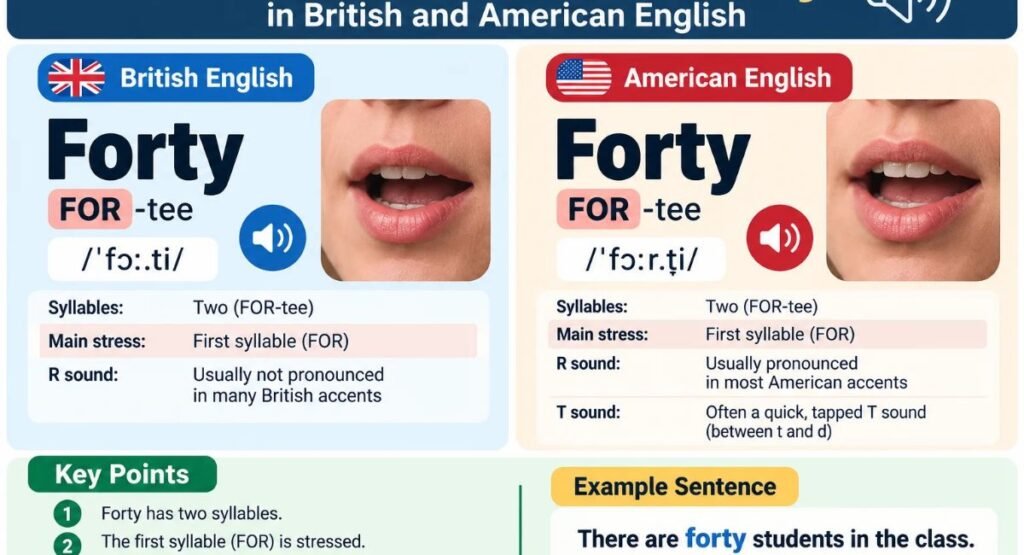
Forty has two syllables, with the main stress on the first: FOR-tee. The capital letters in this simple pronunciation guide indicate the stressed syllable rather than the spelling of the word. Both British and American speakers generally stress the same syllable, although their accents may produce different R and T sounds.
Cambridge Dictionary gives the following representative pronunciations:
| Feature | British English | American English |
| IPA | /ˈfɔː.ti/ | /ˈfɔːr.t̬i/ |
| Simple guide | FOR-tee | FOR-tee |
| Syllables | Two | Two |
| Main stress | First syllable | First syllable |
In many southern British accents, the R in forty isn’t pronounced as a separate consonant. In most American accents, it is. American speakers may also pronounce the T with a quick tap of the tongue, making it sound softer than the clear T often heard in careful British pronunciation. These are accent differences, not competing spellings.
Forty vs Fourteen: How to Avoid Confusing Them
Forty and fourteen can be surprisingly difficult to distinguish in conversation, especially over the telephone or in a noisy room. They differ by more than one digit: forty means 40, while fourteen means 14. Mixing them up in a price, address or appointment time can cause a practical misunderstanding.
Stress provides a helpful clue. Forty usually has first-syllable stress, while fourteen commonly has final-syllable stress when spoken on its own. However, sentence rhythm can affect stress, so it isn’t a completely reliable test. When accuracy matters, repeat the number or clarify it with the digits: “Do you mean fourteen, one-four, or forty, four-zero?”
What Part of Speech Is Forty?
Forty is a cardinal number. It answers the question “How many?” rather than “Which position?” Its grammatical role depends on how it’s used in a sentence.
In “Forty students attended”, the word functions as a number determiner specifying the quantity of students. In “Only forty attended”, it stands independently because the people being counted are understood from context. You can also refer to the number itself, as in “Forty is an even number.”
Forty is not a verb, so it has no past tense, present participle or conjugated forms. Nor does the usual countable-versus-uncountable distinction apply to it as a number determiner. Instead, it can quantify plural countable nouns or appear with measurement expressions involving mass nouns.
| Construction | Example | Explanation |
| Plural countable noun | Forty books | Specifies 40 individual books |
| Measurement | Forty litres of water | Measures an amount of water |
| Independent numeral | Only forty remained | The counted noun is understood |
| Compound modifier | A forty-year-old house | Describes the house’s age |
| Ordinal form | The fortieth page | Identifies a position |
The word can also occur with prepositions, although it doesn’t require one particular preposition. “Forty of the applicants” identifies part of a group, “forty out of fifty” expresses a proportion, and “over forty” indicates a value greater than 40. Each construction adds a different relationship to the basic number.
When Should You Write Forty Instead of 40?
Both forms are correct. The choice between forty and 40 is usually a matter of writing style rather than spelling accuracy. In ordinary prose, you might write, “She waited forty minutes.” In a timetable or data table, “40 minutes” is often easier to scan.
Formal writing doesn’t always require numbers to be spelled out. Scientific publications, business reports and academic style guides may prefer numerals in certain situations. If you’re following a particular style guide, use its rules consistently rather than assuming that spelling out every number automatically makes your writing more professional.
Forty-Year-Old or Forty Years Old?
These two expressions are both correct, but they belong in different sentence structures.
When the age comes before a noun and acts as a compound modifier, use hyphens and keep year singular: “a forty-year-old teacher”. When the age follows the verb, write “the teacher is forty years old” without hyphens.
The distinction is easier to see in pairs:
- A forty-year-old bridge needs repairs.
- The bridge is forty years old.
- They interviewed a forty-year-old applicant.
- The applicant was forty years old.
A common error is writing “a forty years old teacher”. This mixes the two grammatical patterns. Choose the construction that matches the position of the age expression in your sentence.
Forty vs Fortieth: Cardinal and Ordinal Numbers
Forty tells us how many. Fortieth tells us which position.
Imagine a race with forty runners. That sentence describes the total number of participants. Now imagine someone finishes in fortieth place. The second sentence identifies the runner’s position in the finishing order. The two words are related, but they cannot replace one another without changing the meaning.
The distinction also appears in birthdays and anniversaries. A person who turns forty celebrates their fortieth birthday. A company celebrating its fortieth anniversary has reached the 40th anniversary of its founding. In both cases, fortieth describes a position in a sequence, while forty expresses the number itself.
Examples of Forty in Everyday and Formal English
Here are original examples showing how forty works in different situations:
- Everyday conversation: “Give me forty minutes, and I’ll finish the presentation.”
- Academic writing: “The researchers collected responses from forty volunteers.”
- Business communication: “We need forty additional chairs for tomorrow’s conference.”
- Travel: “The nearest railway station is forty kilometres from the village.”
- Finance: “The customer received a refund of forty pounds.”
- Age: “My sister decided to return to university at forty.”
- Mathematics: “Five multiplied by eight equals forty.”
- Workplace instruction: “Please print forty copies of the revised agenda.”
- Informal exaggeration: “I’ve checked my bag forty times, and I still can’t find my keys.”
- Formal reporting: “Forty applications met the eligibility criteria.”
The ninth sentence is different from most of the others. In casual conversation, saying “forty times” can be an exaggeration meaning “many times”. The speaker may not have counted every attempt. In a research report, however, a claim involving forty observations should represent an actual recorded quantity unless the writer clearly identifies it as an estimate.
Synonyms and Related Expressions for Forty
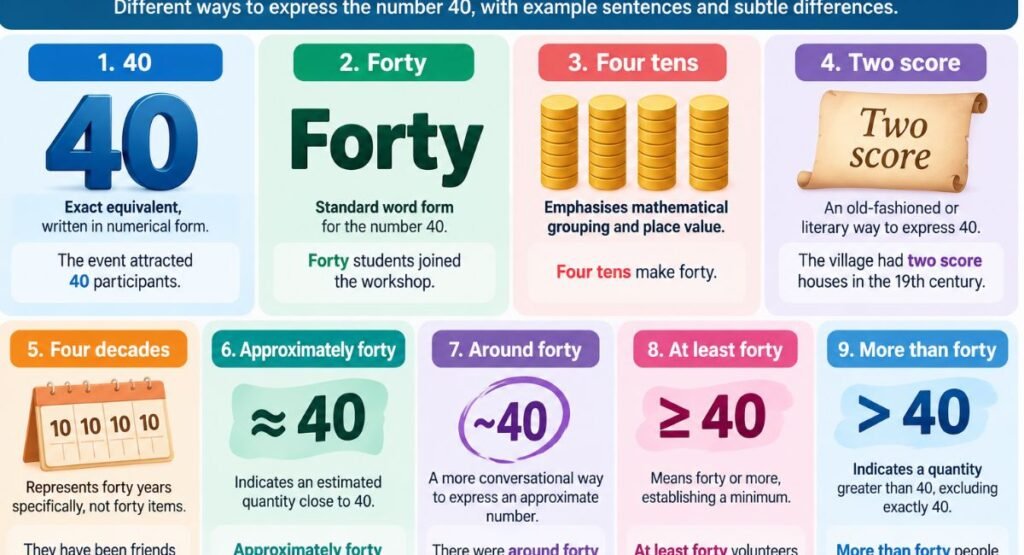
Numbers don’t behave like ordinary descriptive words when it comes to synonyms. You can replace happy with cheerful in some contexts, but replacing forty with thirty changes the numerical meaning completely.
A few expressions are equivalent to forty, while others add approximation, historical flavour or a specific measurement context.
| Expression | Subtle difference |
| 40 | Exactly the same number, written in digits |
| Four tens | Highlights place value and multiplication |
| Two score | An old-fashioned or literary way to express forty |
| Four decades | Means forty years, not forty items |
| Around forty | Suggests an approximate quantity |
| Nearly forty | Usually means close to, but below, forty |
| At least forty | Means forty or more |
| More than forty | Excludes exactly forty |
Consider a researcher who interviews forty participants. Rewriting that as “around forty participants” would weaken the precision of the statement. Likewise, four decades is suitable when discussing a forty-year period, but not when counting forty customers. These distinctions matter because related numerical expressions are not automatically interchangeable.
Does Forty Have an Antonym?
Forty has no true lexical antonym. Numbers identify values rather than opposite qualities, so another number cannot automatically be described as the opposite of forty.
You can, however, construct useful contrasts when comparing quantities or thresholds.
| Expression | Example and meaning |
| Fewer than forty | Fewer than forty guests arrived — a count below 40 |
| More than forty | More than forty guests arrived — a count above 40 |
| Under forty | The driver is under forty — an age below 40 |
| Over forty | The driver is over forty — an age above 40 |
| Not forty | The total was not forty — the exact value is denied |
| Zero | Zero tickets were sold — none were sold, rather than forty |
These are contextual contrasts, not dictionary antonyms. The distinction is worth making because presenting zero or twenty as a universal opposite of forty would be linguistically misleading.
The Origin and History of the Word Forty
Forty has roots in Old English. The historical form fēowertig combines elements related to feower, meaning four, and -tig, associated with a group of ten. Related number words appear in other Germanic languages, including German vierzig and Dutch veertig. These connections help explain how the English word developed within a wider language family.
The Online Etymology Dictionary records the early Middle English form feowerti from the early twelfth century. Older spellings varied, and the form fourty also appears in the historical development of English. What cannot be confidently reduced to one simple rule is why the modern spelling settled on forty rather than retaining the U. It is more accurate to acknowledge that history than invent a tidy explanation.
Special Expressions Using Forty
Forty has a few uses that go beyond simply counting objects. These expressions are worth learning because their meanings cannot always be worked out by translating each word separately.
Forty winks is an informal expression meaning a short sleep or nap. Someone might say, “I’m going to have forty winks before dinner.” It doesn’t mean the person intends to sleep for exactly forty seconds or minutes.
The forties can describe the ages from 40 to 49. For example, “She started her business in her forties.” It can also refer to a decade, such as the 1940s, when the historical context is clear.
The Roaring Forties is a geographical term for the belt of strong westerly winds in the Southern Hemisphere, generally between 40 and 50 degrees south latitude. Here, forties refers to a range of latitudes rather than someone’s age.
Forty-niner is a historical term associated with people who travelled to California during the gold rush of 1849. The name comes from the year, not from a group of forty-nine people.
These established expressions show why studying forty can offer more than memorising the correct spelling.
Common Mistakes With Fourty and Forty
The spelling error fourty is easy to understand, but it’s not the only mistake learners make. Compound numbers, ordinal forms and age expressions can also cause problems.
| Incorrect | Correct | Why |
| Fourty | Forty | The number 40 has no U |
| Fourty-one | Forty-one | The tens component is forty |
| Fourty-five | Forty-five | Compound numbers retain forty |
| Fourtieth | Fortieth | The ordinal form is fortieth |
| Forty student | Forty students | Use a plural countable noun |
| A forty years old teacher | A forty-year-old teacher | Compound modifier needs hyphens |
| She is forty-year-old | She is forty years old | No hyphens in this construction |
One useful spelling check is to separate compound numbers into their components. For forty-four, write forty first and then four, joining them with a hyphen. That prevents the U from accidentally moving into the first part.
Is Forty Spelled Differently in British and American English?
No. Forty is the standard spelling in both British and American English, as well as in Canadian and Australian English. Fourty is not a regional alternative.
This is unlike pairs such as colour and color, where British and American spelling conventions differ. The U in colour doesn’t provide a reason to insert one into forty. If you’re writing an essay for a British university or preparing a document for an American employer, the spelling of the number remains the same.
How to Remember the Spelling of Forty
A quick memory trick is: “Forty forgot its U.”
It’s not a historical explanation, but it works as a reminder. You can also remember the contrasting pair: fourteen keeps its U; forty doesn’t.
For a more reliable spelling exercise, try writing these without looking at the answers:
- The number 40 in words.
- The number 45 in words.
- The ordinal number 40th.
- The number 44 in words.
Answers: Forty, forty-five, fortieth and forty-four.
The last example is especially useful. It reminds you that forty-four contains a U only because its second component is four.
Conclusion
Forty is the correct modern English spelling of 40. Fourty is a common misspelling, not an accepted British or American variation. The apparent inconsistency comes from the fact that four and fourteen contain a U, while forty and fortieth do not.
The easiest way to remember the distinction is to practise the related forms together: forty, forty-one, forty-four and fortieth. Once you understand the spelling, pronunciation and grammar, you can use the word confidently in everyday conversation, academic work and professional writing.
Frequently Asked Questions
Is it forty or fourty in British English?
Forty is the correct spelling of the number 40 in British English. Fourty is considered a spelling mistake in modern standard English. The same rule applies to American, Canadian and Australian English. Although four contains the letter U, forty is always written without it when expressing the number 40.
Why is forty spelled without a U?
Forty is spelled without a U because its modern spelling developed through historical changes in the English language. Although the related word four contains a U, the standard form of forty does not. Earlier English texts sometimes used alternative spellings, but forty became the accepted form in contemporary written English.
Is fourty ever acceptable in English?
Fourty is not an accepted standard spelling of the number 40 in modern English. However, similar spellings appeared in historical texts before English spelling conventions became more consistent. Today, dictionaries recognise forty as the correct form. Use forty in academic assignments, professional documents, emails and everyday writing to avoid spelling errors.
How do you spell 40th and 45 in words?
The ordinal number 40th is spelled fortieth, while the cardinal number 45 is written forty-five. Fortieth indicates a position in a sequence, such as a fortieth birthday. Forty-five expresses a quantity and uses a hyphen between its two number words. Neither spelling contains the letter U.
Should I write forty or 40 in formal writing?
Both forty and 40 are correct, but the preferred form depends on the writing style and context. Many academic and professional style guides recommend numerals for measurements, statistics and numerical data. Spelled-out numbers may be appropriate in ordinary prose. Follow your publication’s style guide and maintain consistency throughout the document.



One Comment