Threshold or Threshhold Meaning in [Language]
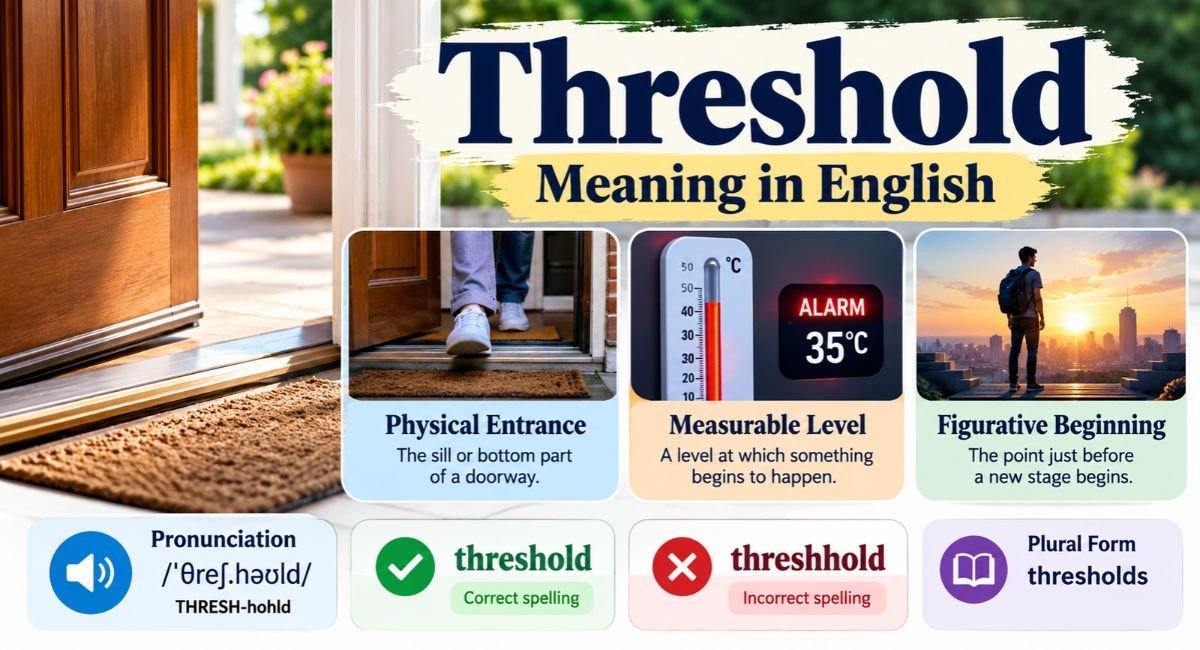
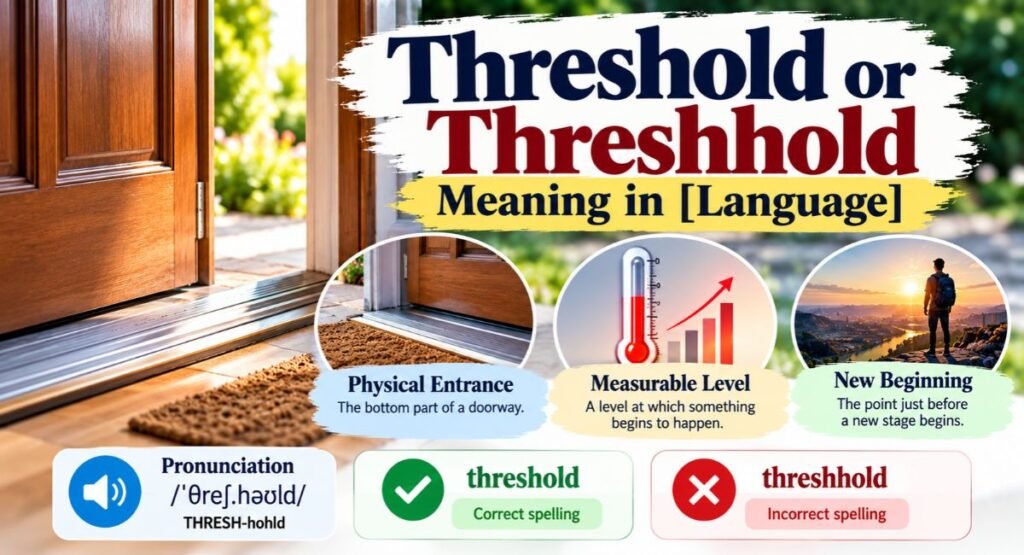
Threshold means the bottom part of a doorway, a level at which something starts to happen, or the point just before a new stage begins. The correct spelling is threshold, not threshhold. In [Language], the translation depends on whether the word describes a physical entrance, a measurable limit or a new beginning.
Understanding threshold or threshhold meaning in [Language] starts with a simple idea: a threshold marks a boundary between two conditions, places or stages. Sometimes that boundary is something you can step across. At other times, it is an invisible line that determines when a rule applies or a change occurs.
Consider three situations. You step across the threshold of your house, your income rises above a tax threshold, or you find yourself on the threshold of a new career. The same English word appears in each sentence, but its meaning changes. Recognising those differences is more useful than memorising one translation.
Threshold Meaning in [Language]: Three Main Definitions
Threshold is a noun with several related meanings. Its translation into [Language] should reflect the specific sense intended by the speaker or writer. A word that accurately describes a doorway may not work when discussing temperatures, financial requirements or life changes.
The three primary meanings are physical entrance, triggering level and beginning of a new stage.
| Meaning | Simple explanation | Example |
| Physical threshold | The sill or bottom part of a doorway | She stepped across the threshold. |
| Measurable threshold | A level at which something begins to happen or have an effect | The alarm activates above a set threshold. |
| Figurative threshold | The point just before a new situation begins | He is on the threshold of a new career. |
The exact [Language] translations cannot be supplied reliably until the intended language is identified. The distinctions above show which meanings need separate equivalents.
Threshold as a Doorway or Entrance
Imagine walking into an old house. A narrow piece of wood runs along the bottom of the doorway. That piece is the threshold. In some buildings, it may be made of stone, metal or another material.
This physical sense also explains expressions such as “cross the threshold” and “stand on the threshold”. A person crossing a threshold is literally entering or leaving a room. The word refers to the doorway’s lower boundary rather than the entire door.
Threshold as a Level That Triggers a Change
Suppose a greenhouse has a temperature alarm programmed to activate at 35°C. That temperature is the alarm’s activation threshold. When the measured temperature reaches the specified level, the system responds.
The same idea appears in finance, education and technology. An applicant might need to reach a qualifying score, while a sensor might require a certain signal strength before registering a reading.
A threshold does not always mean the highest permitted amount. It can identify a minimum requirement, an upper trigger or another decision point, depending on the rule being discussed.
Threshold as the Beginning of Something New
Threshold also appears in figurative writing. Someone “on the threshold of adulthood” is approaching a new stage of life rather than standing at an actual doorway.
This meaning is particularly useful when describing an important transition. A graduating student might be on the threshold of professional life, while a company may be on the threshold of expansion.
The expression suggests that a change is close, not necessarily that it has already happened.
Threshold Pronunciation: British and American English
Threshold has two syllables, with the main stress on the first syllable.
| Feature | Pronunciation |
| British IPA | /ˈθreʃ.həʊld/ |
| American IPA | /ˈθreʃ.hoʊld/ |
| Simple phonetic guide | THRESH-hohld |
| Syllables | thresh–hold |
| Word stress | First syllable |
The opening /θ/ sound is the same consonant heard at the beginning of “think” and “three”. Place the tip of your tongue gently between your teeth and let air pass through without vibrating your vocal cords.
The letters “sh” produce the /ʃ/ sound heard in “ship”. The word should not be pronounced with an extra syllable between these consonants.
The American and British pronunciations are similar, although the vowel in the second syllable differs.
Threshold or Threshhold: Which Spelling Is Correct?
The correct spelling is threshold. The spelling threshhold is incorrect in standard English.
One reason learners make this mistake is that the word seems to contain several smaller parts. When writing quickly, they may insert an extra “h” before the final section.
A useful spelling reminder is:
thres
hold
threshold — correct spelling
threshhold
threshhold — incorrect spelling
The spelling can be remembered as “thres” followed by “hold”. This is only a memory technique, not a historical explanation of how the word developed.
Other possible spelling errors include “treshold” and “thresold”. Neither is standard English.
Threshold Grammar: Part of Speech, Plural and Prepositions
Threshold is primarily a countable noun.
You can say “a threshold”, “the threshold”, “two thresholds” or “several thresholds”. Its plural form is thresholds.
- Singular: “The sensor has a fixed threshold.”
- Plural: “Different sensors have different thresholds.”
- With an adjective: “The organisation established a minimum threshold.”
- Before another noun: “The threshold value was adjusted.”
In technical language, threshold can also function as a verb, especially when describing the processing of digital images or data. For example, software may “threshold an image” by separating pixel values according to a chosen cutoff.
In general English, however, threshold is overwhelmingly used as a noun. Expressions such as “reach a threshold” or “exceed a threshold” are usually more appropriate than using it as a verb.
Threshold With Common Prepositions
The preposition used with threshold often reveals its intended meaning.
| Expression | Example | Meaning |
| Threshold of | On the threshold of adulthood | Approaching a new stage |
| Threshold for | Threshold for admission | Requirement or qualifying level |
| Above the threshold | Above the safety threshold | Higher than the specified level |
| Below the threshold | Below the income threshold | Lower than the specified level |
| At the threshold | Standing at the threshold | At a doorway or relevant boundary |
| Across the threshold | Walked across the threshold | Crossed a doorway |
Notice that “threshold for” often identifies what a requirement applies to, while “on the threshold of” frequently refers to an approaching experience.
For example, “the threshold for admission” is natural when discussing educational requirements. “On the threshold of success” is appropriate when describing an approaching achievement.
Original Threshold Example Sentences With Explanations
Learning threshold through different situations makes its meanings easier to recognise. These examples show how the word works in ordinary conversation, formal communication and specialist writing.
Everyday English Examples
“The dog refused to cross the threshold until its owner came inside.”
Here, threshold refers to the bottom of a doorway. The sentence describes an actual physical boundary.
“After dealing with constant interruptions, I reached my patience threshold.”
This means the speaker had reached the point where they could no longer comfortably tolerate interruptions. In casual conversation, someone might simply say, “I’ve had enough.”
Education and Career Examples
“Applicants must achieve the minimum score threshold before their applications can be considered.”
The threshold is a required academic level. The sentence does not mean that achieving the score guarantees admission.
“With her final examination completed, Leena stood on the threshold of a new chapter in her life.”
This is a figurative use. The threshold represents the approaching transition from education to another stage.
Business and Financial Examples
“The online store offers free delivery when an order reaches the spending threshold.”
Here, threshold describes the minimum purchase amount required to qualify for an offer.
“The bank reviewed its lending thresholds after changing its risk assessment policy.”
This formal example describes numerical requirements used in financial decisions.
Science and Technology Examples
“The warning light switches on when the pressure exceeds the specified threshold.”
Threshold identifies a pressure level that triggers a response.
“The researcher lowered the detection threshold to identify weaker signals.”
In this context, the threshold is a criterion used to decide whether a signal has been detected. Lowering it may make weaker signals detectable, but it can also increase false detections.
Literary Example
“At the threshold of a difficult decision, he wondered whether returning home was still possible.”
The word creates an image of someone standing before an important change. There is no actual doorway in this sentence.
Threshold vs Limit, Boundary, Minimum and Cutoff
Threshold is often explained as a synonym of limit. That explanation is useful as a starting point, but it can lead to mistakes.
Imagine a swimming pool with a warning system. A temperature threshold determines when a warning appears. A temperature limit identifies the highest acceptable temperature. The two numbers might be equal, but their functions are different.
| Word | Distinct meaning | Best use |
| Threshold | Point where a condition begins or triggers a response | Alarm activation threshold |
| Limit | Boundary of what is allowed, possible or acceptable | Speed limit |
| Boundary | Line separating physical or abstract areas | Property boundary |
| Minimum | Lowest amount required or possible | Minimum payment |
| Cutoff | Point used to decide inclusion or exclusion | Application cutoff score |
| Brink | Point immediately before an important, often negative event | Brink of disaster |
| Verge | Point close to the beginning of an event or condition | Verge of tears |
These differences matter when translating threshold into [Language]. A translation equivalent to “limit” may work in a numerical context but could be misleading when the sentence refers to an approaching life change.
High Threshold vs Low Threshold: A Practical Comparison
A high threshold means that a larger amount or stronger stimulus is needed before a particular response occurs. A low threshold means that a smaller amount or weaker stimulus is enough.
Consider two motion sensors.
Illustrative motion-sensor example
Motion signal strength
5/10
Low threshold: 3
Triggered
High threshold: 8
Not triggered
Adjust the signal strength to see how different thresholds affect activation. Values are illustrative, not measurements from actual equipment.
The low-threshold sensor activates at a signal strength of 3, whereas the high-threshold sensor activates at 8. At a signal strength of 5, only the low-threshold sensor responds.
The same underlying distinction appears in expressions such as “low boredom threshold” and “high pain threshold”, although each has its own meaning.
Pain Threshold Is Not the Same as Pain Tolerance
This is a particularly important distinction.
Pain threshold is the point at which a stimulus first becomes painful. Pain tolerance concerns how much pain a person is willing or able to endure after pain begins.
For example, two people might begin to feel pain at a similar stimulus intensity but differ in how long they tolerate it.
In everyday English, “high pain threshold” is sometimes used more loosely to describe someone who can handle pain well. In medical or scientific discussions, distinguishing pain threshold from pain tolerance is important.
Does Threshold Have an Antonym?
There is no single word that serves as the opposite of threshold in every context.
If threshold means the beginning of a stage, words such as “end”, “conclusion” or “finish” may express the opposite idea.
If the context concerns entering a building, “exit” may contrast with “entrance”. However, an exit is not literally the antonym of a door sill.
For numerical thresholds, the more useful contrast is often between being above and below a specified level.
For example:
“The candidate’s score was above the admission threshold.”
“The candidate’s score was below the admission threshold.”
Here, the same word remains in both sentences. The relationship to the threshold changes.
Common Mistakes With Threshold and How to Fix Them
Some errors involving threshold are simple spelling mistakes. Others arise because the learner understands one meaning but applies it to every situation.
Mistake: Adding an Extra H
Incorrect: “The threshhold was exceeded.”
Correct: “The threshold was exceeded.”
Threshold is the standard spelling, regardless of whether the word describes a doorway or a numerical level.
Mistake: Using the Wrong Preposition
Incorrect: “She is on the threshold for a new career.”
Correct: “She is on the threshold of a new career.”
The established figurative expression is “on the threshold of”.
Mistake: Treating Every Threshold as a Maximum
Incorrect interpretation: “The minimum spending threshold is £50, so customers cannot spend more than £50.”
Correct interpretation: “Customers must spend at least £50 to qualify.”
A minimum spending threshold sets a lower requirement, not a spending ceiling.
Mistake: Confusing Pain Threshold With Pain Tolerance
Unclear: “He has a high pain threshold, so he can tolerate pain indefinitely.”
Better: “He has a high pain threshold, but that does not necessarily tell us how much prolonged pain he can tolerate.”
The two concepts concern different aspects of pain.
Mistake: Using Threshold Where Simpler English Works Better
Awkward: “I reached my hunger threshold.”
More natural: “I was extremely hungry.”
Threshold is useful when identifying an actual trigger point or making a deliberate figurative comparison. It is not automatically the best word for every feeling or experience.
The Origin of Threshold: What We Know
Threshold has roots in Old English. Historical forms include therscold and threscold. The word referred to the bottom of a doorway, and the physical sense remains familiar in modern English.
Oxford Learner’s Dictionaries connects the first element with a Germanic sense related to treading or threshing. However, the origin of the second element is not established. It is therefore misleading to present the modern spelling as proof that the word originally meant “thresh” plus “hold”.

Oxford Learner’s Dictionaries
+1
The development of its figurative meanings is easier to understand. A doorway separates one space from another. Over time, threshold also came to describe points separating one condition, period or experience from the next.
How to Choose the Correct Meaning of Threshold
When you encounter threshold in an unfamiliar sentence, look at the surrounding nouns and verbs.
If the sentence mentions a door, room, floor or entrance, the word probably has its physical meaning.
If it includes measurements, qualifying conditions or numerical values, threshold probably identifies a level at which a rule or effect begins.
If the sentence describes an approaching event or life transition, threshold is likely figurative.
Compare these examples:
- “She stepped over the threshold.” — Physical doorway.
- “His earnings exceeded the threshold.” — Numerical level.
- “They stood on the threshold of discovery.” — Approaching development.
This context-first method is also the safest way to select the appropriate translation in [Language].
Test Your Understanding of Threshold
Vocabulary practice
0 of 4 answered
1. The alarm activates when smoke concentration reaches a set threshold.
Physical doorway
Triggering level
New life stage
2. The children waited on the threshold before entering.
Physical doorway
Minimum requirement
Emotional limit
3. She is on the threshold of a remarkable career.
Maximum limit
Door sill
Beginning of a new stage
4. A lower detection threshold can allow a system to identify weaker signals.
Signals need greater strength
Signals can be detected at lower strength
The sensor has no limit
Conclusion
Threshold is a useful English word because it connects a physical idea with several abstract ones. It can describe the bottom of a doorway, a measurable point that triggers a response, or the beginning of a new stage.
The correct spelling is threshold, not threshhold. For natural English, pay attention to phrases such as “threshold for admission”, “above the threshold” and “on the threshold of a new beginning”.
Most importantly, do not assume that every instance means “limit”. The surrounding context determines the intended meaning and its appropriate translation.
Frequently Asked Questions About Threshold
What is the simple meaning of threshold in [Language]?
Threshold refers to the bottom part of a doorway, a level where something begins to happen, or the point before a new stage starts. Its translation into [Language] depends on context. A physical entrance, an income requirement and the beginning of a career may require different translated expressions.
Is threshold or threshhold the correct spelling?
Threshold is the correct standard English spelling. Threshhold is a spelling error caused by adding an unnecessary letter. The word is primarily a noun and has the plural form thresholds. It can describe a physical doorway, a measurable trigger level or an approaching transition.
What is the difference between threshold and limit?
Threshold usually identifies a point at which something starts, changes or produces a response. Limit describes a boundary or permitted extent. A sensor may activate when a threshold is reached, while a safety limit may identify the highest acceptable reading. The two terms overlap in some contexts.
What does on the threshold of mean?
“On the threshold of” means being close to the beginning of an important experience, condition or period. For example, “She is on the threshold of a new career” suggests that her professional life is about to begin. The expression is often used in formal or figurative writing.
What is the difference between high threshold and low threshold?
A high threshold requires a relatively stronger stimulus or greater amount before a response occurs. A low threshold requires less. For instance, a sensor with a low detection threshold may respond to weaker signals than one with a high threshold. The practical meaning depends on what is being measured.