
Skilful vs. Skillful Meaning in [Language]
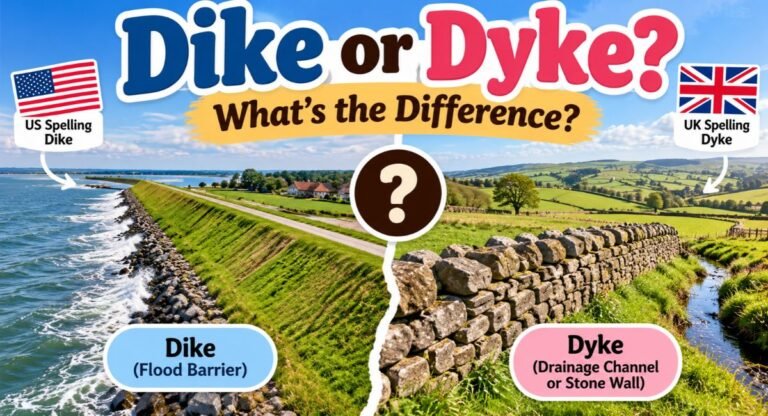
Skilful and skillful are two spellings of the same adjective. Both describe someone who performs an activity well or an action carried out with ability and care. Skilful is the usual British English spelling, while skillful is the American English spelling. Their meaning and standard pronunciation are the same.
Understanding the exact keyword phrase “Skilful vs. skillful meaning in [language]” begins with a simple distinction: the words differ in spelling, not meaning. A British writer might praise a skilful surgeon, while an American writer would describe the same surgeon as skillful. Neither spelling suggests greater expertise, and both are correct in the appropriate regional context.
The interesting part is how the adjective behaves in real sentences. You can describe a skilful person, a skilful performance or someone’s skilful handling of a difficult situation. Yet not every synonym fits those same expressions naturally. Knowing where to use skilful, skilled, talented or expert will improve your English more than memorising a dictionary definition.
Skilful and Skillful Meaning in Simple English
Skilful means being good at doing something, especially when the activity requires practice, knowledge, judgement or special ability. A skilful pianist controls timing and technique, while a skilful mechanic understands how to diagnose and repair problems. The adjective describes demonstrated competence rather than simply an interest in an activity.
The meaning becomes slightly broader when the word describes an action. Consider the phrase “skilful handling of a complaint”. It suggests that someone dealt with the problem effectively, perhaps by choosing their words carefully or finding a practical solution. The adjective can therefore describe physical ability, creative judgement, technical competence and the thoughtful management of difficult circumstances.
Skilful Meaning in [Language]: Translation and Context
The English meaning is clear, but an exact translation into [language] cannot be provided until the target language is identified. A suitable equivalent should convey competence, ability or well-executed performance. Translating it as simply intelligent or talented may be misleading because skilful does not necessarily mean someone possesses exceptional intelligence or natural ability.
Context matters when translating expressions such as skilful hands, a skilful negotiator and skilful use of evidence. The first may emphasise manual dexterity, the second effective interpersonal judgement and the third careful application of knowledge. A good translation should preserve those differences rather than mechanically substitute the same equivalent in every sentence.
Skilful vs. Skillful: Why Are There Two Spellings?
British English generally prefers skilful, while American English uses skillful. The difference is particularly noticeable because the underlying noun, skill, contains two Ls. In the British adjective, the spelling contains a single L before the suffix -ful. American English retains the double L from the noun.
There is no change in meaning, grammatical function or standard pronunciation. In a UK-based school assignment, “a skilful writer” would normally be the expected spelling. In an American publication, “a skillful writer” is more appropriate. The choice depends on editorial convention, not the person’s ability.
| Context | Preferred spelling | Example |
| British English | Skilful | She is a skilful photographer. |
| American English | Skillful | She is a skillful photographer. |
| British adverb | Skilfully | He skilfully repaired the clock. |
| American adverb | Skillfully | He skillfully repaired the clock. |
Why the Word Family Can Be Confusing
An easy spelling trap is assuming that every word beginning with skill must retain two Ls. British English uses skill and skilled but normally writes skilful and skilfully. American English uses skill, skilled, skillful and skillfully. This explains why spelling by analogy alone does not always work.
Another trap involves the suffix -ful. It has one L, even though the separate adjective full has two. In American skillful, the double L belongs to the base word skill; the suffix itself is still -ful. Keeping the base word and suffix separate makes the spelling pattern easier to understand.
How to Pronounce Skilful and Skillful
The pronunciation of both adjectives is essentially identical in standard British and American English. There are two syllables, and the first receives the stress. The simple pronunciation guide is SKIL-fuhl, with the IPA transcription /ˈskɪl.fəl/. The second syllable is weaker and shorter than the first.
Do not pronounce the double L in American skillful as an extra syllable or separate consonant sound. Likewise, avoid placing strong stress on the ending. In a sentence such as “She’s a skilful painter”, the adjective should flow naturally without giving its final syllable unnecessary emphasis.
Skilful Grammar: Adjective, Prepositions and Word Forms
Skilful and skillful are adjectives, so they describe people, actions or qualities. They can appear before nouns, as in “a skilful dancer”, or after linking verbs, as in “the dancer is skilful”. They do not have verb tenses. Countability also does not apply to the adjective, although the related noun skill has both countable and uncountable uses.
The noun skill can refer generally to ability, as in “This job requires skill”. Its plural, skills, refers to particular abilities, as in “She has strong communication skills”. The related adverb, skilfully or skillfully, explains how an action is performed. Compare “a skilful repair” with “the repair was skilfully completed”.
Skilful At or Skilful In: Which Is Correct?
Both skilful at and skilful in are accepted combinations. Skilful at often introduces a particular activity, while skilful in can introduce a field, method or situation. Oxford Learner’s Dictionaries records both prepositions, so there is no reason to declare either form incorrect.
Compare these sentences:
- She is skilful at repairing antique furniture.
- He is skilful in managing workplace disagreements.
- The player is skilful at controlling the ball.
- The diplomat is skilful in negotiations.
The distinction is not absolute. “Skilful at managing teams” and “skilful in managing teams” are both natural. What matters is the meaning of the surrounding phrase and the wording that sounds appropriate in context.
More Skilful or Skilfuller?
Use more skilful for the comparative and most skilful for the superlative. These are the standard, natural choices in contemporary English. For example, “Nadia is more skilful at chess than her brother” compares two people, while “She is the most skilful player in the club” compares her ability with that of the entire group.
American English follows the same grammatical pattern: more skillful and most skillful. Learners sometimes attempt forms such as skilfuller or skillfullest by applying the -er and -est endings used with shorter adjectives. Those are not the recommended forms for ordinary modern usage.
Original Skilful and Skillful Example Sentences
The adjective is useful because it works across occupations, hobbies, sport and everyday situations. The following examples show more than a change in spelling. Each highlights the particular kind of competence being described, whether that involves physical coordination, sound judgement or the careful application of knowledge.
Notice the difference between praising someone generally and praising a particular action. Calling someone a skilful editor describes their ability, while referring to skilful editing evaluates the work itself. That distinction lets writers offer specific praise without making broader claims that the evidence does not support.
- The skilful violinist adjusted her bowing to match the orchestra’s quieter passage.
- His skillful parking impressed everyone in the crowded car park.
- The teacher’s skilful questions helped the class identify an error in their reasoning.
- A skillful negotiator knows when to speak and when to listen.
- The goalkeeper made a skilful save despite the poor visibility.
- Her skillful editing reduced the report’s length without losing important information.
- The carpenter’s skilful restoration preserved the chair’s original character.
- My grandfather is remarkably skilful at repairing mechanical watches.
- The manager used skillful timing to introduce an unpopular proposal.
- The artist’s skilful use of negative space made the design feel balanced.
Skilful vs. Skilled, Talented, Expert and Proficient
Several adjectives describe ability, but each one directs attention towards a different quality. Skilful often highlights effective performance, while skilled commonly emphasises competence developed through training or experience. Talented may suggest natural aptitude, proficient indicates a reliable standard of ability, and expert usually suggests advanced knowledge or mastery.
These are tendencies, not rigid definitions. A talented singer can also be skilful, and an expert engineer will often be highly skilled. The distinction becomes most useful when deciding what you actually know about someone. Have you observed an excellent performance, confirmed professional training or simply noticed promising potential?
| Word | Distinctive emphasis | Natural example |
| Skilful | Effective performance or application of ability | Skilful handling of a complaint |
| Skilled | Developed competence, often through training | Skilled electrician |
| Talented | Aptitude or impressive potential | Talented young musician |
| Expert | Advanced knowledge or mastery | Expert forensic analyst |
| Proficient | Reliable command of an activity | Proficient in Spanish |
| Deft | Quick, precise or tactful execution | Deft handling of a delicate issue |
Why “Skilful Surgeon” and “Skilled Surgeon” Are Not Quite the Same
A skilled surgeon is someone described as possessing developed surgical competence. A skilful surgeon is someone whose ability or performance is being praised. Both are natural expressions, and neither phrase proves the person has a particular qualification, experience level or success rate.
The difference becomes clearer when describing an individual procedure. “The surgeon’s skilful movements minimised unnecessary tissue damage” refers to performance during an operation. “The hospital employs skilled surgeons” describes professional competence more generally. Choosing between these expressions depends on which fact the writer intends to communicate.
When Skilful Sounds More Natural Than Talented
A talented child might show unusual promise in music without having spent many years practising. A skilful pianist, by contrast, demonstrates control and competence during a performance. Talent and skill can develop together, but neither automatically proves the presence of the other.
The distinction matters when praising someone fairly. If you have watched a person complete a complicated task with precision, skilful may be more informative than talented. You are describing something observable rather than speculating about whether their ability came naturally.
Antonyms of Skilful: Choosing the Right Opposite
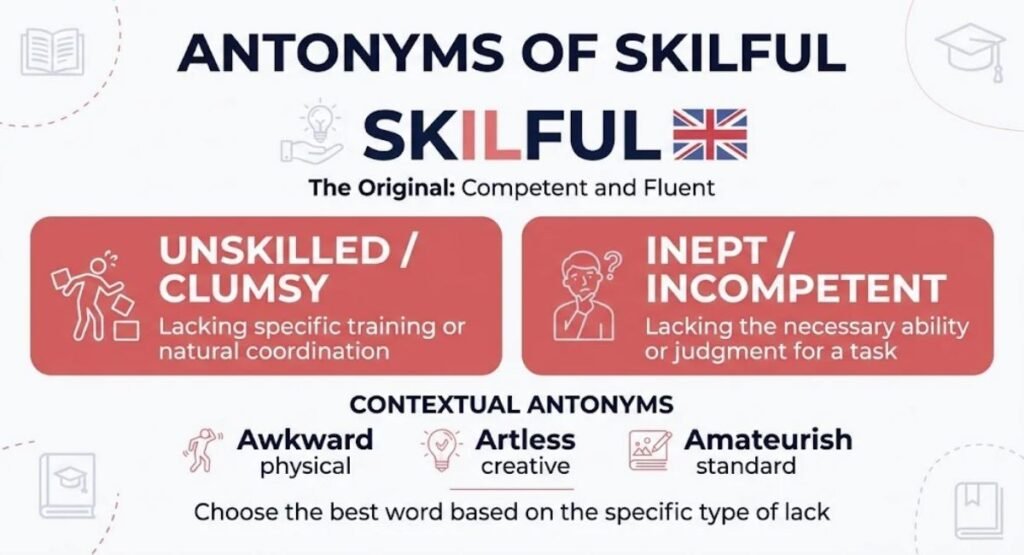
The most useful opposite depends on what is missing. Unskilled refers to a lack of particular developed abilities or training, while clumsy suggests poor coordination. Inept describes ineffective performance, and incompetent is a stronger judgement about someone’s ability to meet an expected standard.
Inexperienced deserves special care. Someone can be inexperienced yet highly capable, particularly when learning a new activity quickly. Similarly, a temporary mistake does not necessarily make an experienced person incompetent. Selecting an antonym without considering these distinctions can produce a harsher or less accurate description than intended.
| Antonym | Meaning in context |
| Unskilled | Lacking particular training or developed ability |
| Clumsy | Moving or handling things without smooth coordination |
| Inept | Performing a task poorly or awkwardly |
| Incompetent | Unable to meet an expected standard of performance |
| Inexperienced | Having limited practical experience |
| Amateurish | Appearing insufficiently polished or professional |
Origin and Etymology of Skillful
The adjective skillful is formed from the noun skill and the suffix -ful, which can express possession of a quality. Etymonline records skillful, including the spelling skilful, from the early fourteenth century. Its older meanings included being knowledgeable or guided by reason. The modern sense involving practised abilities is recorded by the 1560s.
The noun skill entered English from Old Norse skil, a word associated with distinction and discernment. Its meaning later developed towards knowledge and practical ability. The history is more complicated than a simple claim that Americans added a letter or British writers removed one. The consulted etymological source does not establish a single event responsible for the modern regional preference, so no such explanation is asserted here.
Common Mistakes With Skilful and Skillful
The most frequent errors arise from treating skilful as a verb or confusing it with the adverb skilfully. Because the adjective describes a person or thing, it cannot normally replace an adverb describing how someone performs an action. “She handled the problem skilful” is incorrect; “She handled the problem skilfully” is the correct British English construction.
Another mistake is treating skilful and skilled as completely interchangeable. You can describe a skilled carpenter or a skilful carpenter, but skilled handling sounds less natural than skilful handling in many contexts. The difference is one of established usage and emphasis, not a strict prohibition against particular combinations.
| Mistake | Improved version | Explanation |
| She works very skilful. | She works very skilfully. | An adverb describes how she works. |
| He is a skillfully designer. | He is a skillful designer. | An adjective modifies the noun designer. |
| She is skilful to painting. | She is skilful at painting. | At is the natural preposition here. |
| He has many skilfuls. | He has many skills. | Skills is the plural noun. |
| This is the most skillfully player. | This is the most skillful player. | The superlative needs an adjective. |
A Useful Editing Test
Try identifying what your sentence actually evaluates. If it describes a person’s ability, skilful or skillful may work. If it describes the manner of an action, choose skilfully or skillfully. If it names an ability, use skill or skills. This test solves most grammatical confusion without requiring learners to memorise complicated rules.
For regional consistency, check the entire word family rather than the headword alone. A British article using skilful should normally use skilfully, while an American article using skillful should use skillfully. The noun skill and the adjective skilled retain their double L in both standard varieties.
When Should You Use Skilful in Formal or Casual Writing?
Skilful is useful in formal writing because it can describe a specific quality without exaggerating someone’s status. An academic might praise a skilful interpretation of evidence, while a workplace review might mention skilful conflict resolution. Such phrases identify effective work rather than automatically claiming that the person involved is an expert.
In casual speech, people often prefer simpler descriptions such as good at or great at. “My brother is really good at fixing bikes” sounds relaxed and natural, whereas “My brother is a skilful bicycle mechanic” has a more descriptive tone. The right choice depends on the situation, not a rule that one expression is inherently more correct.
Conclusion
The key distinction between skilful and skillful is straightforward: British English generally prefers the first spelling, and American English uses the second. Both are adjectives with the same core meaning and standard pronunciation. They describe people who demonstrate ability and actions performed effectively, whether in sport, creative work or professional situations.
The more valuable lesson is knowing what the adjective communicates. Skilful describes demonstrated competence, while alternatives such as skilled, talented, proficient and expert place different emphasis on training, aptitude or mastery. Choosing the right expression, using the correct grammatical form and maintaining regional spelling consistency will make your English clearer.
Frequently Asked Questions
What is the difference between skilful and skillful?
Skilful and skillful have the same meaning and pronunciation. Their difference is primarily regional spelling. Skilful is generally preferred in British English, while skillful is the standard American form. Both adjectives describe a person with ability or an action performed well. Choose the spelling appropriate for your audience and use it consistently.
Is skilful correct in British English?
Yes. Skilful is the usual British English spelling of the adjective. It can describe people, performances, decisions or actions requiring ability. American English generally prefers skillful. Both are recognised spellings, and choosing one over the other does not suggest a difference in intelligence, training or the quality of someone’s performance.
What does skilful mean in [language]?
Skilful means having or demonstrating the ability to perform an activity effectively. It can refer to physical coordination, technical competence, creative judgement or careful problem-solving. The precise translation depends on the target language and the context. A translation should preserve the intended sense of ability rather than simply suggest intelligence or natural talent.
What is the difference between skilful and skilled?
Skilful often draws attention to effective performance, while skilled commonly emphasises competence developed through learning or experience. For example, skilful handling describes how something was managed, whereas a skilled technician describes a capable professional. Their meanings overlap, so the choice depends on the specific quality a writer wants to highlight.
How do you pronounce skilful and skillful?
Both spellings share the same standard pronunciation, represented as /ˈskɪl.fəl/ in IPA. A simple pronunciation guide is SKIL-fuhl. The word has two syllables, with stress on the first. The second syllable is unstressed, and the additional L in American spelling does not create another sound or syllable.

One Comment