
Smokey vs. Smoky: Meaning, Spelling & Examples
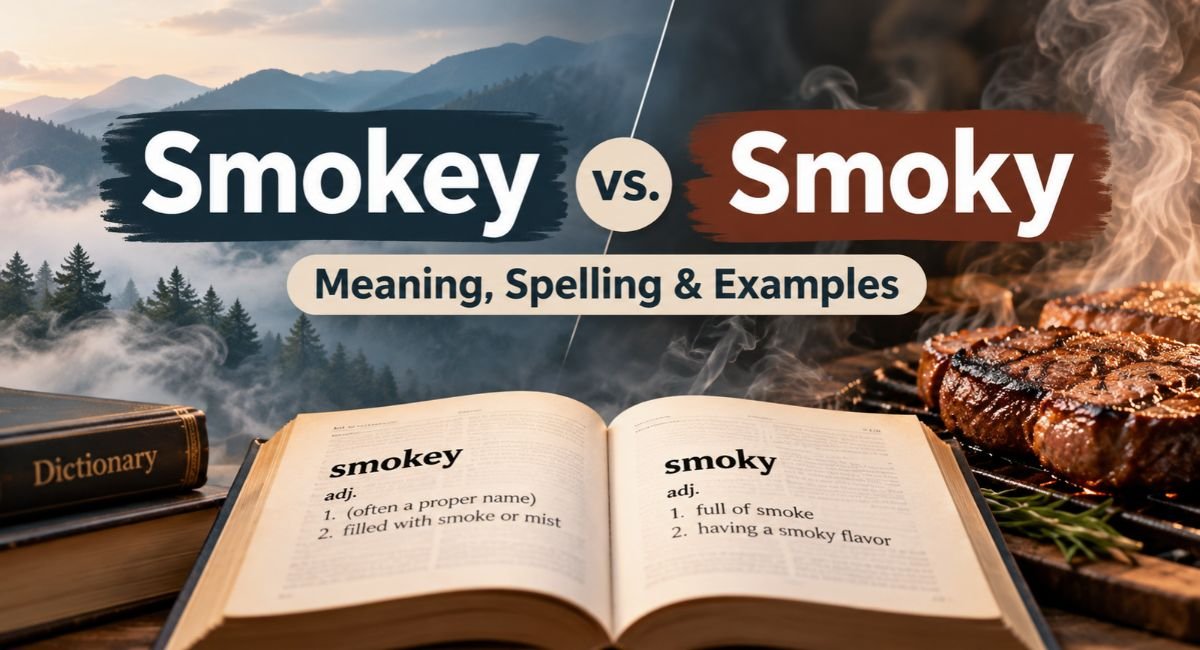
Smokey vs. smoky compares two accepted spellings of an English adjective. Smoky is the standard spelling for something filled with smoke or resembling smoke in appearance, smell, or flavour. Smokey is a less common variant that also appears in established names, including Smokey Bear. Both words have identical pronunciations.
What Does Smoky Mean in English?
Smoky is an adjective that describes something containing smoke, producing smoke, or having qualities associated with smoke. A smoky kitchen might contain smoke from burnt food, while a smoky fireplace may produce more smoke than expected. The word can also describe the appearance of the sky when smoke or a smoke-like haze reduces visibility. In these situations, smoky refers to a physical condition that someone can usually see or smell.
The meaning extends beyond actual smoke. A smoky flavour reminds someone of food cooked over a fire, while smoky blue describes a muted shade with greyish qualities. Writers also use the word to describe voices, makeup, and atmosphere. These meanings are not interchangeable: a smoky voice does not contain smoke, and smoky blue is a colour description rather than evidence of a fire.
definition in the Cambridge English Dictionary
What Does Smokey Mean in English?
Smokey is a recognised alternative spelling of smoky, but it is less commonly used as an ordinary adjective. Cambridge Dictionary lists it as an alternative form, meaning it should not automatically be described as a nonexistent or universally incorrect word. Nevertheless, smoky is the conventional choice when describing smoke-filled buildings, flavours, colours, or aromas. Using the standard spelling is particularly helpful in academic assignments, professional articles, and instructional writing.
Smokey is also familiar as a personal name or nickname. Someone might name a grey kitten Smokey, or the word might appear in an established business name. The most recognisable example is Smokey Bear, the American wildfire-prevention character. In these cases, Smokey functions as a name rather than an ordinary descriptive adjective. A spellchecker should not replace the character’s name with Smoky simply because the latter is the usual adjective spelling.
Smokey vs. Smoky: Key Differences Explained
The central difference between smokey vs. smoky is standard usage, not meaning or pronunciation. Smoky is the preferred form for descriptive writing, while smokey is a less usual variant and a familiar spelling in certain names. Both forms are understood in English, but choosing smoky for general descriptions helps readers recognise the word immediately. The distinction becomes especially important when a sentence includes an official name that must retain its established spelling.
| Feature | Smoky | Smokey |
| Standard adjective | Preferred | Less common variant |
| Describes smoke-filled air | Yes | Possible, less usual |
| Describes flavours | Yes | Possible, less usual |
| Describes colours | Yes | Possible, less usual |
| Pronunciation | SMOH-kee | SMOH-kee |
| Part of speech | Adjective | Adjective; also used as a name |
| Comparative | Smokier | Usually smokier |
| Superlative | Smokiest | Usually smokiest |
Neither spelling represents a strict American-versus-British distinction. Cambridge’s British and American dictionary entries recognise smoky as the main form, with smokey as an alternative. A student writing about pollution should therefore choose smoky air, while someone mentioning Smokey Bear should preserve the character’s name. This gives learners a dependable rule without wrongly declaring the less common spelling invalid.
How to Pronounce Smokey and Smoky?
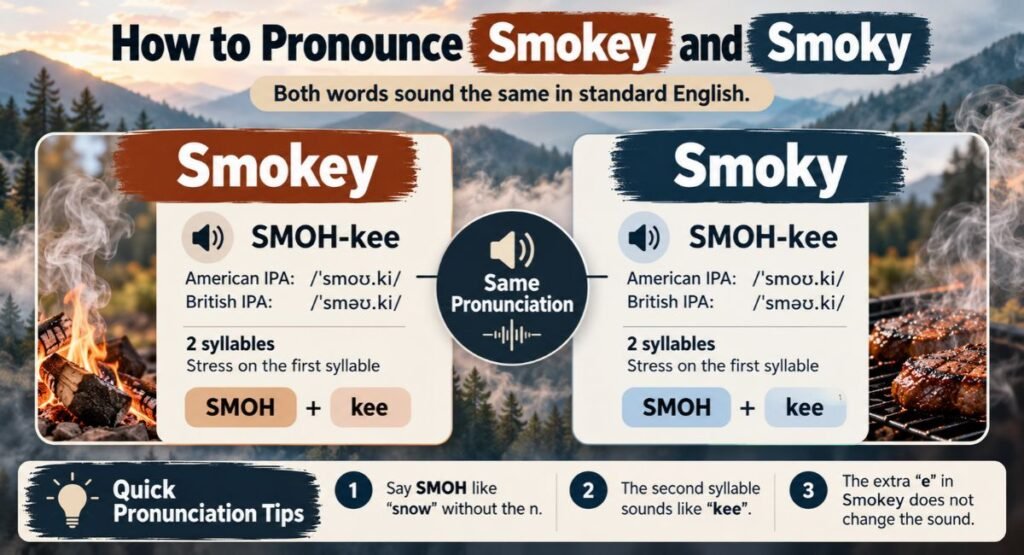
Both spellings are pronounced identically. They contain two syllables, with the first receiving the main stress. The sound begins with the consonant combination sm, followed by the long o sound heard in go, and ends with a k sound and an ee sound. The additional e in smokey does not produce another syllable, so readers should not attempt to pronounce it separately.
| Word | Simple pronunciation | American IPA | British IPA |
| Smoky | SMOH-kee | /ˈsmoʊ.ki/ | /ˈsməʊ.ki/ |
| Smokey | SMOH-kee | /ˈsmoʊ.ki/ | /ˈsməʊ.ki/ |
American and British IPA use different symbols for the long o vowel, reflecting accent differences rather than separate pronunciations for the two spellings. The first syllable remains stressed in both varieties. Learners should concentrate on the rhythm rather than the number of written letters. The pronunciation is unchanged whether the word describes smoke in a room, the flavour of grilled food, or someone’s nickname.
Pronunciation in English
Part of Speech and Grammar Rules for Smoky
Smoky is an adjective, not a noun or verb in its ordinary descriptive use. It can appear before a noun, as in “a smoky room,” or after a linking verb, as in “The room became smoky.” These positions are called attributive and predicative adjective uses. Both are grammatically correct. Because smoky is an adjective, it does not become plural when describing several items: “The rooms were smoky” is correct, not “The rooms were smokies.”
The adjective has two standard degree forms: smokier and smokiest. Smokier compares degrees of smokiness, while smokiest expresses the highest degree within a group. For example, “This fireplace is smokier than the other one” compares two fireplaces. “That was the smokiest kitchen in the building” identifies the strongest example. The related noun smokiness describes the quality or degree of being smoky
Smoke, Smoking, Smoked and Smoky: Grammar Differences
These four related words are easy to confuse because they share the same root but perform different grammatical functions. Smoke can be a noun or verb, smoking can be a verb form or an adjective, smoked often describes something treated with smoke, and smoky describes a smoke-related quality. Recognising these distinctions makes sentences clearer, especially when discussing cooking, fireplaces, or air conditions.
| Word | Grammar | Example |
| Smoke | Noun | Smoke escaped through the window. |
| Smoke | Verb | Wet wood can smoke when heated. |
| Smoking | Present participle | The chimney is smoking. |
| Smoked | Past participle/adjective | We bought smoked cheese. |
| Smoky | Adjective | The kitchen was smoky. |
| Smokiness | Noun | The sauce had noticeable smokiness. |
Unlike the verb smoke, smoky has no ordinary verb tense forms. You cannot normally write “the room smokied” to mean it became filled with smoke. Instead, use a verb such as became or turned: “The room became smoky.” This distinction is useful for English learners who might otherwise treat every related word as a different tense of the same verb.
Common Expressions and Prepositions With Smoky
Smoky commonly appears beside words connected with air, weather, flavours, and appearances. Natural combinations include smoky air, smoky haze, smoky aroma, smoky flavour, smoky grey, and smoky voice. The surrounding noun determines the intended meaning. For example, smoky air suggests actual smoke, while smoky grey describes a visual impression. Learning these combinations is more useful than memorising one definition and applying it to every sentence.
Smoky does not require a fixed preposition. Writers may describe air as “smoky from a nearby fire,” a room as “smoky with cooking fumes,” or a sauce as having “a smoky flavour from grilled peppers.” The preposition depends on the relationship being expressed. From often introduces a source or cause, while with can describe what is present. These are natural sentence patterns rather than special grammar rules exclusive to smoky.
Smoky Flavour vs. Smoked Food: What’s the Difference?
In cooking, smoky describes a taste or aroma that resembles smoke. A smoky barbecue sauce might contain smoked paprika, while grilled vegetables can develop smoky notes during preparation. However, describing food as smoky does not prove it was prepared in a traditional smoker. Ingredients, cooking methods, and flavourings may produce similar sensory characteristics, so the word describes the result rather than confirming one particular process.
Smoked is more specific because it generally indicates that food has been exposed to smoke during preparation or preservation. Smoked salmon and smoked cheese describe products associated with that process, whereas smoky salmon or smoky cheese emphasises flavour. This distinction matters in recipes and product descriptions: if a food has only been seasoned to taste smoky, claiming it was smoked could misrepresent how it was made.
Smoky Meaning in Colours, Makeup and Appearance
In colour descriptions, smoky usually suggests a muted shade with greyish, shadowy, or subdued qualities. Smoky blue might describe a soft blue with grey undertones, while smoky purple can suggest a darker, less vivid purple. These are descriptive colour names rather than exact scientific specifications. Two paint companies may use smoky for noticeably different shades, so the word alone cannot identify an exact colour code.
Smoky eyes is another familiar expression. It describes an eye-makeup style that blends darker and lighter shades to create a softened, shadow-like effect around the eyes. The term does not refer to actual smoke. Although some cosmetic products use smokey in their names, smoky is the standard adjective in general descriptions. An editor should preserve a product’s official spelling while using conventional spelling in surrounding explanatory text.
What Does Smoky Mean When Describing a Voice?
A smoky voice is a figurative description of a voice that sounds low, textured, breathy, or slightly rough. Music reviewers may use the expression for a singer whose performance creates an intimate or atmospheric impression. For example, “Her smoky voice suited the slow jazz song” suggests a particular vocal quality, not the physical presence of smoke. The expression is subjective, so different listeners may describe the same voice differently.
Smoky overlaps with words such as husky and raspy, but the meanings are not identical. Husky usually emphasises breathiness or a slightly rough quality, while raspy suggests a scratchier sound. Smoky can include texture as well as mood or atmosphere. A writer should not assume that someone described as having a smoky voice smokes cigarettes or has a medical condition. The adjective alone provides no reliable evidence of either.
Smoky Mountains or Smokey Mountains: Which Is Correct?
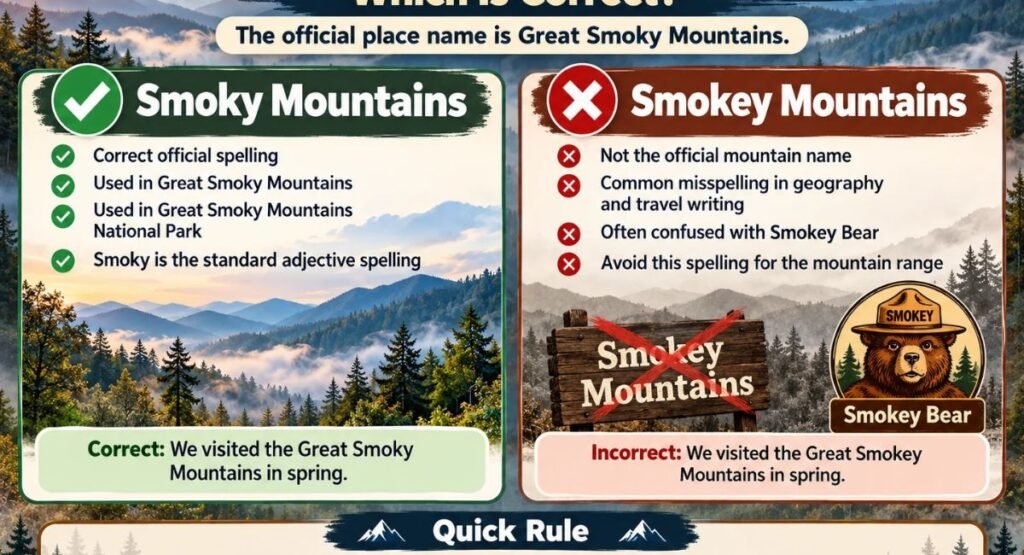
The official name is the Great Smoky Mountains, a mountain range along the border of Tennessee and North Carolina in the United States. Great Smoky Mountains National Park uses the same spelling. Adding an e to produce Great Smokey Mountains is incorrect when referring to the official geographical name. Travel writers, students, and website editors should check recognised place names rather than applying a general spelling preference without verifying them.
The name is commonly associated with the smoke-like haze visible across the mountains. This provides a useful example of smoky describing appearance rather than necessarily referring to a fire. In a travel article, “The Great Smoky Mountains looked hazy in the morning” is natural English. The official name also reinforces the standard adjective spelling, making it a useful memory aid for learners.
Smokey Bear or Smoky Bear: Which Is Correct?
Smokey Bear is the correct official name of the American wildfire-prevention character. The campaign began in 1944, and the character became closely associated with messages about preventing human-caused wildfires. His name contains the additional e, unlike the standard adjective smoky. The U.S. National Park Service confirms this spelling, providing a clear example of why proper names should not be automatically changed to match general vocabulary rules.
It is also useful to know that his official name is Smokey Bear, without the as part of the name. The longer expression “Smokey the Bear” is familiar to some audiences, but it is not the character’s official name. For accurate educational writing, use Smokey Bear. Comparing this name with Great Smoky Mountains demonstrates that both spellings can be correct when attached to different established names.
Smokey vs. Smoky: Original Example Sentences
A practical way to understand smokey vs. smoky is to compare situations where the adjective describes a physical condition with situations where it describes a sensory impression. Smoke in a kitchen is something people can see or smell, while a smoky voice is a figurative description. Proper names introduce another distinction because their established spellings should be preserved. The following sentences demonstrate these uses in everyday, formal, and descriptive English.
- Everyday conversation: The kitchen became smoky after I left the toast in the oven too long.
- Formal report: Firefighters entered the smoky building wearing protective breathing equipment.
- Food review: The roasted peppers gave the soup a pleasant smoky flavour.
- Interior design: The designer chose smoky blue curtains for the living room.
- Music review: Her smoky voice added warmth to the quiet jazz performance.
- Beauty writing: The makeup artist created a subtle smoky-eye effect using brown and charcoal eyeshadow.
- Grammar comparison: The second fireplace was smokier than the first.
- Travel writing: Our family visited Great Smoky Mountains National Park during spring.
- Proper name: The children recognised Smokey Bear from a wildfire-prevention poster.
- Casual conversation: We named our grey kitten Smokey because of the colour of his fur.
Notice that the first seven sentences use smoky or one of its grammatical forms as an adjective. The remaining examples involve proper names. This distinction offers a straightforward editing test: identify whether the word describes a quality or identifies someone or something by name. In the first case, smoky is generally preferred. In the second, the established spelling takes priority.
Synonyms of Smoky and Their Meaning Differences
Choosing a synonym for smoky requires understanding what the original sentence describes. If a room contains actual smoke, smoke-filled may be a precise alternative. If a distant landscape is difficult to see, hazy may be more suitable because poor visibility can result from mist, dust, or pollution rather than smoke alone. These words overlap, but treating them as exact equivalents can accidentally introduce information that the original sentence did not provide.
| Synonym | Meaning and usage difference |
| Smoke-filled | Specifically contains smoke |
| Hazy | Visibility is reduced, but smoke is not necessarily present |
| Sooty | Covered with dark deposits left by combustion |
| Murky | Dark or difficult to see through |
| Charred | Blackened or damaged by intense heat |
| Roasted | Cooked by dry heat, without necessarily developing a smoky flavour |
| Woodsy | Suggestive of trees, wood, or forests |
| Dusky | Somewhat dark or shadowy |
| Husky | Slightly rough or breathy, usually describing a voice |
| Raspy | Rough or scratchy in sound |
Food writing needs particular care because smoky, charred, and roasted communicate different qualities. A roasted vegetable may be sweet without tasting smoky, while charred meat may have blackened areas but little pleasant smoke flavour. Similarly, husky is often more specific when describing vocal texture, whereas smoky may imply a mood or atmosphere. The best synonym depends on the precise meaning, not merely whether two words appear together in a thesaurus.
Antonyms of Smoky With Examples
Smoky does not have one universal antonym because its meanings vary by context. When describing air filled with smoke, smoke-free provides a direct contrast. Clear may also work if the writer is discussing visibility. For example, “The air was smoky in the morning but clear by afternoon” expresses a meaningful change. Clean can describe air quality, although clean air is not always identical to air without visible smoke.
For flavour, non-smoky is the most literal opposite, while delicate and mild may provide useful contrasts in particular food descriptions. A mild sauce can still taste smoky, so mild is not an exact antonym. When discussing colours, bright or vivid may contrast with the muted appearance suggested by smoky. These are contextual opposites rather than strict dictionary antonyms, and readers should choose them according to the sentence’s intended meaning.
Word Origin and Etymology of Smoky
The adjective smoky comes from the noun smoke combined with the adjective-forming suffix -y. The word is recorded in Middle English around 1300 in the form smoki, referring to something producing or containing smoke. Historical evidence shows that its meanings expanded over time. Smoke-like appearances were described by the late fourteenth century, while uses relating to flavours, colours, and voices developed in later centuries.
The modern spelling smoky follows a familiar word-formation pattern: the final silent e in smoke is dropped before adding -y. The alternative spelling smokey remains recognised, but historical spelling variation should not be confused with a separate meaning. There is no need to claim that smokey originated exclusively in America or was deliberately invented for advertising. Such explanations are not established by the dictionary evidence.
Common Mistakes When Using Smokey and Smoky
The most frequent mistake is treating smokey as either the standard spelling in every situation or a completely invalid word. Both conclusions are misleading. Smoky is the conventional adjective, while smokey is an accepted alternative. In formal descriptive writing, “The room was smoky” is the safer choice. However, changing Smokey Bear to Smoky Bear would be an error because the original is an established proper name.
Another mistake involves confusing the adjective with related word forms. The standard comparative is smokier, not smokeyer, and the superlative is smokiest, not smokeyest. Learners may also confuse smoked with smoky when describing food. Smoked usually refers to a preparation process, while smoky describes a taste or smell. A product can have a smoky flavour without having undergone the smoking process, so the distinction is important in accurate descriptions.
How to Remember Smokey vs. Smoky
The easiest memory trick begins with smoke. Remove the final e and add y to produce smoky, the standard adjective. You can then apply that spelling to smoky air, smoky food, smoky colours, and smoky voices. Remember Smokey Bear as an established name that retains the additional e. This approach is more useful than trying to learn a strict American-versus-British rule, since both English varieties commonly use smoky.
A quick editing exercise can reinforce the distinction. Complete the sentences “The room became ,” “The sauce had a ___ flavour,” and “The second fire was ___ than the first.” The answers are smoky, smoky, and smokier. Then consider ” Bear teaches wildfire prevention” and “We visited the Great ___ Mountains.” Those answers are Smokey and Smoky because each belongs to a different established proper name.
Conclusion
The main distinction in smokey vs. smoky is spelling preference and context. Smoky is the standard adjective for things that contain, produce, or resemble smoke, including air, flavours, colours, and voices. Smokey is a recognised alternative spelling and also appears in established proper names. Both forms share the same pronunciation, while smokier and smokiest are the standard comparative forms. For everyday and professional descriptions, choose smoky and preserve the verified spelling of names.
Frequently Asked Questions
What is the main difference between smokey and smoky? Smoky is the standard English adjective describing something filled with smoke or resembling smoke in appearance, taste, or smell. Smokey is a recognised but less common alternative spelling. It also appears in established names, including Smokey Bear. The two spellings share the same pronunciation and general adjective meaning.
Is smokey a correct English spelling? Yes, smokey is recognised as an alternative spelling of smoky in English dictionaries. However, smoky is the conventional spelling for general descriptions of air, food, colours, and smells. Smokey also appears in personal names, nicknames, and titles. Writers should normally use smoky unless an established name requires the alternative spelling.
Should I write smoky flavor or smokey flavor? Smoky flavor is the standard American English spelling, while smoky flavour is the corresponding British English form. Both describe a taste reminiscent of smoke. Smokey may appear in particular brand or product names, but smoky is generally preferable in recipes, restaurant reviews, product descriptions, and other ordinary food-related writing.
Why is it Smokey Bear but Great Smoky Mountains? Smokey Bear is the established name of the American wildfire-prevention character, while Great Smoky Mountains is the official geographical name. Proper names keep their recognised spellings even when they differ from ordinary vocabulary conventions. Both are correct because each identifies a specific named entity rather than simply applying a general spelling preference.
How do you pronounce smokey and smoky? Both words have identical pronunciations in standard English. They contain two syllables, with the main stress on the first. American English commonly uses /ˈsmoʊ.ki/, while British English uses /ˈsməʊ.ki/. The additional letter e in smokey does not create an extra syllable or change the pronunciation.


One Comment