
Racket vs. Racquet: Meaning, Spelling, Pronunciation and Examples
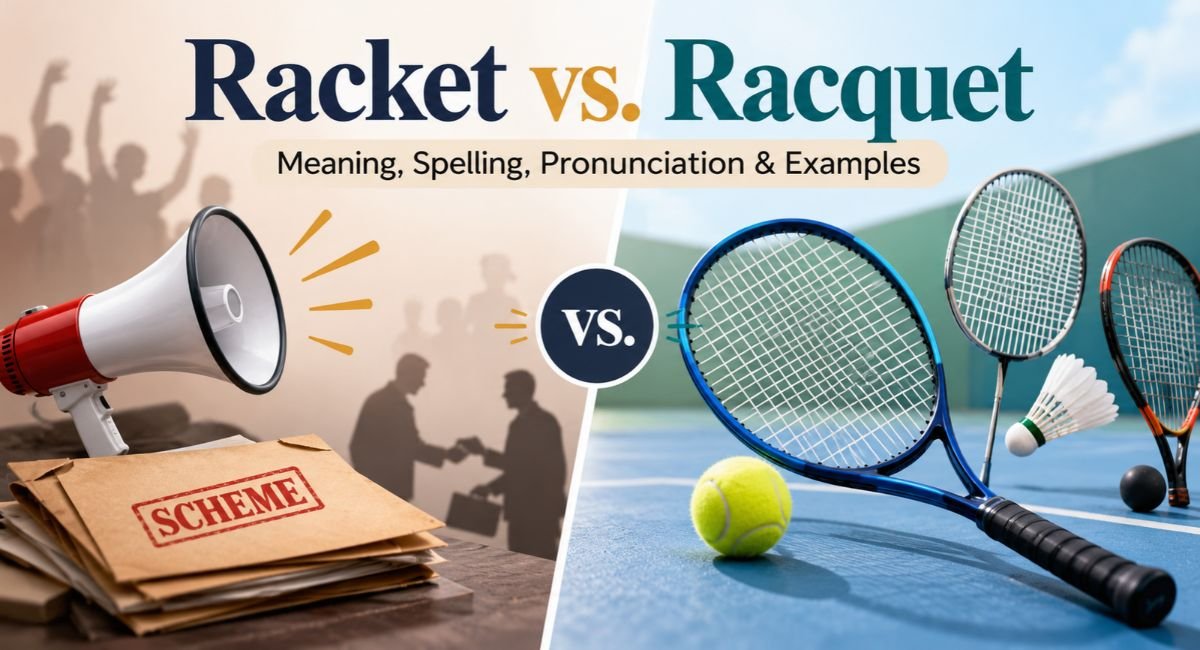
Racket vs. racquet is a spelling comparison between two accepted English words for sports equipment used in tennis, badminton, and squash. Both have the same pronunciation and sporting meaning. However, racket can also mean a loud, unpleasant noise or a dishonest money-making scheme. Racquet is normally used only in sporting contexts.
What Does Racket Mean in English?
The word racket has three main meanings in English, and the surrounding context tells you which one is intended. In sports, a racket is a piece of equipment with a handle, frame, and tightly stretched strings used to strike a ball or shuttlecock. Tennis, badminton, and squash players all use rackets, although their equipment differs in size, weight, and construction. When discussing this type of sporting equipment, both racket and racquet are correct spellings.
Outside sports, racket often describes an unpleasant, continuous noise. Imagine trying to study while someone drills into a wall next door. You might complain, “What a terrible racket!” The word can also describe a dishonest activity intended to make money, particularly an organised operation involving deception or intimidation. For instance, a protection racket involves demanding payments through threats. These additional meanings explain why racket is more versatile than racquet.
What Does Racquet Mean in English?
Racquet is an alternative spelling of racket when referring to sporting equipment. It describes the implement used to hit a ball or shuttlecock in tennis, badminton, squash, and similar games. A player might carry a tennis racquet to practice, purchase replacement racquet strings, or choose a lightweight racquet for improved manoeuvrability. None of these expressions changes meaning when racket replaces racquet. Both spellings are recognised in standard English dictionaries.
You may encounter racquet in sporting club names, product descriptions, and specialist publications. However, it is not inherently more formal, technically superior, or exclusively British. Some organisations prefer one spelling, while others use the alternative. The important distinction is semantic: racquet normally refers to sporting equipment and related terminology. It would sound incorrect in standard English to describe a noisy party or a fraudulent financial operation as a racquet.
Racket vs. Racquet: Key Differences Explained
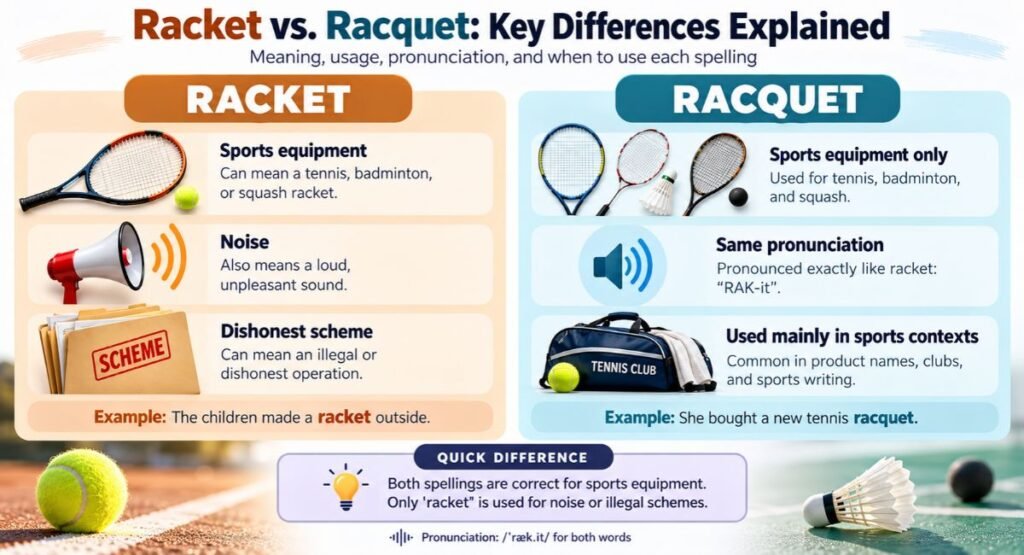
Understanding racket vs. racquet requires looking beyond spelling. Although both words describe sporting equipment, they are not interchangeable in every sentence. In tennis, either spelling works because the intended object remains unchanged. In discussions about noise or dishonest activity, racket is the appropriate choice. This difference makes context particularly important for English learners, editors, and writers preparing sports-related content.
| Feature | Racket | Racquet |
| Sports equipment | Correct | Correct |
| Loud, unpleasant noise | Correct | Not standard |
| Dishonest money-making activity | Correct | Not standard |
| Pronunciation | RAK-it | RAK-it |
| Part of speech | Mainly a noun | Noun |
| Plural | Rackets | Racquets |
| American English | Accepted | Accepted |
| British English | Accepted | Accepted |
Neither spelling belongs exclusively to American or British English. Both appear in the two varieties, although publishers, sporting organisations, and individual writers may favour one form. A useful writing rule is to choose racket for general explanations and preserve racquet when it appears in an established name or when following a particular editorial style. Consistency matters, but preserving the terminology of a quoted source or official organisation is equally important.
How to Pronounce Racket and Racquet
Racket and racquet are homophones, meaning that they sound alike despite having different spellings. Both words have two syllables, with the strongest stress falling on the first. Their pronunciation is the same in standard British and American English. The additional letters in racquet do not create an extra syllable or a different consonant sound, so there is no need to give each spelling a separate pronunciation.
| Word | Simple pronunciation | IPA |
| Racket | RAK-it | /ˈræk.ɪt/ |
| Racquet | RAK-it | /ˈræk.ɪt/ |
To pronounce either word, begin with the same vowel sound found in cat and back. The first syllable carries the stress, while the second is short and unstressed. In ordinary speech, the final vowel may become less distinct depending on the speaker’s accent. The pronunciation does not change when racket refers to sporting equipment, noise, or an illegal scheme.
Part of Speech and Grammar Rules for Racket and Racquet
Racket and racquet are primarily nouns. When describing sports equipment, both are countable, meaning they can appear with numbers and articles such as a, an, and the, where grammatically appropriate. For example, “She bought a racket” refers to one item, while “The club ordered ten racquets” describes several. Their regular plural forms are rackets and racquets, and their singular possessive forms are racket’s and racquet’s.
The noise meaning of racket behaves slightly differently. British learner dictionaries commonly describe it as a singular countable expression, particularly in “make a racket,” while American dictionary treatments may classify that meaning as uncountable. In everyday English, expressions such as “What a racket!” and “Stop making that racket!” are natural. The criminal meaning is countable, as in “The investigation uncovered two separate rackets.” Racket also has uncommon verbal uses, but learners will encounter it most often as a noun.
Common Expressions and Prepositions With Racket
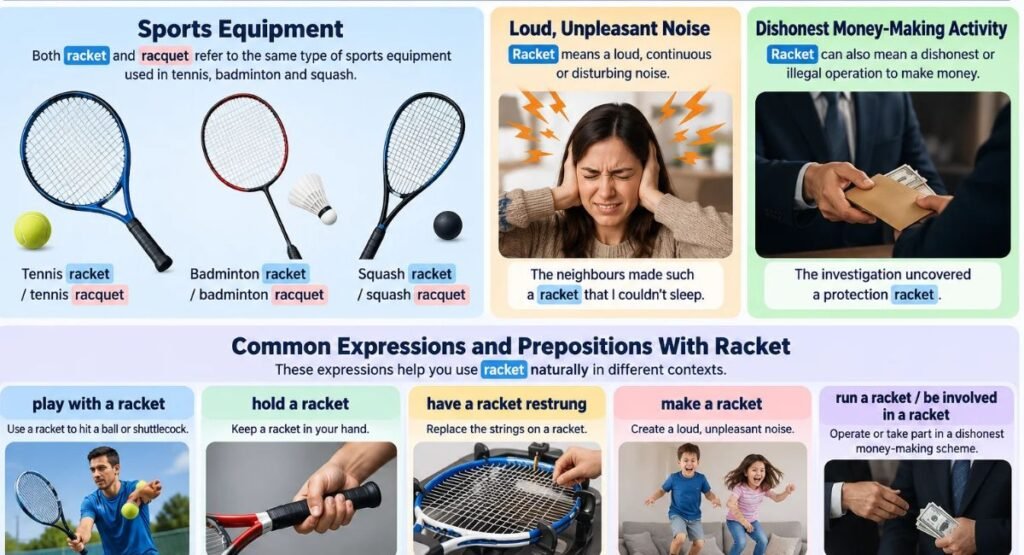
A useful way to learn racket is through the words that commonly appear beside it. Sports writing includes expressions such as “play with a racket,” “hold a racket,” “replace the grip on a racket,” and “have a racket restrung.” These combinations describe actions involving physical equipment. They are not fixed grammatical rules, but they make sentences sound natural and help readers recognise the sporting meaning immediately.
The other meanings have their own familiar combinations. People “make a racket” when they create disturbing noise, while journalists may write about someone “running a racket” or being “involved in a protection racket.” A business may also be called “a racket” informally when someone believes its prices are unfairly high. That last expression can be an opinion rather than a literal allegation of criminal conduct, so writers should consider the tone and implications carefully.
Tennis Racket or Tennis Racquet: Which Is Correct?
Both tennis racket and tennis racquet are correct. They refer to the same kind of equipment: a handled frame with strings used to hit a tennis ball. Neither spelling indicates a different design, quality level, or playing technique. If an online shop lists a tennis racquet and another lists a tennis racket, the spelling alone tells you nothing about the product’s performance. Technical specifications, including weight, head size, and string pattern, are more useful when comparing equipment.
For professional or instructional writing, follow the terminology used by the relevant governing body or publisher. The International Tennis Federation uses racket in its English rules, demonstrating that the shorter spelling is appropriate in official sporting material. A club that includes racquet in its registered name, however, should retain that spelling. Writers should not silently alter proper names simply to create uniform spelling across an article.
Badminton Racket or Racquet: Which Should You Use?
Both badminton racket and badminton racquet are acceptable English expressions. In either case, the word refers to the lightweight, strung implement used to strike a shuttlecock. The spelling does not indicate whether the equipment is intended for beginners, intermediate players, or professionals. Differences between individual models involve construction materials, balance, flexibility, grip size, and string tension rather than the choice between racket and racquet.
When writing badminton instructions, accuracy about the equipment matters more than spelling preference. For example, “Hold the racket loosely before serving” and “Check the racquet strings for damage” are both understandable. However, using different spellings repeatedly within one short guide may distract readers. Choose one form unless you are referring to an official product name or quoting another source that uses the alternative.
Squash Racket vs. Squash Racquet
The same spelling principle applies to squash. Both squash racket and squash racquet refer to equipment used to strike a small rubber ball against the court walls. A squash racket typically has a longer handle and a different playing design from a badminton racket. These distinctions relate to the requirements of each sport, not the spelling of the equipment’s name.
In a sports article, writers can select whichever spelling suits their publication’s style. A sentence such as “The player replaced the grip on her squash racquet” remains correct if racquet becomes racket. What matters is that the reader understands the sporting context. This flexibility is useful for editors who work with different English-speaking audiences and need consistent terminology without presenting one accepted spelling as an error.
Racket and Racquet Example Sentences in Different Contexts
The most effective way to understand these words is to observe how their meanings change across situations. In sporting contexts, either spelling can work. In everyday complaints about noise or formal discussions of dishonest activity, racket is the appropriate form. The following original examples demonstrate conversational English, sports instruction, workplace communication, and written reporting. Each sentence provides clues that help identify the intended meaning.
- Sports: Olivia replaced her tennis racket after its frame cracked during practice.
- Sports equipment: The coach inspected every racquet before the junior tournament.
- Casual conversation: Could you stop making that racket? I’m trying to finish my homework.
- Formal report: Investigators uncovered a suspected financial racket involving false invoices.
- Product description: This lightweight badminton racquet is designed for players who prefer quick handling.
- Everyday life: The construction workers made such a racket that the meeting had to be moved.
- Sports instruction: Keep your racket face steady as you prepare to return the serve.
- News reporting: Police announced arrests connected with an alleged protection racket.
- Written communication: Participants should bring their own squash racquets to the training session.
- Informal speech: I can’t hear the television over the racket coming from upstairs.
These examples also show why a single translation or short definition can be misleading. The same spelling may refer to an object, a disturbing sound, or a dishonest operation. When readers encounter racket in an unfamiliar sentence, the surrounding nouns and verbs often reveal its meaning. Words such as strings, grip, serve, and tournament suggest sports, while noise, investigation, fraud, and protection point towards other senses.
Synonyms of Racket and Racquet With Meaning Differences
Synonyms are useful only when they preserve the intended meaning. In sports, racket has several related equipment terms, but these are not exact replacements. A bat is used in games such as cricket or table tennis, while a paddle is common in pickleball and some varieties of table tennis terminology. A club is used in golf. These implements share the purpose of striking an object, but their designs and sporting functions differ.
| Word | Meaning and usage distinction |
| Bat | A striking implement used in sports such as cricket and baseball |
| Paddle | A usually solid-faced implement used in games such as pickleball |
| Noise | A general term for sound, whether pleasant or unpleasant |
| Din | A loud, prolonged mixture of unpleasant sounds |
| Commotion | A disturbance involving movement, noise, or excitement |
| Uproar | A strong collective reaction, often expressed loudly |
| Scam | A dishonest plan designed to deceive people |
| Fraud | Deception used to obtain an unfair or unlawful benefit |
| Extortion | Obtaining money or another benefit through threats or coercion |
When racket means noise, din often comes closest to its sense of a loud and unpleasant mixture of sounds. Commotion suggests activity as well as noise, while uproar may describe people reacting strongly to controversial news. In dishonest-business contexts, scam and fraud emphasise deception, whereas extortion involves coercion. These distinctions prevent inaccurate substitutions, particularly in news reporting and formal explanations.
Antonyms of Racket and Racquet
Neither racket nor racquet has a standard direct antonym when referring to sports equipment. A badminton shuttlecock is not the opposite of a racket, just as a paddle is not the opposite of a tennis racquet. Physical objects do not necessarily belong to opposite word pairs. For learners, it is more accurate to describe these as related items than to invent antonyms simply to complete a vocabulary list.
When racket describes noise, however, words such as silence, quiet, and calm provide useful contrasts. “The classroom became quiet after the racket stopped” demonstrates the difference naturally. For racket meaning dishonest activity, honesty, integrity, and legitimate business are conceptual contrasts rather than exact dictionary antonyms. For example, “The company operated as a legitimate business rather than a fraudulent racket” makes the intended contrast clear.
Word Origin and Etymology of Racket and Racquet
The sporting word racquet entered English through forms related to Old French rachette and modern French raquette. Historical records connect these words with ball games, including earlier forms of tennis in which players struck the ball with their hands. The spelling racket developed alongside racquet in English, and both forms eventually became established terms for sporting equipment. The history helps explain their unusual spelling relationship without suggesting that either modern form is incorrect.
The deeper origin of the French word remains uncertain. Some etymological explanations propose a connection with an Arabic word meaning the palm of the hand, but that derivation is disputed and should not be presented as established fact. The racket meaning loud noise has a separate recorded history and may have developed through sound imitation. The later dishonest-activity meaning has several proposed explanations, none of which should be treated as conclusively proven.
Common Mistakes When Using Racket and Racquet
One common mistake is assuming that racquet is a misspelling simply because racket is frequently seen in everyday writing. Both are correct in sports contexts. Another error is treating the spellings as a strict American-versus-British distinction. Neither variety of English exclusively owns one form. Learners may also incorrectly pronounce racquet with an extra syllable because of its unusual letter combination. Both words are pronounced identically.
The most important spelling errors occur when racquet replaces racket in non-sporting meanings. “The neighbours made a terrible racquet” should use racket, while “The police discovered a criminal racquet” should also use racket. Writers should remember that racket describing noise is informal and may not suit every formal document. In professional reporting, allegations involving a racket should also be supported by evidence rather than stated as proven misconduct.
How to Remember Racket vs. Racquet
An easy memory technique is to associate racquet with sports and racket with a wider range of meanings. If a sentence mentions tennis, badminton, squash, strings, or a player, either spelling will normally work. If the sentence describes loud noise, an annoying disturbance, or a dishonest money-making operation, choose racket. This simple decision rule is more useful than memorising an unreliable claim about national spelling differences.
Try applying the rule to a few situations. A sports coach buys a new racket or racquet; both forms are acceptable. Children shouting outside make a racket, never a racquet. Investigators uncover a suspected protection racket, not a protection racquet. Once you recognise these patterns, the spelling choice becomes easier in everyday conversation, academic writing, sports articles, and professional communication.
Conclusion
The difference in racket vs. racquet is mainly about meaning and usage. Both spellings correctly describe sporting equipment, and both have the same pronunciation. However, racket also refers to unpleasant noise and dishonest money-making activity, while racquet is normally limited to sports. Neither spelling is exclusively American or British. For accurate writing, consider the context, follow relevant editorial conventions, and avoid using racquet outside its established sporting meaning.
Frequently Asked Questions
What is the main difference between racket and racquet?
The main difference between racket and racquet is their range of meanings. Both words describe sports equipment used in tennis, badminton, and squash. However, racket can also refer to a loud, unpleasant noise or a dishonest money-making operation. Racquet is generally restricted to sports-related contexts.
Is it tennis racket or tennis racquet?
Both tennis racket and tennis racquet are correct English expressions. They describe the same piece of sports equipment used to hit a tennis ball. Racket is a common spelling in general English, while racquet also appears in sporting contexts. Choose either spelling and use it consistently throughout your writing.
Is racquet British English or American English?
Racquet appears in both British and American English, so it is not exclusively British. Similarly, racket is widely accepted in both language varieties. The preferred spelling may depend on the sport, publication, or organisation. Rather than following a strict regional rule, writers should consider their audience and editorial style.
Do racket and racquet have the same pronunciation?
Yes, racket and racquet have the same pronunciation in standard English. Both words contain two syllables and are pronounced RAK-it, with stress on the first syllable. Their IPA transcription is /ˈræk.ɪt/. The additional letters in racquet do not change how the word sounds, making the two spellings homophones.
Can racquet mean a loud noise or an illegal business?
No, racquet is not normally used for these meanings in standard modern English. When describing a loud disturbance, use racket, as in “The children made a racket.” Similarly, a dishonest or illegal operation is called a racket, such as a protection racket. Racquet remains primarily a sports-related spelling.




One Comment