
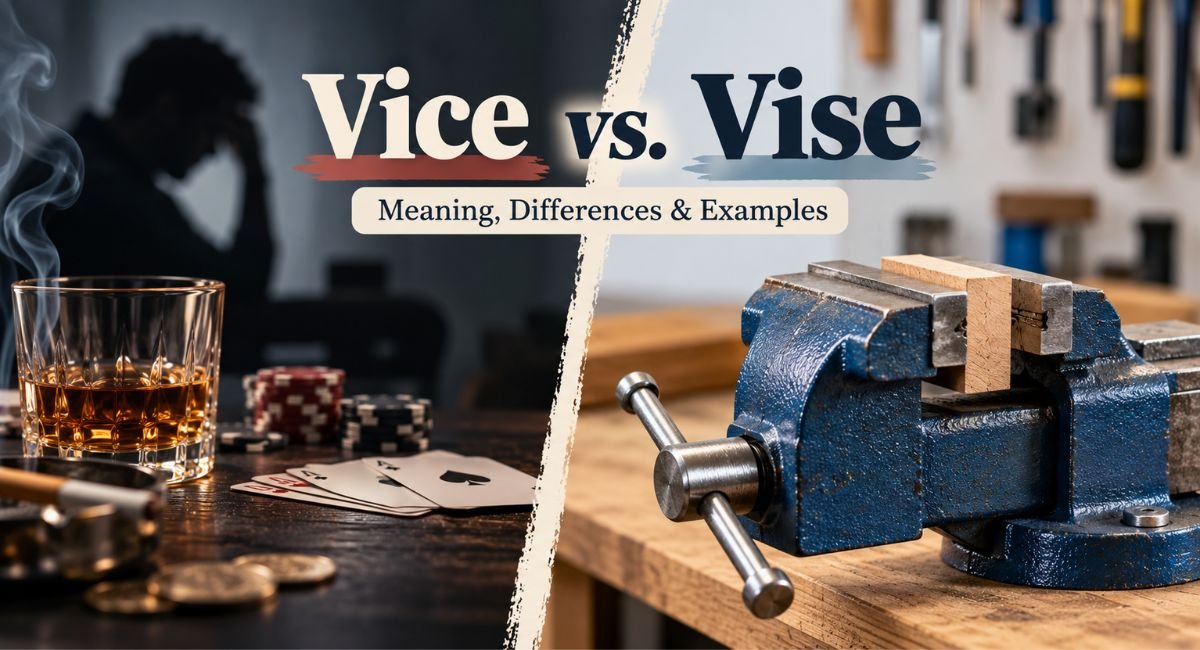
Vice vs. Vise: Meaning, Differences & Examples
Vice means a moral fault, undesirable habit, or immoral behaviour. Vise is the usual American English spelling for a tool that holds objects firmly. British English calls the same tool a vice. Both words are pronounced alike, but their meanings differ. Titles such as vice president always use vice, never vise.
The difference between vice vs. vise can be confusing because both words sound exactly the same. Their spelling depends on what you’re describing and, in one important case, whether you’re writing in British or American English.
A British carpenter might tighten a vice around a wooden board. An American carpenter would tighten a vise. Neither would use vise when talking about greed, dishonesty, or a personal weakness.
Then there are expressions such as vice president, vice versa, and a vice-like grip. These look similar, but they don’t all share the same history or meaning.
The easiest way to choose the correct spelling is to understand the context rather than memorise a rule about the letters c and s.
Vice vs. Vise: What’s the Difference?
The distinction becomes straightforward when you separate the different meanings of vice.
In British and American English, vice can describe a moral weakness or undesirable behaviour. The word also appears in official titles indicating a deputy or secondary position.
The workshop tool is where the regional spelling changes. British English usually uses vice, while American English uses vise.
| Meaning | British English | American English |
| Moral fault or weakness | Vice | Vice |
| Bad habit or indulgence | Vice | Vice |
| Mechanical gripping tool | Vice | Vise |
| Deputy title | Vice | Vice |
| Latin expression meaning the reverse | Vice versa | Vice versa |
For example, “Greed is a vice” is correct in both varieties of English.
However, “The carpenter tightened the vise” follows American spelling, while “The carpenter tightened the vice” follows British spelling.
The word vice in vice president is not interchangeable with vise.
What Does Vice Mean in English?
In simple English, a vice is a personal weakness, bad habit, or type of behaviour considered morally wrong.
The word can describe serious wrongdoing, but people also use it humorously for pleasures they think they indulge in too often.
Someone might consider dishonesty a vice because it violates an ethical principle. Another person might jokingly describe expensive coffee as their only vice.
Those two uses share a general idea of undesirable behaviour, but their seriousness is very different.
Vice Meaning as a Bad Habit
A vice can be an activity or habit someone enjoys despite recognising that it may be excessive or undesirable.
Imagine a person who buys an expensive coffee every morning even though they’re trying to save money.
They might say, “Buying fancy coffee is my one vice.”
This is a light-hearted admission, not necessarily a serious statement about morality.
The word doesn’t automatically mean addiction. A vice can be a minor indulgence, whereas addiction has a more specific meaning involving impaired control and significant consequences.
Vice Meaning as a Moral Fault
In formal discussions, vice often describes an undesirable quality of character.
Greed, cruelty, dishonesty, and envy may be regarded as vices within various moral traditions.
Consider the sentence:
“The novel explores how unchecked ambition can lead to corruption and vice.”
Here, the word refers to moral wrongdoing, not a harmless personal indulgence.
This meaning is common in philosophy, literature, religious discussion, and ethical criticism.
Vice Meaning in Crime Reporting
The word vice is also associated with certain activities historically regarded as immoral and, in some jurisdictions, unlawful.
A vice squad is a police unit traditionally responsible for investigating particular offences, including some connected with commercial sex, illegal gambling, or drugs.
For example:
“The detective previously worked in the city’s vice unit.”
The precise responsibilities of such a unit depend on local laws and police organisation. The label vice should not be taken to mean that every activity historically associated with it is illegal everywhere.
Vice Meaning in Official Titles
In titles such as vice president, vice principal, and vice captain, vice- indicates a deputy or subordinate position.
“The vice president presented the company’s annual report.”
This doesn’t describe the person’s moral character. It identifies their organisational role.
The title element has a separate Latin origin associated with acting in another person’s place.
What Does Vise Mean in English?
A vise is a mechanical device that holds an object firmly while someone works on it.
A typical bench vise has two jaws, one of which moves when a screw mechanism is turned. This allows a workpiece to be held in position for suitable tasks such as filing, sanding, or shaping.
Imagine a mechanic trying to file a small metal bracket. Rather than holding the bracket with one hand, the mechanic may place it in a vise so that it remains steady during the work.
In British English, the same tool is called a vice.
How Does a Bench Vise Work?
A common bench vise uses a screw-driven mechanism to move its jaws closer together or farther apart.
The stationary jaw provides one gripping surface, while the movable jaw adjusts to the workpiece.
When the handle is turned, the jaws close around the material. Turning it in the opposite direction releases the object.
Different jobs require different holding methods. A vise that works well for a metal bracket may not be suitable for delicate wood without appropriate protective jaw coverings.
Common Types of Vises
| Type | Typical use |
| Bench vise | General workshop holding tasks |
| Woodworking vise | Holding timber for woodworking operations |
| Machine vise | Securing workpieces during machining |
| Drill-press vise | Holding suitable materials during drilling |
| Pipe vise | Gripping pipes and cylindrical workpieces |
Not all vises are interchangeable. Their jaws, mounting systems, and intended applications differ.
Is a Vise the Same as a Clamp?
A vise is a type of workholding device. A clamp is a broader category of equipment used to hold objects together or in position.
For example, a woodworker might use several clamps to hold glued boards together while the adhesive cures.
The same woodworker might use a bench vise to hold one board during planing.
Both tools provide grip, but their designs and practical uses differ.
Vice vs. Vise in British and American English
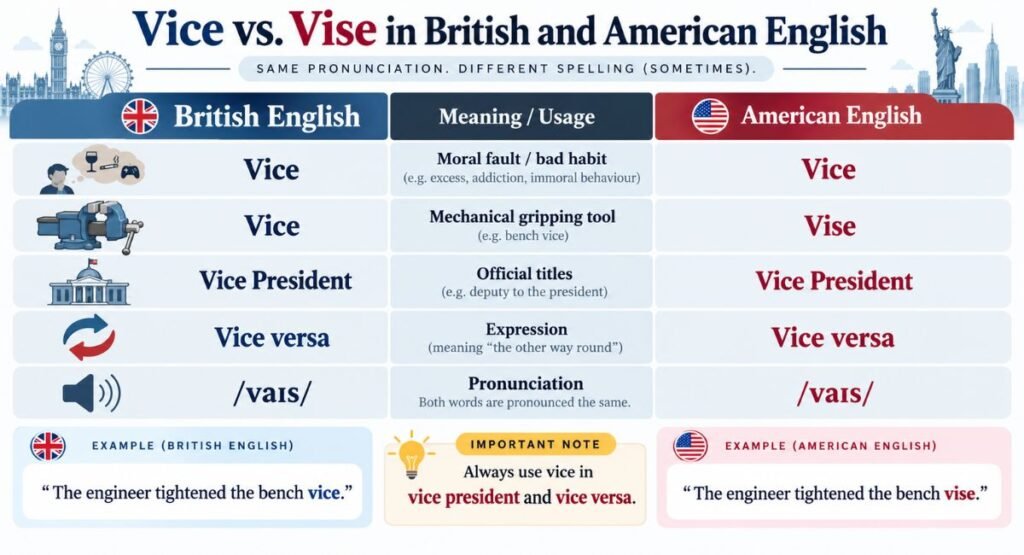
The tool spelling is the most important regional difference.
In British English, the word vice can represent two entirely different nouns: a moral weakness and a mechanical holding tool.
In American English, these meanings are normally distinguished in writing by using vice for moral faults and vise for the tool.
British English: Bench Vice
“The technician secured the metal bracket in a bench vice.”
This is standard British spelling.
The workshop context makes it clear that the sentence refers to equipment rather than immoral behaviour.
American English: Bench Vise
“The technician secured the metal bracket in a bench vise.”
This sentence describes the same activity using American spelling.
The equipment itself doesn’t change because the word is written differently.
Why Vice President Never Becomes Vise President
American spelling does not change every instance of vice into vise.
The word in vice president is a title element meaning deputy or next in rank. It is unrelated in meaning to the workshop tool.
Consequently, vice president is correct in both British and American English, while vise president is incorrect.
How to Pronounce Vice and Vise
Both words are homophones, which means they have the same pronunciation.
| Word | Simple pronunciation | IPA |
| Vice | VYSS | /vaɪs/ |
| Vise | VYSS | /vaɪs/ |
| Wise | WYZ | /waɪz/ |
Vice and vise each have one syllable. They begin with /v/, contain the vowel sound /aɪ/, and end with the unvoiced consonant /s/.
Vice vs. Wise Pronunciation
Wise is not a homophone of vice.
It begins with /w/ rather than /v/ and ends with the voiced consonant /z/ rather than /s/.
Compare:
“The wise carpenter inspected the vise.”
This sentence contains two different words with distinct pronunciations.
Vice and Vise Grammar Rules
The moral meaning of vice is generally a noun. The workshop tool is also a countable noun, while the element vice- in an official title serves a different grammatical function.
Is Vice Countable or Uncountable?
Vice can be either countable or uncountable, depending on what it means.
When referring to a specific fault or habit, it is countable.
“His greatest vice was gambling.”
“Several of the characters struggled with personal vices.”
When referring to immoral behaviour in general, it can be uncountable.
“The novel examines vice and corruption.”
This distinction explains why a vice is natural when naming one weakness, while the broader moral meaning may appear without an article.
Is Vise a Countable Noun?
Yes. A mechanical vise is countable.
“The workshop has a new vise.”
“The technician inspected three vises.”
In British English, the corresponding forms are vice and vices.
A British sentence containing vices could therefore refer to moral faults or several pieces of workshop equipment. Context determines the meaning.
Can Vise Be Used as a Verb?
Some dictionaries also record vise as a verb meaning to grip, clamp, or hold tightly.
Its forms include vises, vised, and vising.
These forms are less common than the noun. In modern workshop instructions, writers will often prefer a clearer phrase such as:
“Clamp the component in a vise.”
That is usually more familiar than saying, “Vise the component.”
Common Prepositions and Word Combinations
Rather than learning the words separately, pay attention to the expressions in which they appear.
| Expression | Example |
| A life of vice | “The novel portrays a life of vice and excess.” |
| Vice and virtue | “The debate explored vice and virtue.” |
| A vice in someone’s character | “His dishonesty was a serious vice in his character.” |
| Secure something in a vise | “Secure the bracket in a vise.” |
| Tighten a vise around something | “He tightened the vise around the workpiece.” |
| Release something from a vise | “She released the part from the vise.” |
| Grip something like a vise | “His hand closed around the handle like a vise.” |
The tool-related expressions describe physical holding, while moral expressions refer to behaviour or character.
Vice vs. Vise: Original Sentence Examples
Everyday Conversation
- “He jokingly calls expensive chocolate his only vice.”
- “My grandfather believed greed was one of the worst human vices.”
- “She admitted that procrastination had become a troublesome habit, though she laughed when calling it a vice.”
Formal and Literary Writing
- “The novel examines the tension between virtue and vice.”
- “The philosopher argued that dishonesty undermines trust within a community.”
- “The report discussed how the city’s vice unit had changed over several decades.”
Workshop and Technical Writing
- “The carpenter secured the board in a vise before smoothing its edge.”
- “The mechanic inspected the bench vise before beginning the repair.”
- “A pipe vise can hold suitable cylindrical workpieces.”
- “The technician loosened the vise and removed the bracket.”
Professional Titles
- “The vice president chaired the meeting in the president’s absence.”
- “The vice principal welcomed the new students.”
- “The vice captain led the team during the second half.”
British and American Comparison
- British English: “The engineer tightened the vice.”
- American English: “The engineer tightened the vise.”
The last two sentences describe the same tool. The spelling changes according to regional convention.
What Does a Vice-Like Grip Mean?
The expression a vice-like grip describes a hold that is extremely firm or difficult to escape.
The comparison comes from the mechanical device, not the moral meaning of vice.
For example:
“Fear held her in a vice-like grip.”
This is figurative language. It doesn’t suggest that the character is inside a workshop tool; it compares the intensity of her fear with the pressure of a tight grip.
American writers may use vise-like when the mechanical comparison is intended.
In British English, vice-like is the expected spelling.
Synonyms for Vice and Vise: Meaning Differences
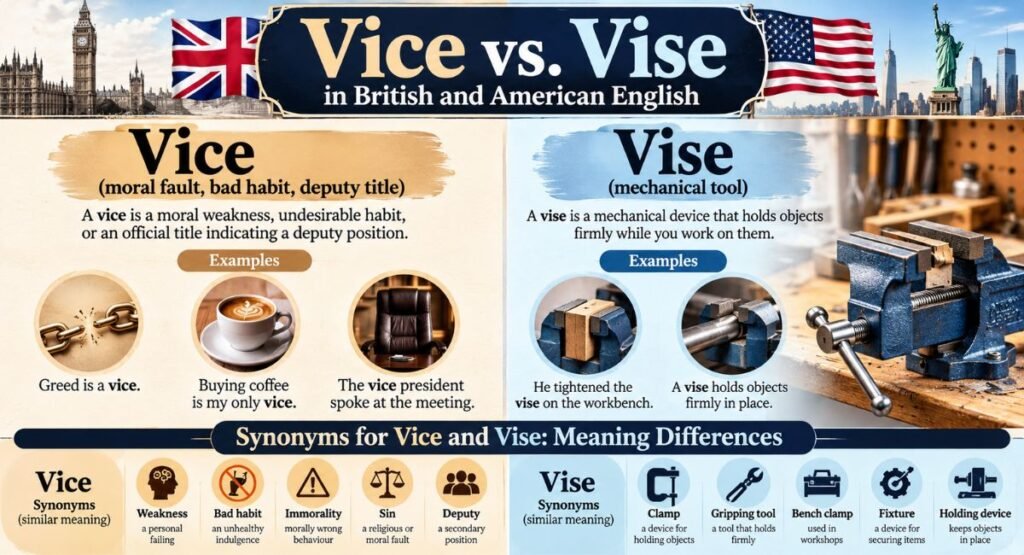
The two words need separate synonym groups because they refer to different concepts.
Synonyms for Vice as a Moral Fault
| Related word | Subtle difference |
| Fault | A mistake or weakness that is not necessarily morally wrong. |
| Flaw | An imperfection in someone’s character, behaviour, or something’s design. |
| Weakness | A limitation or temptation, often less judgemental than vice. |
| Sin | Wrongdoing viewed through a religious or moral framework. |
| Corruption | Serious dishonesty or abuse, particularly within an institution. |
| Indulgence | Something enjoyed for pleasure, sometimes excessively, without necessarily being immoral. |
| Bad habit | Repeated undesirable behaviour that may not carry strong moral judgement. |
Vice vs. Bad Habit
A bad habit is behaviour someone repeats despite unwanted effects.
A vice can also be a repeated behaviour, but the word often carries a stronger moral judgement or a humorous sense of self-criticism.
Calling frequent phone-checking a bad habit sounds ordinary. Calling it a vice makes the statement more dramatic.
Vice vs. Sin
A sin generally refers to behaviour regarded as wrong under a religious or moral system.
Vice can describe moral wrongdoing, but it is also used playfully for relatively harmless pleasures.
For example, “Chocolate is my only vice” normally doesn’t mean the speaker believes eating chocolate is a serious religious offence.
Vice vs. Weakness
A weakness is a broad limitation in ability, character, or self-control.
A vice more specifically suggests undesirable behaviour or a moral failing.
Being nervous during public speaking may be a weakness, but it would not normally be described as a vice.
Related Words for Vise
| Word | How it differs |
| Clamp | A broader term for devices that hold objects together or in place. |
| Grip | The act or manner of holding firmly, not necessarily a tool. |
| Holder | A general item designed to hold or support something. |
| Workholding device | A technical category covering vises, fixtures, and clamps. |
| Bench clamp | A clamp used at a workbench, not necessarily a bench vise. |
A vise is therefore a specific mechanical tool, while these related words can describe a wider variety of devices or actions.
Antonyms of Vice and Vise
What Is the Opposite of Moral Vice?
The strongest general antonym is virtue.
A virtue is a morally good quality, such as honesty, patience, generosity, or courage.
“The story contrasts the virtue of generosity with the vice of greed.”
Other contextual opposites include:
| Word | Meaning and usage |
| Integrity | Strong moral principles: “Her integrity earned the team’s trust.” |
| Honesty | Truthfulness: “He valued honesty over deception.” |
| Self-discipline | Control over impulses: “Self-discipline helped him change an unhealthy habit.” |
| Temperance | Moderation or restraint: “The essay praised temperance over excess.” |
| Goodness | General moral virtue: “The story explores the conflict between goodness and corruption.” |
These are contextual opposites rather than interchangeable dictionary antonyms for every use of vice.
Does Vise Have an Antonym?
The tool itself has no direct lexical antonym.
However, actions performed with it have natural opposites.
Tighten contrasts with loosen, and clamp can contrast with release.
“The mechanic tightened the vise around the component.”
“After finishing the work, the mechanic loosened the vise.”
These actions are opposites, but the noun vise doesn’t have an opposite object.
Word Origin and Etymology of Vice and Vise
Although the words sound alike, the three main word families have different historical roots.
Where Does Moral Vice Come From?
Moral vice comes from Latin vitium, meaning a defect, fault, or imperfection.
It entered English through Old French vice.
The moral meaning is recorded in English around 1300. The broader meaning of a personal flaw or undesirable habit developed during the later medieval period.
The deeper origin of Latin vitium remains uncertain, so proposed prehistoric derivations should not be treated as established facts.
Where Does the Tool Word Vise Come From?
The tool word developed from Anglo-French and Old French forms associated with screws, particularly vis.
Its history is traced to Latin vītis, meaning a vine or tendril, with an association between winding plants and twisting mechanisms.
The specific meaning of a two-jawed clamping tool is recorded from around 1500.
This is a different etymological history from moral vice.
Why Does Vice President Use Vice?
The title element vice- comes from Latin vice, meaning in place of.
It is related to Latin vicis, referring to a turn, change, or alternation.
In a title, vice- indicates a deputy or person next below another officeholder.
This is why vice president has nothing to do with an immoral habit or a workshop vise.
Vice Versa: Meaning and Correct Usage
Vice versa means that a statement is also true when the order of two people or things is reversed.
For example:
“Emma helps Daniel with mathematics, and vice versa.”
This tells us that Daniel also helps Emma with mathematics.
The expression is Latin-derived and is not related to the mechanical tool vise.
Is It Vice Versa or Vise Versa?
The correct expression is always vice versa.
Vise versa is a spelling mistake in both British and American English.
The phrase does not change spelling according to the regional distinction used for the workshop tool.
Common Mistakes With Vice and Vise
Mistake 1: Writing Vise for a Moral Fault
Incorrect: “Greed is his greatest vise.”
Correct: “Greed is his greatest vice.”
The moral word uses vice in both British and American English.
Mistake 2: Writing Vise President
Incorrect: “The vise president attended the meeting.”
Correct: “The vice president attended the meeting.”
Deputy titles use vice, never vise.
Mistake 3: Assuming Vice Cannot Mean a Tool
In British English, vice is the standard tool spelling.
British: “The carpenter tightened the bench vice.”
American: “The carpenter tightened the bench vise.”
Neither sentence is incorrectly spelled when used in the appropriate regional context.
Mistake 4: Writing Vise Versa
Incorrect: “She supports him, and vise versa.”
Correct: “She supports him, and vice versa.”
The Latin-derived expression always uses vice.
Mistake 5: Confusing Vice and Wise
Vice and vise have the pronunciation /vaɪs/.
Wise has the pronunciation /waɪz/.
Correct: “The wise mechanic secured the bracket in a vise.”
Mistake 6: Treating Vice as Another Word for Addiction
A vice is not necessarily an addiction.
A person might humorously describe a fondness for sweet desserts as a vice. Addiction is a more specific term that should not be inferred from that expression alone.
Mistake 7: Mixing Regional Workshop Terminology
For technical writing, choose a consistent spelling.
British English: “Inspect the bench vice and clean its jaws.”
American English: “Inspect the bench vise and clean its jaws.”
Consistency makes workshop instructions easier to follow, especially when the same equipment is mentioned repeatedly.
How to Remember Vice vs. Vise
A simple memory trick can help American English learners.
Vise contains s, as does squeeze. The tool grips an object firmly.
Vice is contrasted with virtue in moral discussions.
The first trick has one limitation: British English uses vice for the gripping tool.
For vice president and vice versa, always use vice, regardless of the country.
Conclusion
Vice and vise are pronounced alike, but their meanings and spellings depend on context.
Vice can describe moral wrongdoing, a personal weakness, or an undesirable habit. In titles, vice- indicates a deputy or secondary position.
Vise is the usual American spelling for a mechanical gripping tool, while British English uses vice for that same device.
The most reliable approach is to identify the meaning first, then apply the relevant regional spelling. That single habit prevents the most common mistakes.
Frequently Asked Questions?
What Is the Main Difference Between Vice and Vise?
Vice refers to a moral fault, undesirable habit, or immoral behaviour. Vise is the standard American spelling for a mechanical tool used to hold objects firmly. In British English, the same tool is usually called a vice. Both words sound identical, but their spelling depends on meaning and regional usage.
Is It Bench Vice or Bench Vise?
Both bench vice and bench vise are correct, depending on the variety of English. British English normally uses bench vice, while American English prefers bench vise. Both describe a device mounted on a workbench that grips materials securely during activities such as filing, drilling, or shaping suitable workpieces.
Are Vice and Vise Pronounced the Same Way?
Yes. Vice and vise are homophones, meaning they share the same pronunciation. Both are pronounced VYSS, with the IPA transcription /vaɪs/. Each has one syllable and ends with an /s/ sound. Their meanings differ, so listeners rely on context to understand which word is intended.
Is It Vice President or Vise President?
Vice president is the correct spelling in both British and American English. The element vice- comes from Latin and indicates someone acting in place of another person or holding a deputy position. It has a different historical origin from moral vice and the mechanical vise. Vise president is incorrect.
Is Vice Versa Related to Vise?
No. Vice versa is a Latin-derived expression meaning that the reverse arrangement is also true. For example, “Emma helps Daniel, and vice versa” means Daniel also helps Emma. The expression is unrelated to the workshop tool called a vise in American English. The spelling vise versa is incorrect.



One Comment