
Second That Emotion, Notion, or Motion: Meaning and Correct Usage
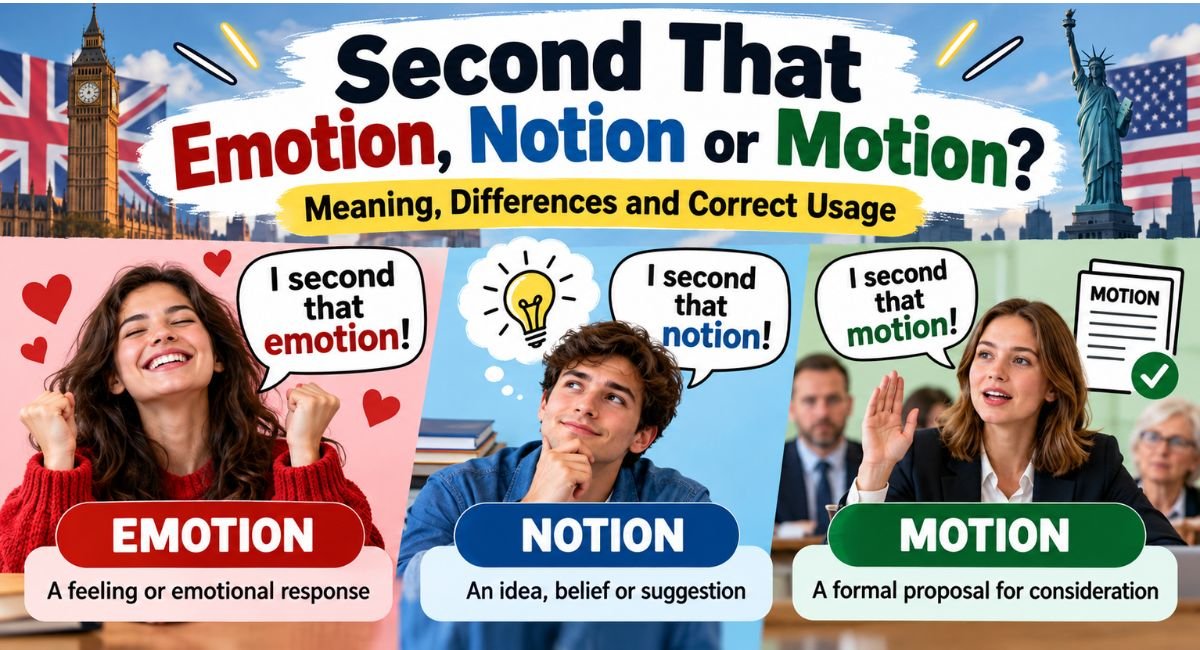
“I second that motion” is the established expression in formal meetings. “I second that notion” informally supports an idea, while “I second that emotion” is playful wordplay made famous by a 1967 Motown song. All three can be understood, but their meanings and appropriate contexts are different.
Second that emotion or notion or motion — which expression should you use? The answer depends on what you’re trying to communicate. You might hear “I second that motion” during a committee meeting, “I second that notion” in a friendly discussion, or “I second that emotion” as a humorous reference to a familiar song.
These phrases sound alike, but replacing one word changes the meaning. The difference becomes especially important in formal meetings, where seconding a proposal has a specific procedural purpose.
This guide explains all three expressions in simple English, including their pronunciation, grammar, origins, common mistakes and examples from everyday conversation.
Second: That Emotion vs Notion vs Motion: What’s the Difference?
The main difference comes from the nouns emotion, notion and motion. Although the words sound similar, they refer to different concepts.
A motion is a formal proposal, a notion is an idea or belief, and an emotion is a feeling. The verb second can express support or agreement, but its exact meaning depends on the situation.
| Expression | Meaning | Common context |
| I second that motion | I formally second a proposal for consideration | Committee meetings |
| I second that notion | I agree with that idea | Informal discussion |
| I second that emotion | I playfully share or support that feeling | Humour and music |
| I second that | I agree with what was said | Everyday conversation |
The safest expression for formal parliamentary proceedings is “I second the motion”. For ordinary agreement, “I second that” is shorter and more natural than either playful variation.
What Does “I Second That Motion” Mean?
“I second that motion” is a conventional expression used in organised meetings. It means another member wants a proposed action to be considered by the group.
A motion is a proposal introduced for discussion or decision. For example, a committee member might suggest increasing the budget for a community project.
Another member can then say, “I second the motion.”
In a meeting using procedures that require seconds, this allows the proposal to move towards formal consideration. The chair may then state the motion before the members discuss or vote on it.
How Does Seconding a Motion Work?
Consider a school committee discussing new library opening hours.
Example of a formal motion
- Proposal
“I move that the school library remain open until 6 p.m.” - Second
“I second the motion.” - Consideration
The chair states the proposal, and members discuss it as permitted by the rules. - Decision
The group votes on the proposal.
This is a simplified example. Actual meeting procedures depend on the rules adopted by the organisation, and not every motion requires a second.
Does Seconding a Motion Mean You Agree?
Not necessarily. In formal parliamentary procedure, a second indicates that another member wants the motion considered. It does not automatically mean the person intends to vote for it.
Imagine a committee member who disagrees with a proposed policy but believes the issue deserves discussion. That member may second the proposal and later vote against it.
This difference is important because, in everyday conversation, “I second that” usually does communicate agreement. Formal seconding and informal agreement are therefore not identical.
A US Department of the Interior meeting guide explicitly distinguishes seconding a motion from agreeing with it.
What Does “I Second That Notion” Mean?
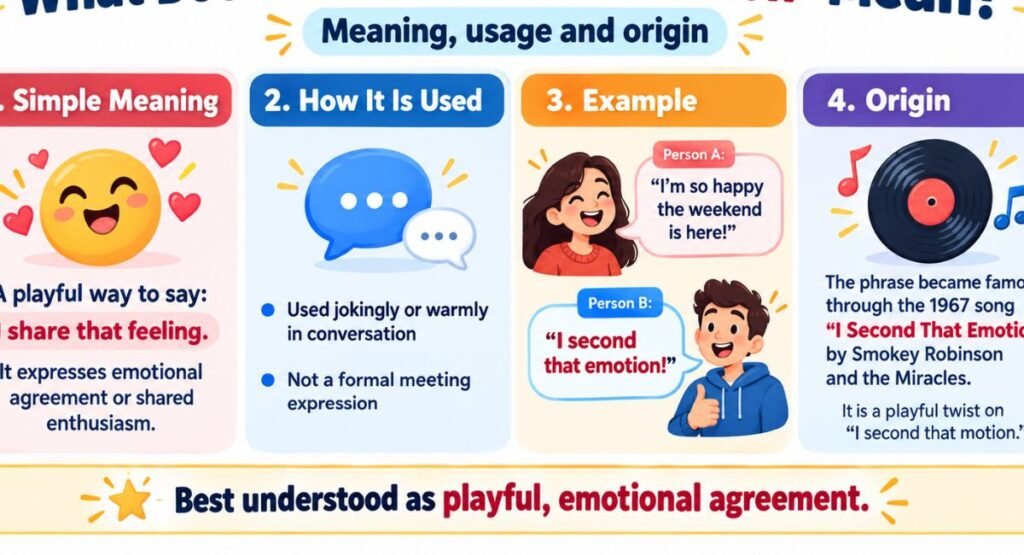
“I second that notion” means something like “I agree with that idea” or “I support that suggestion”.
The noun notion refers to an idea, belief or impression. When someone says they second a notion, they are generally expressing agreement with another person’s thinking.
For example:
“We should introduce a four-day working week.”
“I second that notion!”
The second speaker is supporting the proposed idea rather than performing a formal parliamentary action.
Is “I Second That Notion” Grammatically Correct?
Yes, the expression is grammatically understandable. The verb second can take a direct object, and that notion is a valid noun phrase.
However, “I second that notion” is not the conventional wording for formally seconding a parliamentary motion. It may also sound deliberately playful because it resembles “I second that motion”.
For straightforward professional communication, expressions such as “I agree with that suggestion” or “I support that idea” may be clearer.
When Can You Use “I Second That Notion”?
The expression works best in friendly conversation or informal written discussions.
For instance, when a colleague suggests organising monthly team lunches, you might respond, “I second that notion.”
You would not normally use that wording as a substitute for “I second the motion” in official meeting proceedings.
What Does “I Second That Emotion” Mean?
“I second that emotion” is a playful expression suggesting that someone shares or supports another person’s feelings. It is particularly associated with the song I Second That Emotion.
In ordinary conversation, someone may use it jokingly:
“I’m so happy that the holidays have finally arrived!”
“I second that emotion!”
The reply suggests shared enthusiasm, but it is intentionally humorous rather than a standard idiom for expressing emotion.
Why Is “I Second That Emotion” a Play on Words?
The expression replaces motion with the similar-sounding word emotion.
This substitution creates an unexpected connection between formal meeting language and personal feelings. The humour becomes clearer when the listener recognises the conventional expression “I second that motion”.
Because the phrase has a musical association, it may also be used as a cultural reference rather than as a spontaneous expression of agreement.
The Smokey Robinson Song Behind the Phrase
The song “I Second That Emotion” was written by Smokey Robinson and Al Cleveland and released by Smokey Robinson and the Miracles in 1967.
Robinson’s recollections describe a shopping conversation during which Cleveland accidentally substituted emotion for motion. The unusual wording inspired the song.
Accounts differ about the precise conversational circumstances, so it is safer to describe the story as a reported recollection rather than reconstruct the dialogue as an independently established historical fact.
How to Pronounce Emotion, Notion and Motion
These words share similar sounds, but they do not have identical pronunciations.
| Word | British IPA | American IPA | Simple sound guide |
| Emotion | /ɪˈməʊʃən/ | /ɪˈmoʊʃən/ | ih-MOH-shun |
| Notion | /ˈnəʊʃən/ | /ˈnoʊʃən/ | NOH-shun |
| Motion | /ˈməʊʃən/ | /ˈmoʊʃən/ | MOH-shun |
Capital letters in the simple guides indicate the stressed syllable.
How to Pronounce Emotion
Emotion has three syllables, with stress on the second. The initial vowel is short and unstressed.
The word refers to a feeling or emotional state, such as happiness, fear or sadness.
How to Pronounce Notion
Notion has two syllables, with stress on the first. Its first consonant is /n/, which distinguishes it from motion.
The word describes an idea, belief, or impression.
How to Pronounce Motion
Motion has two syllables and begins with /m/. Its pronunciation differs slightly between British and American English, particularly in the vowel of the first syllable.
The noun may refer to physical movement or, in a meeting, a formal proposal.
Why Are These Words Confusing?
All three contain the /ʃən/ ending, similar to the final sound in words such as action and attention.
Because they sound alike, they can create intentional wordplay or accidental confusion. Learning their distinct meanings is more useful than memorising the phrases without context.
Grammar Rules for “I Second That Motion”
The key grammatical feature of the expression is the verb second.
Many learners know second as an ordinal number, but it can also function as a transitive verb meaning to support or formally second a suggestion.
Cambridge Dictionary records both its procedural meeting usage and its everyday sense of agreement.
English meaning – Cambridge Dictionary
Is Second a Verb or a Noun?
In “I second that motion”, second is a verb.
The sentence follows this structure:
Subject + verb + direct object
“I” is the subject, “second” is the verb, and “that motion” is the direct object.
In another context, second can be a time unit or an ordinal number, as in “Wait a second” and “She finished second”.
Verb Forms of Second
| Verb form | Example |
| Base form: second | I second the motion. |
| Third-person singular: seconds | She seconds the proposal. |
| Past tense: seconded | He seconded the motion. |
| Past participle: seconded | The motion was seconded. |
| Present participle: seconding | Another member is seconding the proposal. |
The verb is regular and follows the usual “-ed” pattern for the past tense.
Are Emotion, Notion and Motion Countable?
All three nouns can be countable, but some also have uncountable uses.
| Word | Countable example | Other use |
| Emotion | She experienced several emotions. | He spoke with emotion. |
| Notion | They discussed two different notions. | — |
| Motion | The committee considered three motions. | The machine was in motion. |
The precise grammatical meaning depends on the sentence.
Which Prepositions Are Used with Motion and Second?
The verb second normally takes a direct object in this construction.
Correct: “I second the motion.”
Incorrect: “I second to the motion.”
Related expressions use different prepositions.
- Vote on a motion.
- Speak in favour of a motion.
- Object to a proposal.
- Agree with an idea.
- Support a motion — no preposition is needed.
Can You Say “I Second This Motion”?
Yes. “I second this motion”, “I second that motion” and “I second the motion” are all grammatical.
The choice between this, that and the depends on how the speaker identifies the proposal.
In formal meeting language, “I second the motion” is particularly conventional.
Second That Emotion, Notion or Motion: 12 Real-Life Examples
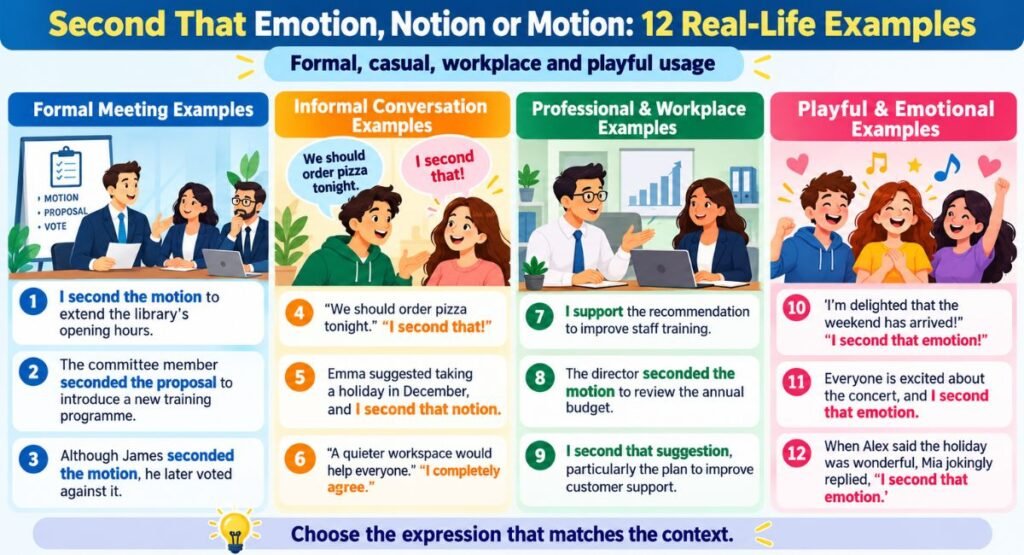
These original examples show how the expressions work in different contexts.
Formal Meeting Examples
- “I second the motion to extend the library’s opening hours.”
- “The committee member seconded the proposal to introduce a new training programme.”
- “Although James seconded the motion, he later voted against it.”
Informal Conversation Examples
- “We should order pizza tonight.” “I second that!”
- “Emma suggested taking a holiday in December, and I second that notion.”
- “A quieter workspace would help everyone.” “I completely agree.”
Professional and Workplace Examples
- “I support the recommendation to improve staff training.”
- “The director seconded the motion to review the annual budget.”
- “I second that suggestion, particularly the plan to improve customer support.”
Humorous and Emotional Examples
- “I’m delighted that the weekend has arrived!” “I second that emotion!”
- “Everyone is excited about the concert, and I second that emotion.”
- “When Alex said the holiday was wonderful, Mia jokingly replied, ‘I second that emotion.'”
The final three examples are playful. They would not be appropriate substitutes for a formal procedural second in official meeting minutes.
Synonyms for “I Second That” and Their Differences
The closest alternative depends on whether you mean formal seconding or genuine agreement.
| Expression | Meaning and nuance | Example |
| I agree | Direct, neutral agreement | I agree with your suggestion. |
| I support that proposal | Clear approval of a proposed action | I support the new policy. |
| I endorse that recommendation | More formal, considered approval | I endorse the committee’s recommendation. |
| I back that idea | Conversational support | I back your idea for the project. |
| I’m in favour of that | Expresses a positive position | I’m in favour of extending the deadline. |
| I share that feeling | Emotional agreement | I share your excitement about the event. |
These expressions are not always interchangeable with formal parliamentary seconding.
For instance, “I support that proposal” communicates actual approval, while a procedural second may simply indicate a desire for the assembly to consider the proposal.
Opposite Expressions for “I Second That”
There is no single perfect antonym because the expression can refer to agreement, approval or a procedural act.
I Disagree
This directly expresses a different opinion.
Example: “I disagree with the suggestion to cancel the event.”
I Oppose That Motion
This indicates opposition to a formal proposal.
Example: “I oppose that motion because the proposed changes would increase costs.”
I Object to That Proposal
This communicates resistance or an objection.
Example: “I object to that proposal because it lacks sufficient evidence.”
I Cannot Support That Recommendation
This is a diplomatic way to express disagreement in professional writing.
Example: “I cannot support that recommendation without further research.”
I Withdraw My Support
This means someone previously supported an idea but has changed their position.
Example: “I withdraw my support for the plan following the latest budget review.”
Withdrawing support is not automatically the same as cancelling a procedural second.
Origin and History of “I Second That Motion”
The expression comes from parliamentary and deliberative meeting language, where members introduce and consider proposals according to recognised procedures.
The verb second acquired a specialised meaning associated with showing that someone besides the proposer wants a motion considered.
Older editions of Robert’s Rules of Order describe seconding motions as part of formal meeting procedure. However, Robert’s Rules did not necessarily originate the expression.
Robert’s Rules of Order
An exact first-use date for “I second that motion” has not been established by the sources reviewed here. It should not be presented as a historical fact without dated documentary evidence.
How Did “I Second That” Become an Everyday Expression?
The formal phrase developed a familiar conversational meaning: “I agree with what you said.”
Someone who says “I second that” during dinner is usually expressing support for another person’s statement rather than performing an official meeting action.
This difference is an example of how specialised language can also acquire a broader everyday use.
Where Did “I Second That Emotion” Originate?
Its well-known cultural association comes from the 1967 Motown song by Smokey Robinson and the Miracles.
The reported slip of the tongue that inspired the title demonstrates how a single substituted word can create memorable humour and wordplay.
Where Did “I Second That Notion” Originate?
“I second that notion” is understandable as a variation on the established phrase using notion, meaning an idea.
However, no reliable single origin or earliest recorded occurrence was established in the sources reviewed. It would be inaccurate to assign the expression to a particular inventor without stronger evidence.
Common Mistakes with Second That Emotion, Notion or Motion
Mistake: Using Emotion in Official Meeting Language
Incorrect for formal procedure: “I second that emotion.”
Correct: “I second the motion.”
The formal noun is motion, not emotion.
Mistake: Assuming Seconding Always Means Agreement
A procedural second does not necessarily communicate support for adoption.
A member may second a motion to allow discussion and subsequently vote against it.
Mistake: Thinking “I Second That Notion” Is Always Wrong
The phrase is understandable and grammatical, although it is not the standard formula for parliamentary procedure.
It can work as informal or deliberately playful agreement.
Mistake: Adding “To” After Second
Incorrect: “I second to that motion.”
Correct: “I second that motion.”
The verb takes a direct object in this construction.
Mistake: Assuming Every Motion Needs a Second
Not all parliamentary motions require a second, and different organisations can adopt different procedures.
Always follow the relevant meeting rules rather than assuming a universal requirement.
Which Expression Should You Use?
| Situation | Best expression |
| Formal committee meeting | I second the motion. |
| Agreeing with a friend | I second that! |
| Supporting an idea playfully | I second that notion. |
| Sharing a feeling jokingly | I second that emotion. |
| Professional email | I support that recommendation. |
| Disagreeing with a proposal | I oppose that proposal. |
The choice becomes simple when you identify whether you are performing a formal procedural action, expressing ordinary agreement or making a joke.
Conclusion
The difference between second that emotion, notion or motion comes down to the meanings of the three nouns and the context in which they appear.
“I second that motion” is the conventional formal expression. “I second that notion” can express informal agreement with an idea. “I second that emotion” is playful wording associated with a famous Motown song.
The most important point is that seconding a motion in formal procedure does not necessarily mean supporting its adoption. Understanding that distinction will help you use these expressions more accurately and naturally.
Frequently Asked Questions?
Is It “I Second That Motion” or “I Second That Notion”?
“I second that motion” is the conventional expression in formal parliamentary meetings. “I second that notion” is an understandable informal variation used to support an idea. Both can make sense, but motion is the appropriate word when formally seconding a proposal. In everyday conversation, “I second that” is often more natural.
What Does “I Second That Emotion” Mean?
“I second that emotion” is a playful expression suggesting that someone shares another person’s feelings or enthusiasm. It became famous through the 1967 song by Smokey Robinson and the Miracles. The phrase plays on “I second that motion” and is usually used humorously rather than in formal discussions.
Is “I Second That Notion” Grammatically Correct?
Yes, “I second that notion” is grammatically understandable because second functions as a verb and notion means an idea or belief. However, it is not the conventional phrase used in parliamentary meetings. In casual conversation, it can express agreement, although “I agree” or “I support that idea” is more direct.
Does Seconding a Motion Mean You Agree with It?
No, not necessarily. Under Robert’s Rules of Order, seconding a motion indicates that another member wants the proposal considered. The person who seconds it does not have to support its adoption and may later vote against it. This differs from everyday speech, where “I second that” generally expresses agreement.
Where Did “I Second That Emotion” Come From?
“I Second That Emotion” became famous as a 1967 Motown song written by Smokey Robinson and Al Cleveland. According to Robinson’s recollections, Cleveland accidentally said “emotion” instead of “motion” during a conversation. The unusual wording inspired the song’s title, turning a verbal slip into a memorable piece of musical wordplay.




One Comment