
Check Up, Checkup or Check-Up? Differences & Examples
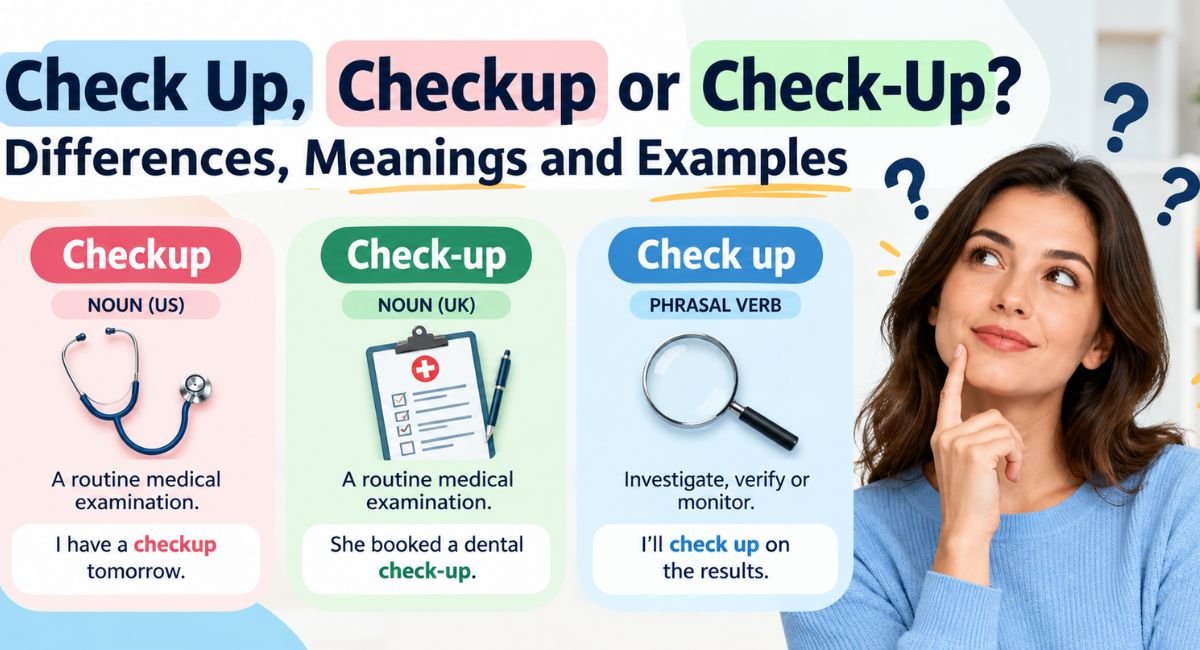
Checkup is a countable noun commonly used in American English for a routine medical examination. Check-up is the usual British English spelling of the same noun. Check up is a phrasal verb meaning to investigate, verify details or monitor someone. The correct choice depends on whether the sentence needs a noun or a verb.
Have you ever written “I need a check up” and wondered whether the words should be joined or hyphenated? The question Check Up, Checkup or Check-Up – Which One to Use? has a straightforward answer, but there are a few details worth learning. All three forms sound alike, yet they do different jobs in a sentence.
The distinction becomes particularly useful when writing about medical appointments or checking on another person. A patient has a checkup, but a nurse might check up on that patient. Those sentences express different actions, and the spelling helps readers recognise which meaning you intend.
Check Up vs Checkup vs Check-Up: What’s the Difference?
The quickest way to distinguish these expressions is to look at the words surrounding them. If an article such as a or the appears immediately before the expression, you probably need a noun. If the expression follows will, should or must, you probably need a verb.
American and British spelling preferences matter for the noun, but not for the phrasal verb.
| Expression | Grammar | Main meaning | Example |
| Checkup | Countable noun, mainly US | Routine medical examination | I have a checkup tomorrow. |
| Check-up | Countable noun, mainly UK | Routine medical examination | She booked a dental check-up. |
| Check up | Phrasal verb | Investigate or monitor | I’ll check up on the results. |
These distinctions are reflected in Cambridge Dictionary, which identifies checkup as the American noun spelling and check-up as its British equivalent.
There is one useful qualification: regional spelling preferences are not absolute. An American reader may encounter check-up, and a British reader will understand checkup. For consistent formal writing, however, following your publication’s preferred spelling is sensible.
What Does Checkup Mean in English?
A checkup is an examination intended to assess someone’s general health. It typically refers to an appointment with a doctor or dentist, rather than treatment for a particular injury or illness.
For example:
“My dentist recommended a checkup in six months.”
Here, checkup names the appointment or examination. It does not tell us which tests or procedures will take place.
You may also encounter the noun in expressions such as annual checkup, routine checkup and health checkup. These phrases describe the type or timing of an examination. An annual checkup is one associated with a yearly schedule, although an individual’s need for appointments depends on personal circumstances and professional medical advice.
Can Checkup Describe Something Other Than a Medical Examination?
Yes, but context is important. Someone might informally say that a car needs a checkup before a long journey. Readers would understand that the vehicle needs to be examined.
Nevertheless, more specific terms may be preferable in professional contexts. A mechanic may conduct a vehicle inspection, an engineer may perform an equipment assessment, and a technician may run a system diagnostic test.
These alternatives are not identical. An inspection involves examining something, while a diagnostic test aims to identify a problem. A checkup is a broader, more conversational expression.
What Does Check-Up Mean in British English?
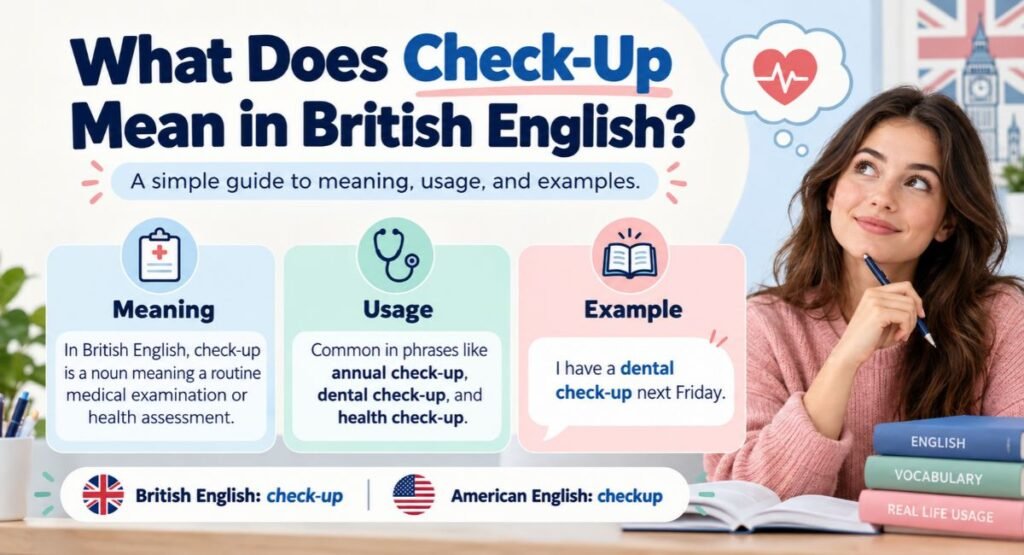
Check-up is a standard British English noun meaning a medical examination, especially one intended to assess general health.
You might read:
“My father has a health check-up next Friday.”
This sentence is grammatically correct in British English. The hyphen joins the two elements into a single noun.
The plural is check-ups:
“The clinic offers regular health check-ups.”
One misconception deserves attention: the hyphenated form is not exclusively an adjective. It is a noun in its own right.
In “My check-up went well”, the word is the subject of the sentence. In “My check-up appointment went well”, it modifies another noun, appointment. This is an example of a noun being used attributively, not proof that check-up is inherently an adjective.
What Does Check Up Mean as a Phrasal Verb?
Check up is a phrasal verb built from the verb check and the particle up. Its meaning depends partly on context.
It commonly describes making an enquiry, investigating information or finding out what someone is doing.
Consider this sentence:
“The manager checked up on the team’s progress.”
The manager did not conduct a medical examination. Instead, the manager investigated how the work was progressing.
A particularly important construction is check up on + someone or something.
Compare these sentences:
- “I’ll check up on the figures before submitting the report.”
- “She checks up on her teenage son when he comes home late.”
- “The supervisor checked up on the contractor’s progress.”
The first concerns verification, the second concerns supervision, and the third concerns work monitoring.
Does Check Up On Sound Caring or Suspicious?
This is where a dictionary definition alone becomes less helpful.
Suppose a colleague says:
“I’ll check on Sarah after her operation.”
That naturally suggests concern for Sarah’s wellbeing.
Now consider:
“The supervisor keeps checking up on Sarah.”
Without further context, this may suggest that the supervisor is watching Sarah’s work or behaviour closely.
Check up on can express genuine concern, but it can also carry a sense of scrutiny. Check on is often a gentler choice when the only intention is to find out whether someone is safe or comfortable.
The expressions overlap, so tone and situation remain important.
How to Pronounce Checkup, Check-Up and Check Up
All three forms have the same basic pronunciation. Neither the space nor the hyphen creates an extra syllable.
| Feature | Pronunciation |
| Simple pronunciation | CHEK-up |
| British IPA | /ˈtʃek.ʌp/ |
| American IPA | /ˈtʃek.ʌp/ |
| Syllables | Two |
| Main stress | First syllable |
The first syllable sounds like check. The second contains the vowel heard in cup.
A useful detail is that the two-word verb may receive different emphasis in a sentence depending on the speaker’s intention. For example, a speaker may emphasise up when contrasting checking something casually with investigating it further. This is a matter of sentence stress, not a separate dictionary pronunciation.
Because the forms sound alike, written grammar is a more reliable guide to choosing the correct spelling than pronunciation.
Grammar Rules for Checkup, Check-Up and Check Up
The noun and verb distinction determines how these expressions fit into a sentence.
Checkup and check-up are countable nouns. They can appear with articles, possessives, adjectives and plural endings.
Check up is a phrasal verb. Its main verb changes tense, while up stays unchanged.
Countable Nouns and Plural Forms
You can say:
- A checkup
- The checkup
- My check-up
- Two checkups
- Several check-ups
The standard American plural is checkups. The British hyphenated plural is check-ups.
Both nouns can be modified by adjectives:
“She arranged a thorough medical check-up.”
“His routine dental checkup took place yesterday.”
The adjective describes the examination; it does not change the grammatical classification of the noun.
Check Up Verb Forms and Tenses
| Form | Example |
| Base form | I check up on the records every Friday. |
| Third-person singular | She checks up on the project. |
| Past simple | He checked up on the complaint. |
| Present continuous | They are checking up on the details. |
| Present perfect | We have checked up on the figures. |
| Future | I’ll check up on the situation tomorrow. |
Notice that only check changes. The particle up stays separate throughout.
Which Preposition Follows Check Up?
The most useful construction to learn is check up on.
Correct: “I’ll check up on the delivery.”
Incorrect: “I’ll check up the delivery.”
The second sentence is not the standard construction for this meaning. If you merely want to inspect or verify something, the simpler verb check may work:
“I’ll check the delivery details.”
You can also use check up without mentioning the object when it is already understood:
“I’m not sure whether that claim is true. I’ll check up before answering.”
In everyday conversation, check or look into it may sound more natural in that example.
Check Up, Checkup and Check-Up in Real-Life Sentences
The examples below show different contexts in which people use these expressions. Some are medical, while others involve family relationships, workplace supervision and information verification.
| Context | Original sentence |
| American healthcare | I booked a checkup after noticing that my prescription needed reviewing. |
| British healthcare | The receptionist confirmed my dental check-up for Tuesday. |
| Family | I’ll check up on Dad after his appointment. |
| Workplace | The project manager checked up on the delayed shipment. |
| Research | Before publishing the figures, she checked up on the original source. |
| Technical | The mechanic suggested giving the engine a thorough checkup before the trip. |
| Formal correspondence | Please check up on the status of the outstanding request. |
| Casual conversation | Can you check up on the parcel while I’m at work? |
| Workplace tension | He felt uncomfortable when his supervisor kept checking up on him. |
| Medical report | The patient attended a routine check-up at the local clinic. |
A subtle distinction appears between the family and workplace examples. Checking up on a relative may be caring, while repeatedly checking up on an employee may imply a lack of trust. The same grammatical construction can therefore communicate different social meanings.
For formal writing, consider whether verify, investigate or follow up communicates the intended action more precisely.
Checkup Synonyms and Their Differences
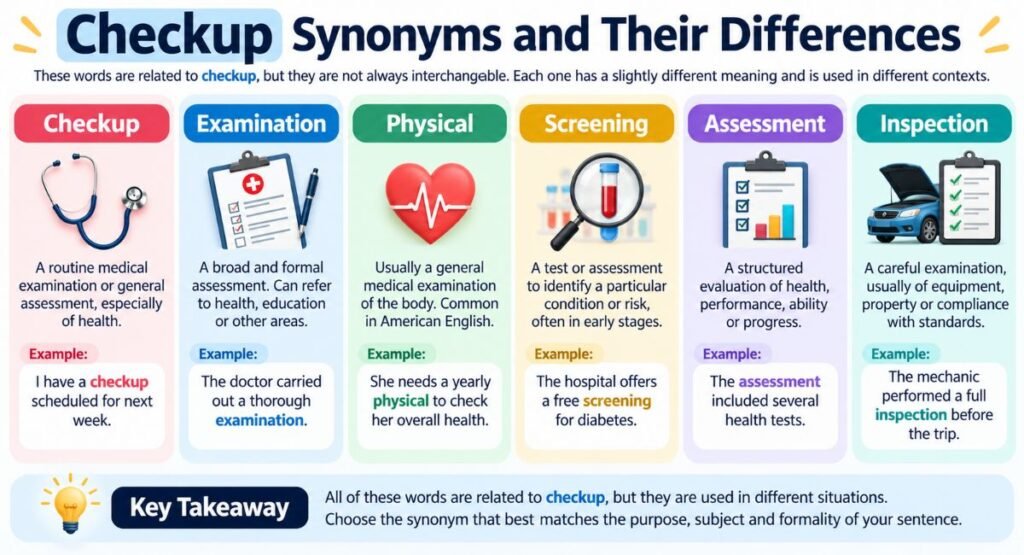
Several words are related to checkup, but they do not describe exactly the same activity.
| Word | How it differs from checkup |
| Examination | A broad term for careful assessment, including medical, academic and physical contexts. |
| Physical | Particularly common in American English for a general examination of bodily health. |
| Screening | Usually intended to identify a particular condition or health risk. |
| Assessment | An evaluation that may involve observations, questions or measurements. |
| Inspection | More common for equipment, buildings, vehicles or compliance checks. |
| Review | Focuses on reconsidering information, progress or decisions rather than necessarily conducting an examination. |
Consider screening and checkup. A screening test may focus on a particular condition, while a general checkup may consider several aspects of a patient’s health.
Similarly, a vehicle inspection is not automatically the same as a service. An inspection identifies the condition of parts, whereas a service may include maintenance work.
Using the more precise word prevents readers from assuming that one procedure includes activities it may not involve.
Synonyms of Check Up as a Verb
The verb has a different set of useful alternatives.
| Verb | Difference in meaning |
| Verify | Establish whether information is accurate. |
| Investigate | Examine an issue, often to discover facts or causes. |
| Monitor | Observe a person, process or condition over time. |
| Follow up | Take action after an earlier enquiry, event or conversation. |
| Look into | Investigate a matter, usually in a relatively conversational style. |
| Check on | Find out about someone’s wellbeing or the condition of something. |
For example:
“I’ll verify the invoice” sounds precise and professional.
“I’ll investigate the invoice discrepancy” suggests that a problem needs explanation.
“I’ll follow up on the invoice” suggests that someone has already raised the matter.
These verbs are useful alternatives, but replacing one with another changes the emphasis of the sentence.
Antonyms of Checkup and Check Up
The noun checkup does not have a direct antonym in ordinary English. An examination is an event or activity, and its opposite depends on what someone means.
For the verb check up, several words express contrasting behaviour.
| Expression | Meaning and usage |
| Ignore | Deliberately pay no attention: “The manager ignored the warning.” |
| Neglect | Fail to provide needed attention: “The company neglected routine inspections.” |
| Overlook | Fail to notice: “The reviewer overlooked an important error.” |
| Disregard | Deliberately dismiss information: “The staff disregarded the instructions.” |
| Leave unchecked | Allow something to remain unexamined: “The figures were left unchecked.” |
These are contextual contrasts, not interchangeable dictionary opposites.
For instance, overlooking an error may be accidental, whereas disregarding a warning usually suggests a conscious decision.
Where Did Checkup Come From?
The noun check-up developed from the verbal expression check up.
According to the Online Etymology Dictionary, the verbal expression check up on is attested from 1889, while the noun check-up, also spelled checkup, is recorded from 1921 in American English.
These dates indicate documented appearances, not necessarily the first time the expressions were spoken.
The relationship between noun and verb resembles several other English combinations:
| Verb phrase | Related noun |
| Work out | Workout |
| Set up | Setup |
| Back up | Backup |
| Check up | Checkup / Check-up |
There is an important limitation to this comparison. English compound formation does not follow a single universal spelling rule, and different dictionaries or style guides may prefer different forms.
For this particular expression, the established distinction is clear: check up is the verb phrase, while checkup and check-up are noun spellings.
Common Mistakes With Check Up and Checkup
Even experienced English writers sometimes confuse these forms, particularly when writing quickly.
The most common error is using the noun spelling where a verb is required.
Incorrect: “I’ll checkup on the report.”
Correct: “I’ll check up on the report.”
Another error involves using the phrasal verb without the required preposition when the object follows it.
Incorrect: “The manager checked up the team.”
Correct: “The manager checked up on the team.”
Here are several additional corrections:
| Mistake | Correct form | Reason |
| She is checkup on the patient. | She is checking up on the patient. | A continuous verb form is required. |
| I had three check up appointments. | I had three checkup appointments. (US) | The noun modifier uses the noun spelling. |
| The patient attended a check up. | The patient attended a check-up. (UK) | The expression is a noun. |
| He checks up his employees every hour. | He checks up on his employees every hour. | The phrasal verb takes on. |
Check Up On vs Check On vs Check In With
These three expressions deserve special attention because choosing the wrong one can change the tone of a message.
Check up on often suggests investigation, supervision or closer observation.
“The teacher checked up on the students’ progress.”
Check on commonly means finding out about someone’s condition or whether something is satisfactory.
“Could you check on the baby while I prepare dinner?”
Check in with usually means making contact to exchange information or request an update.
“I’ll check in with the designer about the revised layout.”
All three can be appropriate, but they are not equally natural in every situation. In a friendly message, check in with may sound more collaborative than check up on, particularly when the recipient does not need supervision.
How to Choose the Correct Spelling Every Time
Try this simple editing test.
First, ask whether the expression names an examination. If it does, use the noun spelling that matches your intended English variety.
Second, ask whether someone is performing an action. If the sentence describes investigating, confirming information or monitoring, use check up.
Finally, read the sentence aloud and check the words around the expression. Articles and plural endings usually signal a noun. Modal verbs and tense changes usually signal a verb.
Consider these three sentences:
“I need a checkup.” — American noun.
“I need a check-up.” — British noun.
“I need to check up on the results.” — Verb phrase.
Only the third describes the act of investigating.
Quick Grammar Practice
Choose the appropriate form before reading the answers.
- I booked an annual _____ at the clinic. (British English)
- The supervisor will _____ on the team’s progress.
- My dentist recommends regular _____. (American English)
- She has been _____ on the delivery.
- The patient attended a routine _____. (American English)
Answers: 1. check-up; 2. check up; 3. checkups; 4. checking up; 5. checkup.
Notice that the plural noun and the progressive verb require different grammatical changes. Recognising those changes is more reliable than trying to memorise how the expression looks in isolation.
Conclusion
The difference between check up, checkup and check-up is easier to understand when you focus on what the expression is doing in the sentence.
Use checkup for the noun in conventional American English and check-up for the noun in conventional British English. Use check up when describing the action of investigating or monitoring, commonly with the preposition on.
One final distinction is worth remembering: checking on someone can communicate concern, while checking up on someone may suggest closer scrutiny. Choosing the right expression is therefore about meaning and tone as well as spelling.
Frequently Asked Questions?
Is checkup one word or two words?
Checkup is one word when used as a noun in American English. The related phrasal verb is written as two words: check up.
What is the difference between checkup and check-up?
Both are nouns with the same basic meaning. Checkup is more typical in American English, while check-up is preferred in British English.
Is check-up correct in British English?
Yes. Check-up is a standard British English noun referring to a medical examination or another type of inspection.
How do you use check up on someone in a sentence?
You might say, “I’ll check up on my neighbour this evening.” This means finding out how the person is doing.
Should I write annual checkup or annual check-up?
Use annual checkup for conventional American English and annual check-up for conventional British English. Both are grammatically correct.



One Comment