
Favour or Favor: Meaning, Spelling & Examples
Favour and favor are two correct spellings of the same English word. Favour is generally preferred in British English, while favor is standard in American English. Both can describe a helpful act, approval, preference, or an advantage. As verbs, they can mean to support, prefer, benefit, or give someone special treatment.
Should you write favour or favor in an email, school assignment, or professional article? Both spellings are correct, but the expected form depends on your audience. British English usually keeps the letter u, while American English omits it.
Compare these two requests:
“Could you do me a favour and collect my parcel?”
“Could you do me a favor and pick up my package?”
Both mean essentially the same thing. The first follows British English conventions, while the second sounds natural in American English.
The word is more versatile than it first appears. You can do someone a favour, vote in favour of a decision, favour one option over another, or have circumstances work in your favour. In American English, favor can even describe family resemblance or the way someone protects an injured leg.
Understanding these distinctions is more useful than simply memorising which country uses the extra letter.
What Does Favour Mean in English?
In simple English, favour can mean helping someone, showing approval, expressing a preference, or giving someone an advantage.
The correct interpretation depends on the situation.
| Meaning | Example | Explanation |
| Helpful act | “Can you do me a favour?” | Someone is asking for assistance. |
| Approval | “The proposal gained favour.” | More people began supporting it. |
| Preference | “I favour the earlier train.” | One option is preferred. |
| Advantage | “The conditions worked in our favour.” | The situation benefited someone. |
| Small gift | “Guests received wedding favours.” | Visitors received keepsakes. |
| Preferential treatment | “The manager favoured his friend.” | One person received special consideration. |
These meanings are connected by the idea of support or goodwill, but they cannot always replace one another.
Favour as an Act of Kindness
A favour is often a small, helpful action performed for another person.
Imagine that you are away from home and an important parcel arrives. Your neighbour collects it so that it won’t be left outside. When you return, you might say, “Thanks for collecting my parcel. I owe you a favour.”
A favour is usually voluntary, although people also use the expression for routine requests.
Favour as Approval or Support
The word can describe support for an idea, person, or proposal.
“The committee voted in favour of extending the library’s opening hours.”
Here, in favour of means the committee supported the proposal.
This use is common in meetings, political discussions, public consultations, and news reports.
Favour as Preference
As a verb, favour can mean preferring one option over another.
“Our company favours rail transport over air freight for shorter journeys.”
The preference might be based on cost, convenience, environmental considerations, or available evidence.
Choosing one option does not automatically mean treating others unfairly.
Favour as an Advantage
Something that works in your favour benefits your position or increases your chances of success.
“Her previous experience worked in her favour during the interview.”
The sentence doesn’t suggest that the interviewer performed an act of kindness. It means her experience was an advantage.
Favour as a Wedding or Party Gift
A favour can also be a small gift given to guests at a celebration.
“Each guest received a jar of homemade jam as a wedding favour.”
In American English, the same gift would be called a wedding favor or party favor.
This meaning is countable: one favour, several favours, or fifty wedding favours.
Favour vs. Favor: British and American Spelling
The main difference between favour and favor is regional spelling. The meanings and grammatical functions remain the same.
| Word form | British English | American English |
| Base word | Favour | Favor |
| Plural noun | Favours | Favors |
| Third-person verb | Favours | Favors |
| Past tense | Favoured | Favored |
| Present participle | Favouring | Favoring |
| Related adjective | Favourable | Favorable |
| Related noun | Favouritism | Favoritism |
When Should You Use Favour?
Use favour when following British English conventions. The spelling is also generally preferred in Australian and New Zealand English.
For example:
“The council voted in favour of the development.”
If your website or publication uses British English, the related forms favoured, favourable, and favourite will normally fit the same spelling style.
When Should You Use Favor?
Use favor in American English.
“The city council voted in favor of the development.”
American English also uses favored, favorable, favorite, and favoritism.
The shorter spelling is not more modern, more formal, or more accurate. It is simply the established American convention.
Is It Favour or Favor in Canadian English?
Canadian English generally favours the spelling favour, although conventions vary across publishers and organisations.
Because Canadian English combines spelling traditions, it is sensible to follow a Canadian publication’s style guide rather than applying every British or American spelling rule automatically.
Which Spelling Works Best for International Readers?
Either spelling is understandable to English speakers.
A UK-focused website would normally use favour, while a US-focused publication would use favor.
For international content, choose a consistent editorial style. Keep the original spelling in official names, book titles, and direct quotations.
How to Pronounce Favour and Favor?
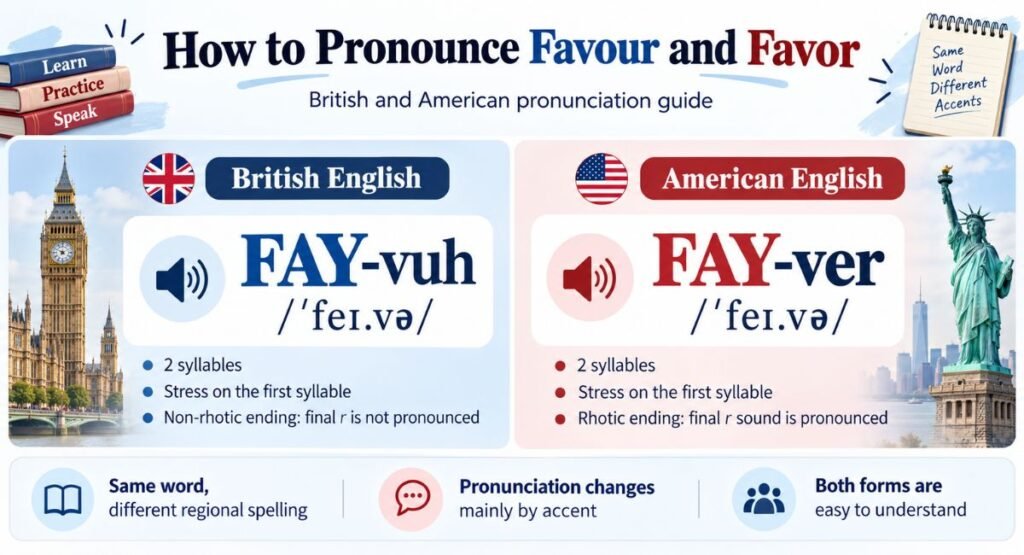
Both spellings represent the same word. Differences in pronunciation mainly reflect regional accents.
| English variety | Simple pronunciation | IPA |
| British English | FAY-vuh | /ˈfeɪ.və/ |
| American English | FAY-ver | /ˈfeɪ.vɚ/ |
Both have two syllables, with stress on the first syllable.
Why Does American English Have an R Sound?
Many southern British accents are non-rhotic, meaning the letter r is not normally pronounced at the end of a syllable unless it links to a following vowel.
General American English is usually rhotic, so speakers pronounce an r-coloured ending in favor.
The spelling difference itself does not cause this variation. It reflects how different English accents pronounce the word.
Favour Grammar: Nouns, Verbs and Prepositions
Favour functions as both a noun and a verb. Its meaning determines whether the noun is countable and which sentence patterns are natural.
Is Favour Countable or Uncountable?
When favour means a particular helpful action, it is countable.
“She did me a favour.”
“Over the years, he has done me several favours.”
When it refers to general approval or goodwill, it is usually uncountable.
“The proposal gained favour with residents.”
“The politician fell out of favour with voters.”
The celebration-gift meaning is countable.
“The wedding planner prepared eighty favours.”
These differences matter because you would naturally say a favour when requesting help, but not normally a favour when referring to general approval.
Favour as a Verb
Favour is normally a transitive verb, meaning it takes an object.
“The committee favours the second proposal.”
Here, the second proposal is the object.
The verb can also be followed by an -ing form:
“I favour travelling by train whenever possible.”
These structures are common in formal and everyday English.
Verb Forms of Favour and Favor
| Verb form | British English | American English |
| Base | Favour | Favor |
| Third-person singular | Favours | Favors |
| Past simple | Favoured | Favored |
| Past participle | Favoured | Favored |
| Present participle | Favouring | Favoring |
Examples:
- “The manager favours flexible working.”
- “The board favoured the original plan.”
- “The committee is currently favouring the lower-cost option.”
- “Previous decisions have favoured larger suppliers.”
Common Prepositions and Expressions
| Expression | Example |
| In favour of | “I’m in favour of extending the deadline.” |
| In someone’s favour | “The decision went in her favour.” |
| Favour something over something | “They favour quality over speed.” |
| Ask for a favour | “Could I ask you for a favour?” |
| Do someone a favour | “She did her colleague a favour.” |
| Curry favour with | “He tried to curry favour with his manager.” |
| Fall out of favour with | “The policy fell out of favour with voters.” |
A useful grammar rule concerns in favour of. When a verb follows this phrase, use its -ing form.
Correct: “I’m in favour of reducing unnecessary costs.”
Incorrect: “I’m in favour of reduce unnecessary costs.”
Here, of is a preposition, so the following verb takes the -ing form.
Favour or Favor: Examples in Different Contexts
The following original sentences illustrate the word’s different uses.
Everyday Conversation
- “Could you do me a favour and water the plants while I’m away?”
- “I owe my brother a favour for helping me move house.”
- “Do yourself a favour and check the train timetable first.”
- “Our family favours simple meals during busy working weeks.”
Academic and Scientific Writing
- “The available evidence favours the second explanation.”
- “The researchers favoured a smaller study with more detailed observations.”
- “Several findings appeared to favour the original hypothesis, although the sample was limited.”
Business and Professional Communication
- “The directors voted in favour of extending the training programme.”
- “The company favors suppliers that demonstrate reliable delivery performance.”
- “The recruitment process must not favour candidates because of personal relationships.”
Legal and Journalistic Writing
- “The court ruled in the tenant’s favour.”
- “Most councillors supported the proposal, but several voted against it.”
- “The policy gradually fell out of favour as its costs became clearer.”
Less-Common American Uses
- “Everyone says the baby favors her grandfather around the eyes.”
- “After the injury, the player was favoring his right ankle.”
The last two examples deserve special attention because the meanings are easy to misunderstand.
Two Less-Common Meanings of Favor
Favor Meaning to Resemble a Relative
In American English, favor can mean looking like a parent or another family member.
“The youngest daughter favors her father.”
Here, the sentence means that the daughter resembles her father, particularly in appearance. It does not mean she likes him more than her mother.
This usage is mainly American and is considered old-fashioned in much contemporary British English.
Favor Meaning to Protect an Injured Body Part
Favor can also mean protecting a painful or injured body part by avoiding normal movement or pressure.
“The runner was favoring his left leg after the race.”
The runner is adjusting their movements to avoid discomfort.
This sense is recorded in both British and American English dictionaries, although spelling follows the usual regional conventions.
Favour vs. Favourite vs. Favouritism
These related words have different meanings, particularly when describing preference.
A favour may be a helpful action or an expression of support. A favourite is someone or something preferred above others. Favouritism suggests unfair preferential treatment.
Consider these sentences:
“I favour Emma’s proposal because it meets the budget.”
This expresses a preference supported by a reason.
“Emma is my favourite colleague.”
This expresses personal preference.
“The manager gives Emma the best assignments because they are friends.”
This situation may suggest favouritism.
The distinction matters in workplace communication because preferring a stronger proposal is not the same as unfairly favouring a particular person.
Synonyms for Favour and Favor: Meaning Differences
The best synonym depends on whether favour refers to kindness, support, approval, or advantage.
| Related word | Meaning difference |
| Help | General assistance; a favour is often a specific helpful action. |
| Kindness | Considerate behaviour rather than necessarily a requested task. |
| Assistance | A neutral or formal word for practical help. |
| Support | Backing, encouraging, or helping someone or something. |
| Approval | Accepting or judging something positively. |
| Preference | Liking or choosing one option more than another. |
| Advantage | A condition that improves someone’s position. |
| Goodwill | A friendly or positive attitude rather than a particular action. |
Favour vs. Help
If a neighbour collects your parcel, you could call it either help or a favour.
However, help also includes ordinary professional duties. A receptionist assisting a customer is providing help, but we would not necessarily describe every routine action as a personal favour.
Favour vs. Kindness
Kindness describes generous or considerate behaviour. A favour generally identifies something specific that one person does for another.
Listening patiently to a worried friend shows kindness. Collecting that friend’s medicine from a pharmacy could be described as doing them a favour.
Favour vs. Support
Support can involve encouragement, practical assistance, or approval over time.
Favouring a proposal often means taking a position on a particular decision.
For example, a manager may support an employee throughout a project while favouring a different employee’s proposal during a meeting.
Favour vs. Preference
A preference identifies the option someone likes or chooses. The verb favour expresses a similar inclination.
“My preference is for the earlier appointment.”
“I favour the earlier appointment.”
Both are natural, but the first uses a noun while the second uses a verb.
Favour vs. Approval
Approval is a positive judgement or acceptance.
A council might formally approve a development, while the project gradually gains favour among local residents.
The first involves an official decision. The second describes increasing support.
Antonyms of Favour and Favor
There is no single antonym that fits every meaning.
| Antonym | Usage |
| Oppose | “Several members opposed the motion.” |
| Disapprove | “Her parents disapproved of the decision.” |
| Reject | “The committee rejected the application.” |
| Hinder | “Heavy rain hindered construction.” |
| Disadvantage | “The policy disadvantaged smaller businesses.” |
| Disfavour | “The proposal fell into disfavour after the review.” |
These are contextual opposites rather than interchangeable replacements.
For example, oppose is a natural opposite of favour a proposal, but it does not express the opposite of do someone a favour.
Common Expressions With Favour
Do Me a Favour
This usually means asking someone to perform a helpful action.
“Could you do me a favour and send the document before lunch?”
In British conversation, “Oh, do me a favour!” can also express annoyance or disbelief. Tone and context determine the meaning.
Return the Favour
To return the favour means helping someone after they previously helped you.
“Amir helped me prepare my presentation, so I returned the favour by proofreading his report.”
The expression suggests reciprocal kindness, not necessarily a formal obligation.
In Favour Of
This means supporting or approving something.
“The parents were in favour of extending the school library’s opening hours.”
It is especially common in voting, policy discussions, and formal decision-making.
Curry Favour
To curry favour means trying to gain someone’s approval, often through flattery or ingratiating behaviour.
“He tried to curry favour with the director by praising every decision.”
The expression often suggests that the behaviour is motivated by personal benefit.
Fall Out of Favour
Something falls out of favour when it becomes less popular or less approved of.
“The original marketing strategy fell out of favour after disappointing results.”
The phrase can describe people, products, ideas, policies, and practices.
Word Origin and Etymology of Favour
The English word ultimately comes from Latin favor, meaning goodwill, support, or partiality. It entered Middle English through Old French favor.
According to historical etymological records, the English noun appeared around 1300. Earlier meanings included attractiveness or charm, while senses involving goodwill, helpful acts, and preferential treatment developed during the fourteenth century.
The expression in favour of is recorded from the sixteenth century.
These historical meanings help explain why the modern word can refer to kindness, approval, and bias.
Why Does British English Include the U?
British English retains the -our spelling in several words influenced by historical French and Middle English spelling conventions.
Examples include:
- Colour / color
- Honour / honor
- Flavour/flavor
- Neighbour / neighbor
However, the pattern is not universal. Words such as author and error use -or in both British and American English.
American spelling reforms and standardisation helped establish many shorter -or forms. Noah Webster influenced American spelling conventions, but the shorter spellings existed before his dictionaries.
Common Mistakes With Favour or Favor
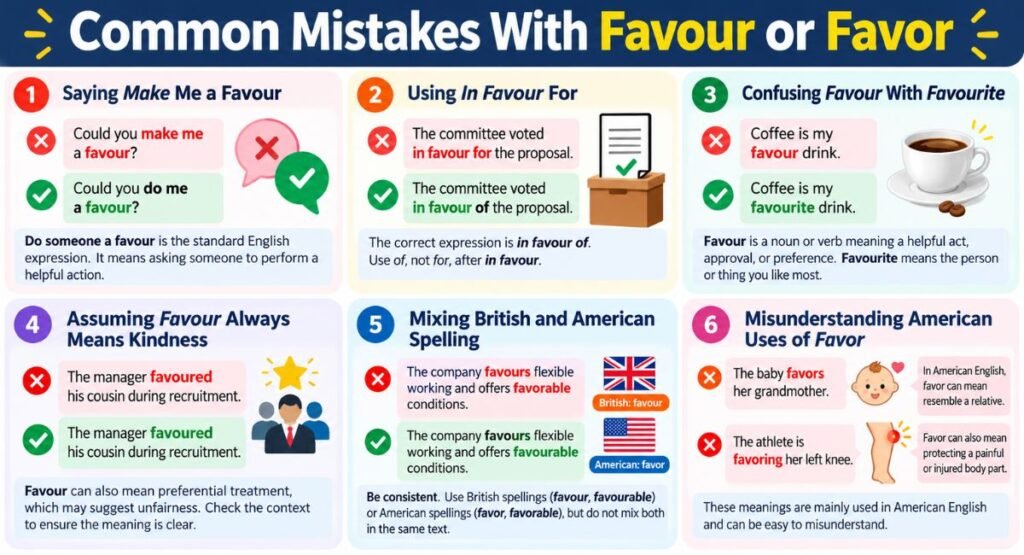
Mistake 1: Saying Make Me a Favour
Incorrect: “Could you make me a favour?”
Correct: “Could you do me a favour?”
Do someone a favour is the established expression.
Mistake 2: Using In Favour For
Incorrect: “The committee voted in favour for the proposal.”
Correct: “The committee voted in favour of the proposal.”
The standard expression is in favour of.
Mistake 3: Confusing Favour With Favourite
Incorrect: “Coffee is my favour drink.”
Correct: “Coffee is my favourite drink.”
You could also say, “I favour coffee over tea.”
Mistake 4: Assuming Favour Always Means Kindness
“The manager favoured his cousin during recruitment.”
This may suggest unfair preferential treatment rather than kindness.
Check whether the sentence concerns assistance, approval, preference, or advantage.
Mistake 5: Mixing British and American Spelling
Inconsistent British-style writing: “The company favours flexible working and offers favorable conditions.”
Consistent British English: “The company favours flexible working and offers favourable conditions.”
Consistent American English: “The company favors flexible working and offers favorable conditions.”
Preserve original spelling in direct quotations and official names.
Mistake 6: Misunderstanding American Uses of Favor
“The baby favors her grandmother.”
This can mean the baby resembles her grandmother.
“The athlete is favoring her left knee.”
This can mean the athlete is protecting a painful or injured knee.
Neither sentence necessarily expresses personal preference.
Which Spelling Should You Use?
The practical rule is simple: choose the spelling that matches your audience.
For British English, use favour. For American English, use favor.
The same principle generally applies to related forms such as favourable/favorable, favoured/favored, and favourite/favorite.
For international writing, either standard spelling can work, provided your editorial style is consistent.
Remember that you should not alter the spelling of official names, titles, or direct quotations merely to match your chosen variety of English.
Conclusion
Favour and favor are two spellings of the same English word. British English generally uses favour, while American English uses favor.
The word has several related meanings. It can describe a helpful action, express approval, indicate a preference, or refer to an advantage. In particular contexts, it can also mean family resemblance or protecting an injured body part.
Understanding these meanings makes expressions such as do me a favour, in favour of, and return the favour easier to use naturally.
Frequently Asked Questions
Is It Favour or Favor in British English?
Favour is the standard British English spelling, while favor is preferred in American English. Both have the same core meanings. British writers also generally use related forms such as favourite, favourable, and favouritism. In formal writing, choose the spelling convention required by your audience, institution, or publication.
Do Favour and Favor Have the Same Meaning?
Yes. Both spellings can refer to a helpful act, approval, goodwill, preference, or an advantage. As verbs, they can mean to support, prefer, or benefit someone or something. American English also uses favor to mean resemble a relative. The intended meaning depends on the context.
Is It Do Me a Favour or Make Me a Favour?
Do me a favour is the standard English expression. It means asking someone to perform a helpful action, often as a polite request. For example, “Could you do me a favour and collect my parcel?” The phrase make me a favour is not standard everyday English. American writers spell the word favor.
What Is the Difference Between Favour and Favourite?
Favour is a noun or verb associated with kindness, support, approval, or preference. Favourite is a noun or adjective identifying someone or something preferred above others. “Can you do me a favour?” requests help, while “Blue is my favourite colour” describes a personal preference. American English uses favorite.
Is It In Favour Of or In Favor Of?
Both expressions mean supporting or approving someone or something. In favour of is the British spelling, while in favor of is American English. For example, “The committee voted in favour of the proposal” means the members supported it. The spelling varies, but the expression’s meaning and grammar remain the same.




One Comment