
Likable vs. Likeable: Meaning, Difference, and Correct Spelling
Both likable and likeable are correct English adjectives meaning pleasant or easy to like. Likable is generally preferred in American English, while likeable is more common in British English. Both words have the same pronunciation, meaning and grammatical function. Choose the spelling that matches your audience and use it consistently.
Likable vs. likeable is a common spelling question, especially when writing about someone’s personality or describing a character in a book. You may encounter “a likable character” in an American review and “a likeable character” in a British publication. Both are correct, but they reflect different spelling preferences.
The distinction is straightforward: the additional “e” does not change the meaning or pronunciation. However, choosing the right spelling is only part of using the adjective accurately. Someone can be likeable without being popular, friendly or deeply loved.
This guide explains the regional spelling differences, pronunciation, grammar and word origin, with original examples that show how the adjective works in everyday and professional English.
Likable vs. Likeable: What’s the Difference?
The main difference between likable and likeable is spelling. American English generally favours likable, while British English usually prefers likeable.
Both words describe a person or something that creates a favourable impression. They are interchangeable in meaning, although writers should normally follow one regional spelling convention throughout a document.
Cambridge Dictionary identifies likeable as mainly British English and likable as mainly American English.
Likable or Likeable: Quick Comparison
| Feature | Likable | Likeable |
| Meaning | Pleasant or easy to like | Pleasant or easy to like |
| Preferred variety | American English | British English |
| Part of speech | Adjective | Adjective |
| Pronunciation | /ˈlaɪ.kə.bəl/ | /ˈlaɪ.kə.bəl/ |
| Syllables | Three | Three |
| Comparative | More likable | More likeable |
| Superlative | Most likable | Most likeable |
| Example | He is a likable teacher. | He is a likeable teacher. |
Neither spelling is inherently more formal or more correct. The preferred form depends on the English variety used by the writer or publication.
What Does Likable Mean in English?
Likable means having qualities that make a person or something easy to like. It is a positive adjective commonly used to describe personalities, behaviour and fictional characters.
A likable person might be thoughtful, amusing, considerate or approachable. However, being likable does not require every one of these qualities.
Consider this example:
“Although Daniel was nervous during the interview, the panel found him likable.”
The sentence suggests that Daniel made a positive personal impression. It does not necessarily mean that he was the most qualified candidate or that everyone had the same opinion of him.
Can Likable Describe Things as Well as People?
Yes. While the adjective is especially common when describing people, writers also use it for fictional characters, animals and other subjects that inspire favourable reactions.
For example:
“The film has a predictable storyline, but its main character is surprisingly likable.”
Here, likable describes the viewer’s positive response to the character. It does not mean that the character is perfect or morally admirable.
Does Likeable Have a Different Meaning?
No. The British spelling likeable has the same definition as likable.
A British writer may describe a character as “warm and likeable”, while an American writer may use “warm and likable“. Both sentences communicate the same quality.
The extra letter does not make the British form stronger, kinder or more affectionate.
Likable or Likeable in British and American English
The spelling variation reflects established regional usage rather than a difference in grammar.
Why Is Likable Preferred in American English?
American English generally uses the spelling likable, which omits the final “e” from like before adding “-able”.
This is consistent with a common English suffix pattern. However, English spelling has exceptions, so the construction should not be treated as a rule that applies to every adjective ending in “-able”.
An American writer might say:
“The new coach has a likable personality and communicates well with the team.”
Why Does British English Prefer Likeable?
British English generally retains the final “e” in likeable.
The additional letter is part of the conventional spelling and does not introduce another sound or syllable.
For example:
“Our new neighbour is a quiet but genuinely likeable person.”
Both spellings are established, and the British form is not a misspelling of the American version.
Which Spelling Is Used in Other Countries?
American and British conventions influence writing in other English-speaking regions.
| English variety | General spelling tendency |
| American English | Likable |
| British English | Likeable |
| Australian English | Often likeable |
| New Zealand English | Often likeable |
| Canadian English | Usage varies |
| Indian English | Often likeable |
| Pakistani English | Often likeable |
These are broad editorial tendencies rather than verified usage frequencies for every country. Individual newspapers, institutions and publishers may follow different style guides.
When preparing professional or academic writing, the safest approach is to follow the relevant publication’s established spelling convention.
How to Pronounce Likable and Likeable
Both spellings have the same standard pronunciation. The extra “e” in likeable does not affect how the word is spoken.
Likable
/ˈlaɪ.kə.bəl/
American spelling preference
Likeable
/ˈlaɪ.kə.bəl/
British spelling preference
Simple sound guide: LY-kuh-buhl
Both forms have three syllables, with stress on the first. Cambridge Dictionary provides the same IPA transcription for both spellings.
How to Pronounce the Three Syllables
The first syllable sounds like lie. The remaining syllables are unstressed, with reduced vowel sounds.
Avoid putting strong emphasis on the “-able” ending. The word sounds natural when the first syllable carries the stress.
The additional written “e” in likeable should never be pronounced as a separate syllable.
Likable and Likeable: Grammar Rules
Both forms are adjectives, meaning they describe qualities rather than actions.
They commonly appear before nouns or after linking verbs such as be, seem, appear, become and remain.
Is Likable an Adjective?
Yes. Likable and likeable are adjectives that describe someone or something favourably.
Examples include a likable teacher, a likeable character and a likable personality.
The adjective can also appear after a linking verb:
“Her new colleague seems very likeable.”
In this sentence, the adjective describes the colleague rather than an action.
Using Likable Before and After a Noun
There are two common adjective positions.
Attributive position: “She is a likable manager.”
Predicative position: “The manager is very likable.”
Both constructions are grammatically correct. The difference is where the adjective appears in the sentence.
Comparative and Superlative Forms
For comparisons, use more and most.
| Degree | American English | British English |
| Positive | Likable | Likeable |
| Comparative | More likable | More likeable |
| Superlative | Most likable | Most likeable |
Examples:
“The protagonist becomes more likeable as the story develops.”
“Of all the characters, Julia is the most likable.”
These forms are natural in both speech and formal writing.
Are Likable and Likeable Countable or Uncountable?
Countability normally applies to nouns, not adjectives. Because likable and likeable are adjectives, they are not classified as countable or uncountable nouns.
Their related abstract noun, likability or likeability, refers to the quality of being likable.
For example:
“The character’s likability is an important part of the story.”
Does Likable Have Verb Forms?
Likable is an adjective, so it does not have its own past, present or future verb tenses.
The related verb is like.
| Verb form | Example |
| Like | I like her personality. |
| Likes | He likes his new colleague. |
| Liked | The audience liked the character. |
| Liking | She is liking the new arrangement more each day. |
The simple present is generally more neutral with the stative verb like. Progressive forms such as “is liking” may be used in particular informal or developing situations.
Common Prepositions and Word Combinations
There is no single preposition that must follow likable or likeable.
| Expression | Example |
| Likable personality | She has a likable personality. |
| Likable to someone | The character seems likable to many viewers. |
| Liked by someone | He is liked by his colleagues. |
| Popular with someone | The teacher is popular with students. |
| Appealing to someone | Her honest manner is appealing to readers. |
In many cases, “viewers find the character likable” sounds more natural than “the character is likable to viewers”.
The distinction between likable and liked by is especially useful because they do not mean quite the same thing.
Likable vs. Likeable: 12 Real-Life Example Sentences
The following original examples show the adjective in American, British, professional, and casual contexts.
American English Examples
- “Our new science teacher is patient, cheerful and genuinely likable.”
- “The film introduces a flawed but likable main character.”
- “Despite feeling nervous, Daniel appeared likable during the interview.”
- “The manager’s honest communication style made her more likable to the team.”
British English Examples
- “Our new neighbour is a friendly and very likeable person.”
- “The lecturer’s relaxed approach makes him particularly likeable.”
- “Although the detective makes mistakes, she remains a likeable character.”
- “The young volunteer impressed everyone with her likeable manner.”
Professional and Academic Examples
- “The survey participants rated the fictional spokesperson as competent and likable.”
- “The novelist creates a likeable protagonist without ignoring her moral weaknesses.”
Casual Conversation Examples
- “I’ve only met him once, but he seems really likable.”
- “She’s such a likeable person that conversations with her feel comfortable.”
These examples demonstrate that the adjective can describe positive personal impressions without implying that a person is universally admired.
Synonyms for Likable and Likeable: Meaning Differences
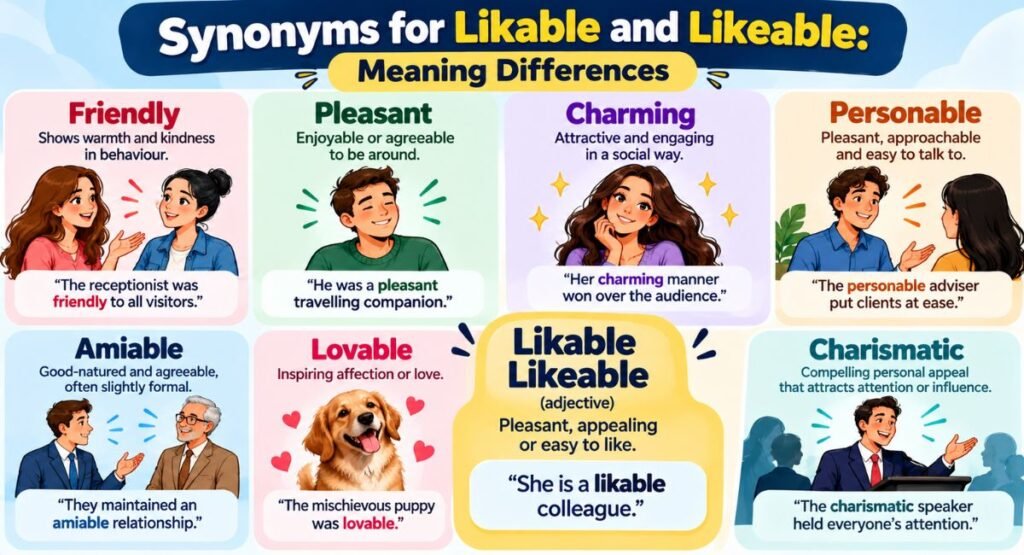
Several adjectives have meanings close to likable, but they do not describe exactly the same qualities.
Friendly vs Likable
Friendly refers to warm, welcoming or kind behaviour. Likable describes the positive impression someone creates.
A friendly person is not necessarily liked by everyone, while a quiet person may be likable without being especially outgoing.
Pleasant vs Likable
Pleasant describes someone or something enjoyable or agreeable.
Likable focuses more directly on the quality of being easy to like.
Example: “The conversation was pleasant, and the interviewer seemed genuinely likable.”
Charming vs Likable
Charming suggests an appealing manner that attracts or delights others.
Someone can be likable without possessing exceptional charm.
Example: “The presenter was charming on stage but reserved in private.”
Personable vs Likable
Personable describes someone pleasant, approachable and socially engaging.
It is useful in professional contexts where interpersonal skills matter.
Example: “The personable consultant quickly put the clients at ease.”
Amiable vs Likable
Amiable suggests a friendly, agreeable or good-natured temperament.
It can sound slightly more formal or literary than likable.
Example: “The two neighbours maintained an amiable relationship despite their disagreement.”
Lovable vs Likable
Lovable suggests someone or something that inspires affection or love.
Likable describes a milder positive impression.
Example: “The puppy was mischievous but lovable, while its owner was simply pleasant and likable.”
Charismatic vs Likable
Charismatic describes a compelling personal presence that can attract attention or influence others.
A charismatic person may not be likable, and a likable person need not be charismatic.
Example: “The speaker was charismatic, although some audience members found his attitude unpleasant.”
Antonyms of Likable and Likeable
The closest direct opposites are unlikable and unlikeable. Other words express related but more specific negative impressions.
Unlikable or Unlikeable
Both mean difficult to like.
Example: “The film’s main character becomes increasingly unlikeable.”
Both spellings are recognised, although the precise editorial preference should follow the relevant dictionary or style guide.
Unpleasant
Unpleasant describes someone or something that creates discomfort or an unfavourable experience.
Example: “His unpleasant remarks made the discussion uncomfortable.”
Disagreeable
Disagreeable suggests an unpleasant temperament, manner or experience.
Example: “The disagreeable customer complained about every minor detail.”
Unfriendly
Unfriendly describes cold or unwelcoming behaviour.
Example: “The receptionist initially seemed unfriendly but became warmer during the conversation.”
Off-Putting
Off-putting refers to behaviour or qualities that discourage interest or create discomfort.
Example: “The interviewer’s dismissive tone was off-putting.”
These words overlap with unlikable, but they are not exact substitutes in every sentence.
Likable vs Liked vs Lovable: What’s the Difference?
Although these words are related, they describe different aspects of how people respond to someone or something.
| Word | Core meaning | Example |
| Likable | Easy to like | He seems likable. |
| Liked | Actually liked by others | He is liked by his colleagues. |
| Lovable | Inspiring affection or love | The character is lovable. |
| Popular | Liked, supported or recognised by many | She is popular at school. |
Likable Means Easy to Like
A likable person has qualities that encourage others to respond positively.
For example:
“The new student seems likable, even though nobody knows her well yet.”
The sentence describes potential appeal rather than existing relationships.
Liked Means Others Actually Like Them
The word liked describes an actual positive response.
“She is liked by most of her classmates.”
Someone can be likable without being widely known or liked.
Lovable Suggests Stronger Affection
Lovable implies qualities that inspire love or warm affection.
A person may find a colleague likable after one meeting, but it would usually take a closer emotional relationship to describe that person as lovable.
Can Someone Be Likable but Not Popular?
Yes. Likability and popularity are different.
Likability describes personal appeal, while popularity describes how widely someone is liked, supported or recognised.
A quiet person may be very likable to those who know them while remaining relatively unknown to others.
This difference is particularly useful when describing fictional characters, public figures or social relationships.
Origin and Spelling History of Likable and Likeable
Both forms developed from the verb like and the suffix -able.
The suffix often forms adjectives meaning capable of being affected by an action. In this case, it produces the meaning “able to be liked”.
The Online Etymology Dictionary dates likeable, also likable, to around 1730 and traces the verb like to Old English lician, meaning to please or be pleasing.
Why Does Likeable Keep the E?
The retained “e” reflects an established spelling variation.
English words ending in a silent “e” do not all behave identically when suffixes are added. Some lose the letter, some retain it, and some have accepted alternatives.
For this adjective, both likable and likeable are dictionary-recognised forms.
Is Likeable Older Than Likable?
The historical source identifies the adjective and its alternative spelling from around 1730, but this does not establish a reliable separate first-use date for each form.
A claim about which spelling was first recorded would require more detailed historical dictionary or corpus evidence.
Similar English Spelling Variations
Related spelling patterns can be seen in usable/useable and lovable/loveable.
However, these words do not necessarily have identical regional preferences or frequency distributions.
Writers should therefore check individual dictionary entries rather than assume all words formed with “-able” follow the same rule.
Common Mistakes When Using Likable and Likeable
Mistake: Thinking Only One Spelling Is Correct
Incorrect assumption: “Likeable is a spelling mistake.”
Correct understanding: Both forms are accepted, with different regional preferences.
Mistake: Mixing Both Spellings in One Article
Inconsistent:
“The first character is likable, but the second becomes more likeable.”
Consistent American English:
“The first character is likable, but the second becomes more likable.”
Consistent British English:
“The first character is likeable, but the second becomes more likeable.”
Direct quotations and official titles may appropriately preserve a different spelling.
Mistake: Confusing Likable with Liked
Incorrect assumption: “If a person is likable, everyone already likes them.”
Correct understanding: Likable describes a quality, while liked describes an actual response.
Mistake: Using Lovable as an Exact Synonym
Lovable often communicates stronger affection.
Describing a new colleague as likable is natural, while lovable may sound too personal in a professional setting.
Mistake: Assuming Likable Means Friendly
Friendliness is one quality that can contribute to likability, but a reserved person may still be likable.
Mistake: Applying the Silent-E Rule Too Broadly
English suffix spelling has exceptions and established variants.
When uncertain, check a reliable dictionary rather than invent a form based on a simplified rule.
When Should You Use Likable or Likeable?
The simplest approach is to choose the spelling that matches your target audience.
In American English
Prefer likable in ordinary American writing.
Example: “The novelist creates a likable protagonist with realistic flaws.”
In British English
Prefer likeable when following British spelling conventions.
Example: “The programme introduces several likeable characters.”
In Academic and Professional Writing
Follow the relevant institution’s style guide.
For professional self-descriptions, words such as approachable, collaborative or personable may be more informative than simply calling yourself likeable.
In Fiction and Character Reviews
Both spellings can describe a character who creates a positive impression despite personal flaws.
For example:
“The protagonist makes questionable decisions but remains likeable because of her honesty.”
A likeable character is not necessarily morally good, which makes the adjective useful in literary criticism.
In Website and SEO Content
Use the spelling that matches the intended readership. A comparison article can naturally include both variants because explaining their difference is the topic.
Avoid repeatedly inserting “likable vs. likeable” into headings where a simpler, more specific heading would help the reader.
Conclusion
Both likable and likeable are correct English adjectives meaning pleasant or easy to like. Likable is generally preferred in American English, while likeable is more common in British English.
The words share the same pronunciation, meaning and grammar. Choose the spelling that suits your audience and keep it consistent.
Remember, being likable is not necessarily the same as being popular, already liked or lovable. Understanding these differences makes your descriptions more precise and natural.
Frequently Asked Questions About Likable vs. Likeable
Is It Likable or Likeable in British English?
Likeable is generally preferred in British English. It describes someone or something that is pleasant and easy to like. Likable is also recognised, but it is more closely associated with American English. For British schoolwork, professional documents and everyday writing, likeable is usually the more natural spelling.
Which Is Correct: Likable or Likeable in American English?
Likable is generally preferred in American English, although likeable is also accepted. Both spellings have the same meaning and pronunciation. The difference concerns regional writing conventions rather than grammar. If you are preparing an article, essay or professional document for American readers, likable is normally the more consistent choice.
Do Likable and Likeable Have the Same Meaning?
Yes. Both spellings describe someone or something that is pleasant, appealing or easy to like. They have the same grammatical function and standard pronunciation. The additional “e” in likeable does not make the word more affectionate, formal or positive. It simply reflects a different established spelling convention.
Is It More Likable or More Likeable?
Both forms are correct. More likable follows the usual American spelling, while more likeable follows the British spelling preference. Both are comparative adjective constructions. For example, “The character becomes more likeable throughout the story” is natural in British English. American writers would generally use more likable instead.
What Is the Difference Between Likable, Liked and Lovable?
Likable means easy to like, while liked means that other people actually have positive feelings towards someone. Lovable suggests stronger affection or qualities that inspire love. A person can be likable without being widely popular, and someone can be liked by others without inspiring particularly deep emotional attachment.



One Comment