
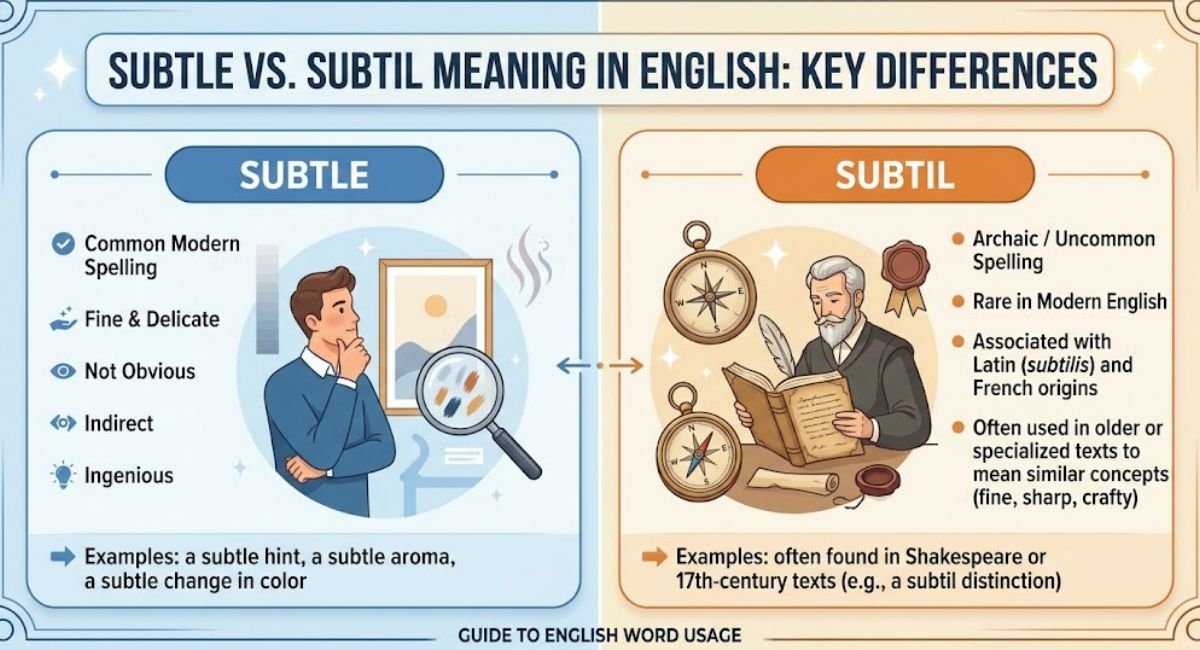
Subtle vs. Subtil Meaning in English: Key Differences
Subtle is the standard English spelling for something delicate, difficult to notice, or cleverly indirect. Subtil is a French adjective with related meanings and an archaic English spelling. In modern English, write subtle. Its letter b is silent, whereas French subtil is pronounced differently and changes form according to grammatical gender.
Understanding subtle vs. subtil meaning in English is about more than choosing the correct spelling. The words look almost identical, but one belongs to everyday modern English while the other is commonly used in French. Their pronunciation also differs enough that applying English pronunciation rules to the French word will produce the wrong sound.
There is another distinction worth learning: subtle does not simply mean small. A subtle warning can have serious consequences. A subtle flavour can transform a dish, and a subtle argument can be intellectually complex. The common thread is that the quality is not immediately obvious, forceful, or easy to recognise.
What Does Subtle Mean in English?
Subtle is an adjective with several closely related meanings. It can describe something that is difficult to notice, a quality that is gentle rather than overpowering, or a way of thinking or communicating that relies on fine distinctions.
Something Difficult to Notice
Imagine two photographs taken seconds apart. They show the same room, furniture, and lighting. Yet in the second photograph, a person’s expression has changed slightly. You may not notice until someone points it out.
That change is subtle because it requires attention to detect.
The word is particularly useful for emotional expressions, changes in behaviour, differences between ideas, and details that are present without being immediately noticeable.
Something Delicate or Understated
A subtle fragrance does not fill an entire room with an overpowering smell. Instead, you might notice a mild trace of citrus or lavender when standing nearby.
The same idea applies to design. Subtle colours and restrained patterns contribute to an overall appearance without competing for attention.
Here, the adjective describes intensity and effect rather than physical size.
Something Clever or Indirect
A subtle question can guide someone towards an answer without revealing it directly.
For instance, a teacher might ask, “What happens if we reverse the order?” instead of immediately telling a student where a calculation went wrong.
This use can describe intelligence, tact, or sophistication. It can also suggest cunning or manipulation when the action is intended to influence someone without their awareness.
Subtle vs. Subtil: The Actual Difference
The spelling difference is meaningful because it reflects different languages and historical developments.
| Feature | Subtle | Subtil |
| Standard modern language | English | French |
| Part of speech | Adjective | Adjective |
| Basic meaning | Not obvious, delicate, refined | Perceptive, refined, delicate |
| Pronunciation | SUT-uhl | French /syp.til/ |
| Letter b | Silent | Usually realised as /p/ before t |
| Gender agreement | None | Masculine singular |
| Example | A subtle argument | Un argument subtil |
Is Subtil a Misspelling?
In an ordinary English sentence, subtil is generally a spelling error.
Incorrect: The lawyer made a subtil distinction.
Correct: The lawyer made a subtle distinction.
But calling subtil universally incorrect would be misleading. It is a standard French word, an attested older English form, and a word found in several other languages.
Historical English spellings were less standardised than modern spellings. The English word has appeared in forms such as sotil, subtil, and subtile. These forms explain why older texts and dictionary entries may look unfamiliar.
What Does Subtil Mean in French?
French subtil has several meanings, depending on what it describes.
A person described as subtil may be perceptive, sharp-minded, or ingenious. An argument may be sophisticated or involve fine distinctions. A nuance subtile is a nuance that is difficult to grasp immediately.
The French word can therefore mean more than something physically delicate. It often describes intellectual skill.
For example:
- Un négociateur subtil — an astute or skilful negotiator.
- Un argument subtil — a subtle or sophisticated argument.
- Une différence subtile — a subtle difference.
- Un parfum subtil — a delicate, subtle fragrance.
How to Pronounce Subtle and Subtil
Pronunciation is one of the clearest differences between the English and French words.
English Pronunciation of Subtle
SUT-uhl
IPA: /ˈsʌt.əl/
Two syllables. Stress the first syllable. Do not pronounce the b.
The vowel in the first syllable sounds like the vowel in cup. In many American accents, the t may sound softer than in careful British pronunciation.
The biggest learner error is pronouncing the written b. English speakers do not normally say the word with a separate b sound.
French Pronunciation of Subtil
/syp.til/
Approximation: süp-teel
The French /y/ is a rounded front vowel, and the final l is pronounced.
To produce the French vowel /y/, place your tongue as though you were saying ee, then round your lips as though you were saying oo.
A further difference concerns the b. In the French consonant sequence bt, it is normally devoiced, giving the pronunciation /pt/. This is why the French word contains a consonant sound that the English word lacks.
French also does not use the same strong first-syllable word stress pattern as English.
Why Is the B Silent in Subtle?
The spelling has a historical explanation.
English borrowed the word through Old French. Its spelling was subsequently influenced by the Latin adjective subtilis, even though the pronunciation did not retain a spoken b.
This is an example of an etymological spelling: the written form reflects the word’s history rather than matching every sound in modern pronunciation.
Subtle Grammar: How to Use the Adjective Correctly
Subtle is an adjective, not a verb or noun. It usually appears before a noun or after a linking verb.
Before a Noun
The typical pattern is:
Subtle + noun
Examples:
- A subtle smile appeared on her face.
- The painting contains subtle shades of blue.
- There is a subtle difference between the two proposals.
The adjective describes a quality of the following noun.
After a Linking Verb
Subtle also works after verbs such as be, seem, remain, and become.
Examples:
- The distinction is subtle.
- Her criticism seemed subtle at first.
- The changes became subtler over time.
These are ordinary adjective constructions rather than special grammar rules unique to this word.
Subtler, Subtlest, and More Subtle
Both the inflected and periphrastic comparison forms are acceptable.
| Form | Example |
| Subtle | The warning was subtle. |
| Subtler | The second warning was subtler. |
| Subtlest | This was the subtlest hint. |
| More subtle | Her approach was more subtle. |
| Most subtle | It was the most subtle distinction. |
The choice between subtler and more subtle often depends on style and sentence rhythm.
Subtle, Subtly, and Subtlety
The three words have different grammatical roles.
| Word | Grammar | Example |
| Subtle | Adjective | She gave a subtle hint. |
| Subtly | Adverb | She subtly hinted at the problem. |
| Subtlety | Noun | He missed the subtlety of her remark. |
The spelling of subtly can be especially troublesome because the e disappears before the adverbial ending.
Correct: She subtly changed the subject.
Incorrect: She subtle changed the subject.
Subtlety may refer to the general quality of being subtle or to an individual fine distinction. In the second meaning, its plural form is subtleties.
Prepositions Used with Subtle
Subtle does not demand a single fixed preposition. The grammatical construction depends on the surrounding words.
Natural combinations include subtle in appearance, subtle about expressing concerns, and a subtle difference between two things.
Notice that between is associated with the noun difference. It is not a special preposition required by subtle.
Subtle Example Sentences in Different Contexts
The following original sentences demonstrate how the meaning changes according to context.
Everyday Conversation
1. “Was that a subtle hint that you want me to make dinner?”
The speaker suspects that a request was communicated indirectly rather than stated openly.
2. The new coffee blend has a subtle orange flavour that becomes noticeable as it cools.
The adjective describes a mild but recognisable taste.
3. I noticed a subtle hesitation before she answered the question.
The hesitation is brief or restrained enough that it might escape casual attention.
Business and Academic Writing
4. The revised contract introduces a subtle distinction between ownership and permission to use the material.
The distinction is intellectually or legally important, even though it may be difficult to recognise.
5. Customer feedback revealed a subtle preference for simpler packaging.
The preference is not necessarily dramatic, but a careful examination may reveal it.
6. The professor challenged a subtle assumption underlying the researcher’s argument.
The assumption is not explicitly stated, and identifying it requires close analysis.
Creative and Emotional Contexts
7. A subtle change in the violin’s tone made the final passage feel unusually sad.
The sentence refers to a small but meaningful artistic effect.
8. Her polite reply contained a subtle criticism of the proposed plan.
The criticism is indirect rather than openly confrontational.
9. The room’s subtle lighting brought out the texture of the old wooden furniture.
The adjective describes controlled, understated visual effects.
Subtle Does Not Always Mean Slight
One of the most useful distinctions for English learners is the difference between subtle and slight.
Consider these two sentences:
“The figures show a slight increase.”
“The figures show a subtle pattern.”
The first sentence describes the size of a numerical change. The second suggests a pattern that may require careful interpretation.
A slight increase can be obvious. A subtle pattern may be statistically or intellectually important. Neither word automatically tells you whether something matters.
This becomes especially important in professional writing. Describing a significant but difficult-to-detect warning sign as slight could give readers the wrong impression.
The reverse problem also occurs: a tiny difference that everyone can see is not necessarily subtle.
Synonyms of Subtle: Which Word Fits Best?
Subtle has several near-synonyms, but each highlights a different idea.
Slight
Slight emphasises smallness in degree or amount.
Use it for a slight delay, a slight temperature rise, or a slight improvement.
Delicate
Delicate often suggests fine construction, gentleness, sensitivity, or fragility.
A delicate ornament may break easily. A subtle ornament may simply avoid attracting much attention.
Nuanced
Nuanced suggests multiple fine distinctions or layers of meaning.
A nuanced explanation considers complexity. A subtle explanation may communicate an idea without stating it directly.
Discreet
Discreet concerns careful behaviour, often to protect privacy or avoid drawing attention.
A discreet conversation keeps information private. A subtle conversation may contain indirect hints.
Understated
Understated usually suggests deliberate restraint.
A deliberately modest design may be understated. A naturally occurring colour change may be subtle without anyone intending it.
Faint
Faint describes weak intensity, particularly in sounds, smells, colours, and sensations.
A faint sound is quiet. A subtle sound may contain an important detail that careful listening reveals.
Refined
Refined emphasises polish, sophistication, or developed taste.
A refined technique may be elegant and skilful. A subtle technique is one whose effects or methods are not immediately apparent.
Antonyms of Subtle and Their Usage
There is no single antonym that works in every situation.
| Antonym | Meaning | Example |
| Obvious | Easy to notice | The mistake was obvious. |
| Blatant | Unmistakably obvious, often offensively so | It was a blatant lie. |
| Overt | Openly expressed | The statement contained overt criticism. |
| Conspicuous | Attracting attention | His bright coat was conspicuous. |
| Bold | Strong or striking | The designer chose bold colours. |
| Heavy-handed | Lacking delicacy or restraint | The message felt heavy-handed. |
For example, the opposite of a subtle hint might be an obvious hint. The opposite of subtle persuasion might be an overt demand. In design, bold may be the more natural contrast.
Choosing an antonym according to context is more useful than memorising one fixed opposite.
Where Did Subtle and Subtil Come From?
The history of this word is unusually revealing because English pronunciation and spelling developed along different paths.
The English adjective is recorded in Middle English in forms including sotil. Its ancestry runs through Old French forms such as sotil and subtil to Latin subtilis, a word associated with fine, delicate, and precise qualities.
One etymological analysis connects the Latin form with weaving and the image of a thread passing beneath the warp of a fabric. The image is useful for understanding the historical association with fineness, although it should not be treated as a definition of modern English subtle.
That older physical sense helps explain a later range of figurative meanings: fine material, refined judgement, precise distinctions, and clever reasoning.
French retained subtil as a standard adjective, while English settled on subtle. This shared origin explains their similarity without making them interchangeable.
French Grammar: Subtil, Subtile, Subtils, and Subtiles
French adjectives commonly agree with the gender and number of the nouns they modify. Subtil follows this pattern.
| Form | Use | Example |
| Subtil | Masculine singular | Un argument subtil |
| Subtile | Feminine singular | Une analyse subtile |
| Subtils | Masculine plural | Des arguments subtils |
| Subtiles | Feminine plural | Des analyses subtiles |
This matters because translating one English adjective into French may produce several written forms.
English: “She made a subtle observation.”
French: Elle a fait une remarque subtile.
The feminine ending belongs to subtile because remarque is a feminine noun.
French also uses the noun subtilité, which corresponds to English subtlety in many contexts. Although the words are related, their pronunciation and spelling conventions remain language-specific.
Common Mistakes with Subtle and Subtil
Writing Subtil in an English Essay
Use subtle for ordinary modern English.
Incorrect: “The novel contains a subtil message.”
Correct: “The novel contains a subtle message.”
Pronouncing Every Written Consonant
The English b is silent. Do not use the French consonant sequence when pronouncing the English word.
Confusing Subtle with Subtly
Use the adjective for a noun and the adverb for an action.
Incorrect: “He subtle avoided the question.”
Correct: “He subtly avoided the question.”
Assuming Every Small Change Is Subtle
Smallness and difficulty of detection are related but distinct ideas.
A one-cent price increase may be slight and obvious. A change in an employee’s attitude may be subtle but important.
Using Subtle to Mean Secret
Something subtle is not necessarily secret.
A subtle hint may be visible or audible to everyone, yet its meaning may not be immediately understood. Secret implies information is deliberately kept hidden, which is a different concept.
Forgetting French Gender Agreement
The French feminine singular form is subtile, not subtil.
Correct: Une différence subtile.
Correct: Un raisonnement subtil.
When Does Subtle Sound Positive or Negative?
The word can express admiration, criticism, or neutral observation.
Consider the phrase subtle persuasion. In one context, it may describe thoughtful communication that respects the listener. In another, it may suggest an attempt to influence someone without being transparent.
The adjective describes the manner of the persuasion, not its moral quality.
The same applies to subtle humour. It may be intelligent and rewarding for attentive listeners, or it may be so indirect that part of the audience misses it.
In literature, a subtle character may show emotional complexity without explaining every feeling. In advertising, a subtle message may create an association without stating the product’s intended appeal directly.
Context—not the adjective alone—determines the interpretation.
How to Choose the Right Word
When deciding between subtle, subtil, and related vocabulary, ask two questions.
First, which language are you writing? In ordinary English, the correct spelling is subtle. In French, choose the adjective form that agrees with the noun.
Second, what quality do you want to emphasise?
A slight change is small. A faint sound is weak. A discreet action avoids attention. A nuanced discussion contains fine distinctions. A subtle quality may be difficult to recognise, restrained in its effect, or expressed indirectly.
These differences become easier to remember through real examples rather than isolated dictionary definitions.
Conclusion
The difference between subtle and subtil is straightforward once you separate modern English usage from French usage. Subtle is the standard English adjective, while subtil is the French masculine form and a historically recorded English spelling.
The English word’s silent b, the French pronunciation /syp.til/, and the adjective’s distinct grammatical patterns are worth remembering. More importantly, subtle does not simply mean small or secret. It describes qualities that can be difficult to detect, refined in their effect, or indirect in expression.
Choosing the word accurately helps you describe not only what happens, but how clearly, delicately, or indirectly it happens.
Frequently Asked Questions
What is the difference between subtle and subtil?
Subtle is the standard English spelling, while subtil is a French masculine adjective with related meanings. Subtil also appears in historical English, but it is not the normal modern spelling. In English, write “a subtle difference.” In French, you might write “un argument subtil” or “une différence subtile.”
Is subtil a correct English word?
Subtil is an attested older English form, but it is not the standard spelling for contemporary English writing. Use subtle in essays, emails, and professional documents. Subtil remains correct in French and may also appear in historical quotations, linguistic discussions, and writing in other languages where that spelling is established.
Why is the letter B silent in subtle?
The silent b reflects the difference between the word’s historical spelling and modern English pronunciation. English borrowed the word through French, and its spelling was later influenced by Latin subtilis. The written b remains, but standard English pronunciation does not include a separate b sound.
What does subtil mean in French?
French subtil can describe someone perceptive or ingenious, an argument involving fine distinctions, or a delicate quality such as a fragrance. Its feminine form is subtile, with plural forms subtils and subtiles. The best English translation depends on context rather than one fixed equivalent for every sentence.
What is the difference between subtle, slight, and delicate?
Subtle describes something difficult to notice, finely distinguished, or indirectly expressed. Slight emphasises smallness in amount or degree, while delicate often suggests gentleness, fragility, or refinement. A slight change can be obvious, a subtle change may be difficult to detect, and a delicate object may be easily damaged.